Capacitors and Dielectrics — Important Questions
ICSE · Class 12 · Physics
45 important questions from Capacitors and Dielectrics for ICSE Class 12 Physics, with answers. Includes multiple choice questions.
Interactive on Super Tutor
Studying Capacitors and Dielectrics? Get the full interactive chapter.
Quizzes, flashcards, AI doubt-solver and a step-by-step study plan — built for important questions and more.
Free trial, no card needed.
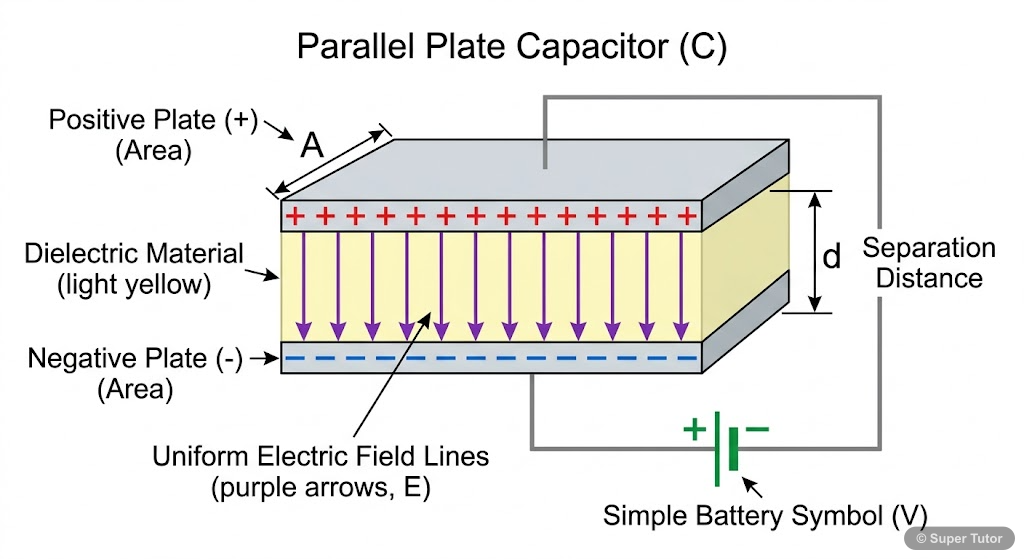
One of 3 illustrations for Capacitors and Dielectrics in Super Tutor — alongside flashcards, concept maps and practice questions.
Important Questions from Capacitors and Dielectrics
Two capacitors of capacitances C₁ = 4 μF and C₂ = 6 μF are connected in parallel across a 100 V battery. What is the total charge stored in the combination?
Show answer
1000 μC
Step 1: In parallel combination, the equivalent capacitance C = C₁ + C₂ = 4 + 6 = 10 μF. Step 2: The voltage across each capacitor in parallel is the same = 100 V. Step 3: Total charge Q = C × V = 10 μF × 100 V = 1000 μC. Alternatively: Q₁ = 4 × 100 = 400 μC and Q₂ = 6 × 100 = 600 μC, so total = 1000 μC. Wrong options: 400 μC is just the charge on C₁. 600 μC is just the charge on C₂. 240 μC results from incorrectly using series formula C = C₁C₂/(C₁+C₂) = 2.4 μF.
The capacitance of an isolated spherical conductor of radius 20 cm placed in vacuum is: (Take 1/4πε₀ = 9 × 10⁹ N·m²/C²)
Show answer
22.2 pF
Step 1: Formula for capacitance of isolated sphere: C = 4πε₀a. Step 2: Since 1/4πε₀ = 9 × 10⁹, we get 4πε₀ = 1/(9 × 10⁹). Step 3: C = a/(9 × 10⁹) where a = 20 cm = 0.20 m. Step 4: C = 0.20 / (9 × 10⁹) = 0.0222 × 10⁻⁹ F = 22.2 × 10⁻¹² F = 22.2 pF. Physics: Capacitance of a sphere depends only on its radius — larger the sphere, greater its ability to store charge at a given potential. 20 pF results from using radius in cm directly. 9 pF and 44.4 pF are arithmetic errors.
A parallel plate air capacitor has capacitance C₀. If the distance between the plates is halved and a dielectric (K = 3) fills the entire space, the new capacitance is:
Show answer
6C₀
Step 1: Original capacitance C₀ = ε₀A/d. Step 2: New plate separation = d/2. Step 3: New dielectric constant K = 3. Step 4: New capacitance C = Kε₀A/(d/2) = K × 2 × ε₀A/d = 3 × 2 × C₀ = 6C₀. Key concept: Halving the distance doubles the capacitance, and inserting dielectric of K=3 multiplies it by 3. Both effects multiply together: C = 2 × 3 × C₀ = 6C₀. 3C₀ forgets the effect of halving distance. 3C₀/2 divides instead of multiplying by 2.
Which statement correctly describes the principle of a capacitor?
Show answer
Bringing an earthed conductor near a charged conductor decreases its potential, thereby increasing its capacitance
The principle of a capacitor is based on the induction effect: Step 1: When an earthed conductor B is brought near charged conductor A (with charge +Q), negative charge is induced on the inner face of B. Step 2: This induced negative charge on B reduces the potential of A (since negative charge reduces potential). Step 3: Since V decreases while Q remains the same, capacitance C = Q/V increases. Step 4: The earthed conductor drains away the positive induced charge, leaving only the negative charge on B, which further reduces the potential of A. This is why a capacitor stores more charge at a g
+41 more questions on Capacitors and Dielectrics (ICSE Class 12 Physics)
Practise AllFrequently Asked Questions
What are the important topics in Capacitors and Dielectrics for ICSE Class 12 Physics?
How many important questions are there in Capacitors and Dielectrics?
Sources & Official References
Content is aligned to the official syllabus. Refer to the board website for the latest curriculum.
More resources for Capacitors and Dielectrics
Practice Quiz
Test yourself with a quick quiz
Revision Notes
Key points for last-minute revision
Formula Sheet
The chapter's formulas in one place
Chapter Summary
Understand the chapter at a glance
Concept Maps
See how topics connect
Study Plan
Step-by-step plan for this chapter
Flashcards
Quick-fire cards for active recall
Syllabus
What topics to cover
For serious students
Get the full Capacitors and Dielectrics chapter — start free.
Quizzes, flashcards, an AI doubt solver and a study plan for ICSE Class 12 Physics. Free to start, no card needed.