Capacitors and Dielectrics — Syllabus
ICSE · Class 12 · Physics
What Capacitors and Dielectrics covers in ICSE Class 12 Physics: 4 topics, for the 2026-27 session. Part of the ICSE Class 12 Physics syllabus.
Interactive on Super Tutor
Studying Capacitors and Dielectrics? Get the full interactive chapter.
Quizzes, flashcards, AI doubt-solver and a step-by-step study plan — built for syllabus and more.
Free trial, no card needed.
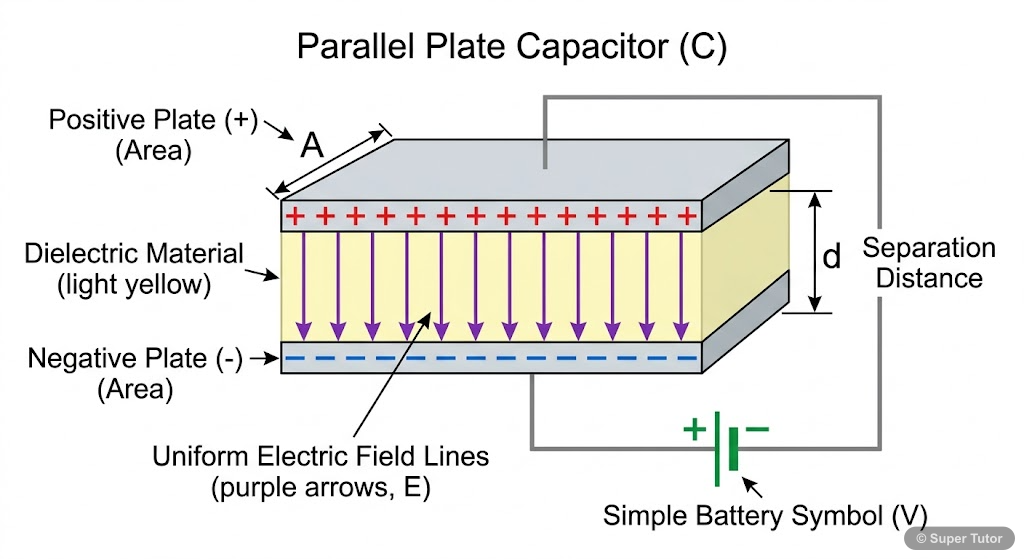
One of 3 illustrations for Capacitors and Dielectrics in Super Tutor — alongside flashcards, concept maps and practice questions.
Topics in Capacitors and Dielectrics
1. Conductors, Insulators, and Free and Bound Charges
- Conductors are materials through which electric charge can easily flow.
- Metals, human body, earth, mercury, and electrolytes are conductors.
- In metals, only negative charge is free to move; positive charge remains immobile.
2. Capacitance and Unit of Farad
- Capacitance is the ratio of charge given to a conductor or capacitor plate to the potential produced.
- Capacitance is a property of the conductor and does not depend on the actual charge Q or potential V applied.
- The SI unit of capacitance is farad.
3. Capacitance of a Charged Conductor and Energy
- When a conductor of capacitance C is charged to Q, its potential is V = Q/C.
- The work done in charging a conductor is stored as electrostatic potential energy.
- Potential energy of a charged conductor is U = (1/2)Q^2/C = (1/2)CV^2.
4. Common Potential, Charge Redistribution, and Loss of Energy
- When two charged conductors are joined, charge redistributes until both reach a common potential.
- The common potential is V = (Q1 + Q2)/(C1 + C2) = (C1V1 + C2V2)/(C1 + C2).
- After connection, redistributed charges are in the ratio C1 : C2.
Key Concepts
Central concept: Capacitors and dielectrics describe how electric charge is stored, how electric potential changes, and how dielectrics modify capacitance, field, energy, and force in electrostatic systems.
Work through every topic in Capacitors and Dielectrics with notes and quizzes
Start This ChapterFrequently Asked Questions
What are the important topics in Capacitors and Dielectrics for ICSE Class 12 Physics?
How should I revise Capacitors and Dielectrics for the ICSE Class 12 board exam?
Sources & Official References
Content is aligned to the official syllabus. Refer to the board website for the latest curriculum.
More resources for Capacitors and Dielectrics
Practice Quiz
Test yourself with a quick quiz
Important Questions
Exam-style questions with answers
Revision Notes
Key points for last-minute revision
Formula Sheet
The chapter's formulas in one place
Chapter Summary
Understand the chapter at a glance
Concept Maps
See how topics connect
Study Plan
Step-by-step plan for this chapter
Flashcards
Quick-fire cards for active recall
For serious students
Get the full Capacitors and Dielectrics chapter — start free.
Quizzes, flashcards, an AI doubt solver and a study plan for ICSE Class 12 Physics. Free to start, no card needed.