Capacitors and Dielectrics — Flashcards
ICSE · Class 12 · Physics
35 flashcards for Capacitors and Dielectrics (ICSE Class 12 Physics) to test yourself on key terms and facts. Sample: "State the definition of capacitance"
Interactive on Super Tutor
Studying Capacitors and Dielectrics? Get the full interactive chapter.
Quizzes, flashcards, AI doubt-solver and a step-by-step study plan — built for flashcards and more.
Free trial, no card needed.
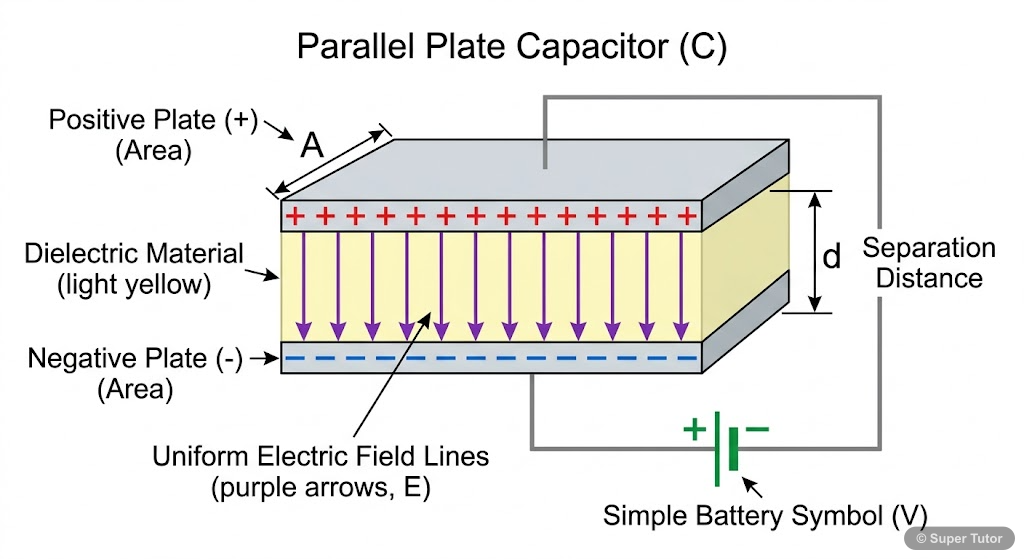
One of 3 illustrations for Capacitors and Dielectrics in Super Tutor — alongside flashcards, concept maps and practice questions.
State the definition of capacitance of a conductor.
Answer
Capacitance of a conductor: C = Q/V Meaning: it is the ratio of charge Q to the potential V produced. Unit: farad (F) Quick example: if Q = 2 C and V = 4 V, then C = 2/4 = 0.5 F.
What is 1 farad in SI units?
Answer
1 farad = 1 coulomb/volt Also written as 1 F = 1 CV^-1 Meaning: a capacitance of 1 F raises potential by 1 V when 1 C of charge is given.
Find the capacitance of an isolated spherical conductor of radius 0.20 m in vacuum. Use ε0 = 8.85 × 10^-12 F/m.
Answer
Given: a = 0.20 m, ε0 = 8.85 × 10^-12 F/m Formula: C = 4π ε0 a Step 1: C = 4π × (8.85 × 10^-12 F/m) × (0.20 m) Step 2: C ≈ 2.22 × 10^-11 F Answer: 2.22 × 10^-11 F = 22.2 pF…
Why is the capacitance of a conductor an intrinsic property and not dependent on the charge given?
Answer
Although C = Q/V, capacitance depends on the conductor’s size, shape, surrounding medium, and nearby conductors. The same conductor can have different Q and V values, but the ratio Q/V for that conduc…
A conductor is given 6 μC charge and its potential becomes 3 V. Find its capacitance.
Answer
Given: Q = 6 μC = 6 × 10^-6 C, V = 3 V Formula: C = Q/V Step 1: C = (6 × 10^-6 C) / (3 V) Step 2: C = 2 × 10^-6 F Answer: 2 μF…
State the capacitance of an isolated spherical conductor and its dependence on radius.
Answer
Formula: C = 4π ε0 a Meaning: capacitance is directly proportional to radius a. So, larger radius means larger capacitance. For a given spherical conductor, capacitance is minimum in vacuum or air.
Find the potential energy stored in a charged conductor of capacitance 4 μF when the potential is 200 V.
Answer
Given: C = 4 μF = 4 × 10^-6 F, V = 200 V Formula: U = (1/2)CV^2 Step 1: U = (1/2) × (4 × 10^-6 F) × (200 V)^2 Step 2: U = 0.5 × 4 × 10^-6 × 40000 J Step 3: U = 0.08 J Answer: 0.08 J…
Why does a dielectric reduce the electric field inside it?
Answer
When a dielectric is placed in an electric field, its molecules become polarised. Induced charges appear on its surfaces and create a field opposite to the applied field. So the field inside the diele…
+27 more flashcards
Practise AllFrequently Asked Questions
What are the important topics in Capacitors and Dielectrics for ICSE Class 12 Physics?
How many flashcards are available for Capacitors and Dielectrics?
How should I revise Capacitors and Dielectrics for the ICSE Class 12 board exam?
Sources & Official References
Content is aligned to the official syllabus. Refer to the board website for the latest curriculum.
More resources for Capacitors and Dielectrics
Practice Quiz
Test yourself with a quick quiz
Important Questions
Exam-style questions with answers
Revision Notes
Key points for last-minute revision
Formula Sheet
The chapter's formulas in one place
Chapter Summary
Understand the chapter at a glance
Concept Maps
See how topics connect
Study Plan
Step-by-step plan for this chapter
Syllabus
What topics to cover
For serious students
Get the full Capacitors and Dielectrics chapter — start free.
Quizzes, flashcards, an AI doubt solver and a study plan for ICSE Class 12 Physics. Free to start, no card needed.