Moving Charges and Magnetic Field — Important Questions
ICSE · Class 12 · Physics
38 important questions from Moving Charges and Magnetic Field for ICSE Class 12 Physics, with answers. Includes multiple choice questions.
Interactive on Super Tutor
Studying Moving Charges and Magnetic Field? Get the full interactive chapter.
Quizzes, flashcards, AI doubt-solver and a step-by-step study plan — built for important questions and more.
Free trial, no card needed.
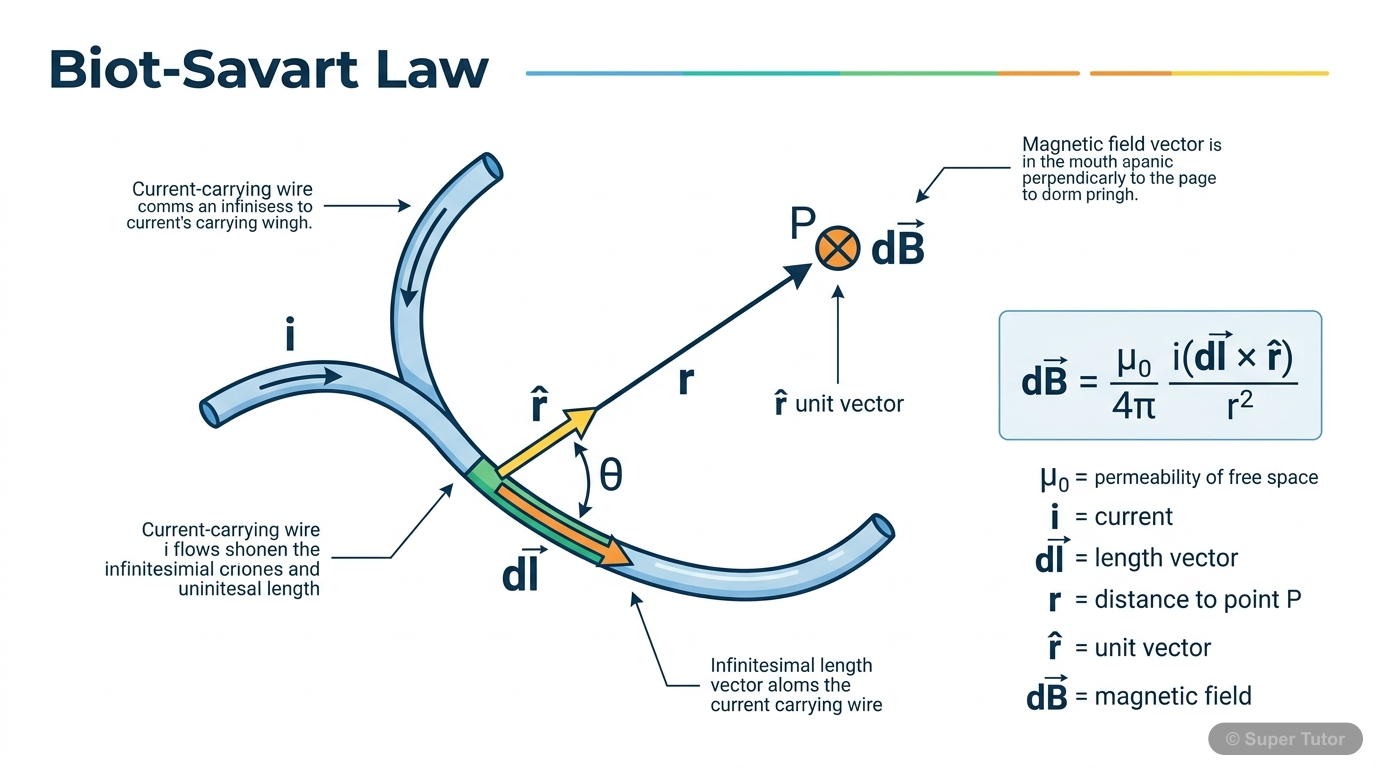
One of 2 illustrations for Moving Charges and Magnetic Field in Super Tutor — alongside flashcards, concept maps and practice questions.
Important Questions from Moving Charges and Magnetic Field
Oersted's experiment demonstrated which of the following?
Show answer
A current-carrying conductor produces a magnetic field around it
Step 1: In Oersted's 1820 experiment, a compass needle was placed near a current-carrying wire. Step 2: When current flowed, the needle deflected, showing a magnetic field was created around the wire. Step 3: When current was reversed, the needle deflected in the opposite direction. This proved that moving charges (electric current) produce magnetic fields. Option A is wrong – a stationary charge produces only an electric field, not magnetic. Option C describes electromagnetic induction (Faraday), not Oersted. Option D is also Faraday's law.
According to Ampere's Circuital Law, the line integral of the magnetic field B around a closed path is equal to:
Show answer
μ₀ times the current enclosed by the path
Step 1: Ampere's Circuital Law states: ∮ B·dl = μ₀I, where I is the net current threading through the area enclosed by the closed path. Step 2: μ₀ is the permeability of free space (4π × 10⁻⁷ N A⁻²). Step 3: Only the current enclosed by the chosen path matters, not the total current in the entire circuit. Option B is wrong as ε₀ is the electric permittivity used in Gauss's law for electric fields. Option C is wrong because it says 'total current' not 'enclosed current'. Option D introduces μ₀ε₀ which appears in electromagnetic wave equations.
When a charged particle moves parallel to a magnetic field, the magnetic force acting on it is:
Show answer
Zero
Step 1: The magnetic force on a moving charge is given by F = qvB sinθ, where θ is the angle between velocity and magnetic field. Step 2: When the particle moves parallel to the field, θ = 0°. Step 3: F = qvB sin0° = qvB × 0 = 0. The force is zero. The particle moves in a straight line without any deflection. Option A (maximum) corresponds to θ = 90°. Option C gives the maximum force formula. Option D is dimensionally incorrect.
The SI unit of magnetic field (B) is Tesla. Which of the following is an equivalent expression for 1 Tesla?
Show answer
1 N A⁻¹ m⁻¹
Step 1: From the force formula F = qvB sinθ, we can write B = F / (qv sinθ). Step 2: Units of B = Newton / (Coulomb × m/s) = N / (A·s × m/s) = N / (A·m). Step 3: So B = N A⁻¹ m⁻¹. This is also equal to 1 Wb m⁻². Step 4: 1 T = 1 N A⁻¹ m⁻¹ = 1 Wb m⁻². Options B, C, D have incorrect arrangements of the units – in B and D, A appears in numerator (positive power), and in C the length unit is in numerator instead of denominator.
+34 more questions on Moving Charges and Magnetic Field (ICSE Class 12 Physics)
Practise AllFrequently Asked Questions
What are the important topics in Moving Charges and Magnetic Field for ICSE Class 12 Physics?
How many important questions are there in Moving Charges and Magnetic Field?
Sources & Official References
Content is aligned to the official syllabus. Refer to the board website for the latest curriculum.
More resources for Moving Charges and Magnetic Field
Practice Quiz
Test yourself with a quick quiz
Revision Notes
Key points for last-minute revision
Formula Sheet
The chapter's formulas in one place
Chapter Summary
Understand the chapter at a glance
Concept Maps
See how topics connect
Study Plan
Step-by-step plan for this chapter
Flashcards
Quick-fire cards for active recall
Syllabus
What topics to cover
For serious students
Get the full Moving Charges and Magnetic Field chapter — start free.
Quizzes, flashcards, an AI doubt solver and a study plan for ICSE Class 12 Physics. Free to start, no card needed.