Capacitors and Dielectrics — Revision Notes
ICSE · Class 12 · Physics
Capacitors and Dielectrics revision notes for ICSE Class 12 Physics: 4 topics in quick points. Part of the ICSE Class 12 Physics syllabus.
Interactive on Super Tutor
Studying Capacitors and Dielectrics? Get the full interactive chapter.
Quizzes, flashcards, AI doubt-solver and a step-by-step study plan — built for revision notes and more.
Free trial, no card needed.
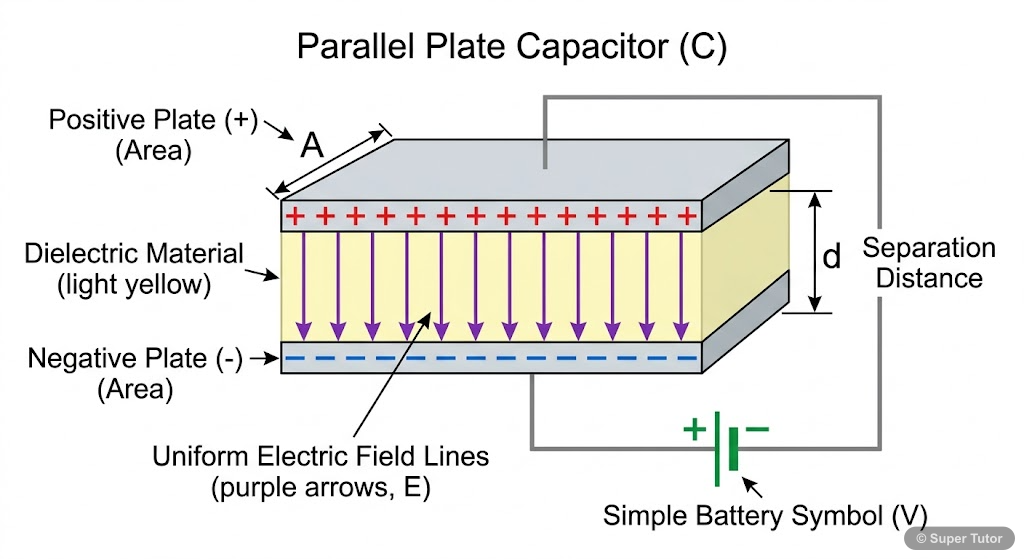
One of 3 illustrations for Capacitors and Dielectrics in Super Tutor — alongside flashcards, concept maps and practice questions.
Key Topics to Revise
1. Conductors, Insulators, and Free and Bound Charges
- Conductors are materials through which electric charge can easily flow.
- Metals, human body, earth, mercury, and electrolytes are conductors.
- In metals, only negative charge is free to move; positive charge remains immobile.
2. Capacitance and Unit of Farad
- Capacitance is the ratio of charge given to a conductor or capacitor plate to the potential produced.
- Capacitance is a property of the conductor and does not depend on the actual charge Q or potential V applied.
- The SI unit of capacitance is farad.
3. Capacitance of a Charged Conductor and Energy
- When a conductor of capacitance C is charged to Q, its potential is V = Q/C.
- The work done in charging a conductor is stored as electrostatic potential energy.
- Potential energy of a charged conductor is U = (1/2)Q^2/C = (1/2)CV^2.
4. Common Potential, Charge Redistribution, and Loss of Energy
- When two charged conductors are joined, charge redistributes until both reach a common potential.
- The common potential is V = (Q1 + Q2)/(C1 + C2) = (C1V1 + C2V2)/(C1 + C2).
- After connection, redistributed charges are in the ratio C1 : C2.
Get complete notes with diagrams and examples
Full NotesKey Concepts
Frequently Asked Questions
What are the important topics in Capacitors and Dielectrics for ICSE Class 12 Physics?
How should I revise Capacitors and Dielectrics for the ICSE Class 12 board exam?
Sources & Official References
Content is aligned to the official syllabus. Refer to the board website for the latest curriculum.
More resources for Capacitors and Dielectrics
Practice Quiz
Test yourself with a quick quiz
Important Questions
Exam-style questions with answers
Formula Sheet
The chapter's formulas in one place
Chapter Summary
Understand the chapter at a glance
Concept Maps
See how topics connect
Study Plan
Step-by-step plan for this chapter
Flashcards
Quick-fire cards for active recall
Syllabus
What topics to cover
For serious students
Get the full Capacitors and Dielectrics chapter — start free.
Quizzes, flashcards, an AI doubt solver and a study plan for ICSE Class 12 Physics. Free to start, no card needed.