Moving Charges and Magnetic Field — Revision Notes
ICSE · Class 12 · Physics
Moving Charges and Magnetic Field revision notes for ICSE Class 12 Physics: 4 topics in quick points. Part of the ICSE Class 12 Physics syllabus.
Interactive on Super Tutor
Studying Moving Charges and Magnetic Field? Get the full interactive chapter.
Quizzes, flashcards, AI doubt-solver and a step-by-step study plan — built for revision notes and more.
Free trial, no card needed.
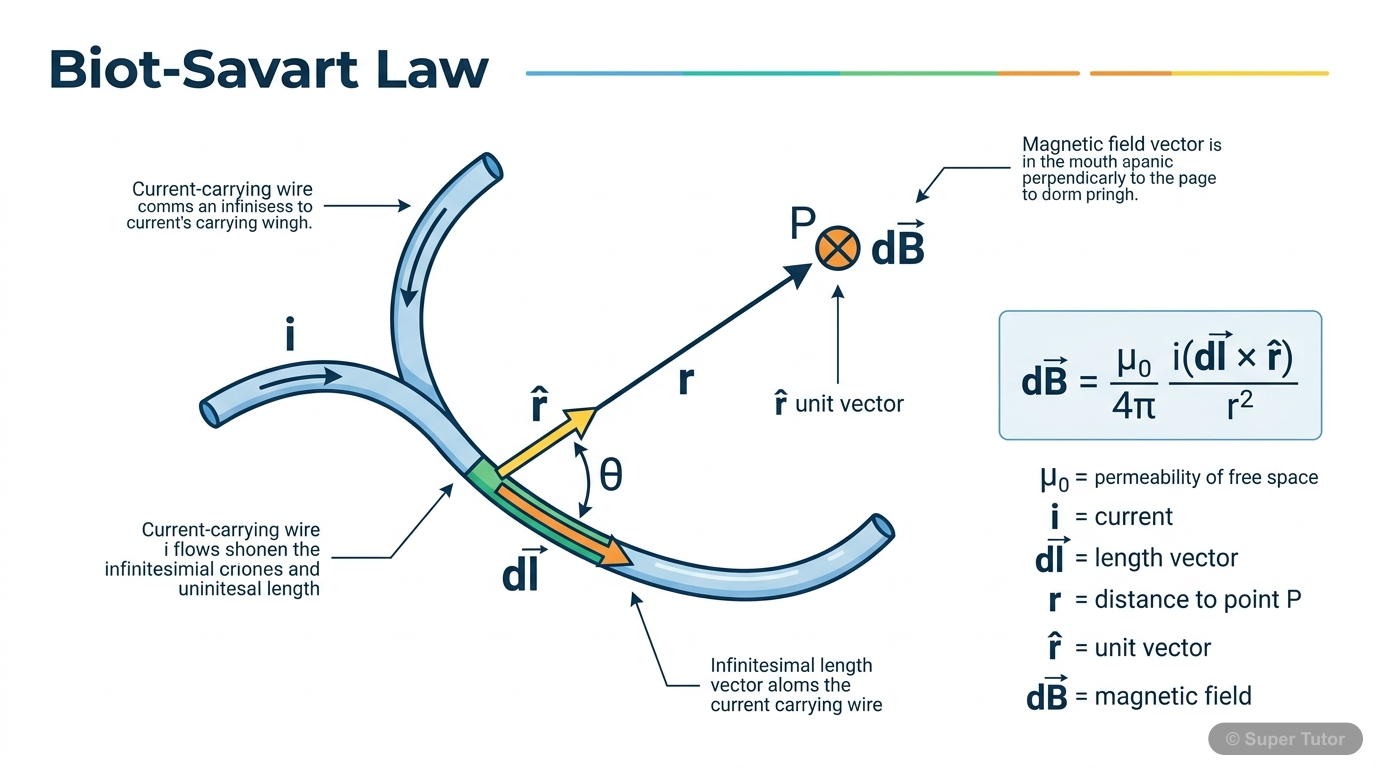
One of 2 illustrations for Moving Charges and Magnetic Field in Super Tutor — alongside flashcards, concept maps and practice questions.
Key Topics to Revise
1. Magnetic Field and Oersted's Experiment
- A magnetic field is the region near a magnet where a magnetic needle experiences torque and rests in a definite direction.
- Earth is also a magnet, so a freely suspended magnetic needle settles in the north-south direction.
- Oersted's experiment established that moving charges produce magnetic field around a current-carrying conductor.
2. Biot-Savart Law and Magnetic Field Due to Current Elements
- The magnetic field due to a current element depends on current, length of element, sine of the angle between element and position vector, and inverse square of distance.
- The direction of magnetic field due to a current element is perpendicular to both the current element and the position vector.
- Biot-Savart law is the magnetic equivalent of Coulomb's law.
3. Fields Due to Straight Wire, Circular Coil, Arc, Solenoid, and Toroid
- For a long straight conductor, magnetic field varies inversely with distance from the wire.
- For a finite straight conductor, field depends on the end angles at the observation point.
- At one end of a finite straight conductor, the field is mu0 I / 4pi r.
4. Force on a Moving Charge and Motion in Magnetic Field
- A moving charge in a magnetic field experiences a force perpendicular to both velocity and field.
- The magnetic force changes only the direction of motion, not the speed or kinetic energy.
- The force is zero when velocity is parallel or antiparallel to the magnetic field.
Get complete notes with diagrams and examples
Full NotesKey Concepts
Frequently Asked Questions
What are the important topics in Moving Charges and Magnetic Field for ICSE Class 12 Physics?
How should I revise Moving Charges and Magnetic Field for the ICSE Class 12 board exam?
Sources & Official References
Content is aligned to the official syllabus. Refer to the board website for the latest curriculum.
More resources for Moving Charges and Magnetic Field
Practice Quiz
Test yourself with a quick quiz
Important Questions
Exam-style questions with answers
Formula Sheet
The chapter's formulas in one place
Chapter Summary
Understand the chapter at a glance
Concept Maps
See how topics connect
Study Plan
Step-by-step plan for this chapter
Flashcards
Quick-fire cards for active recall
Syllabus
What topics to cover
For serious students
Get the full Moving Charges and Magnetic Field chapter — start free.
Quizzes, flashcards, an AI doubt solver and a study plan for ICSE Class 12 Physics. Free to start, no card needed.