Excretion in Humans — Important Questions
ICSE · Class 7 · Biology
45 important questions from Excretion in Humans for ICSE Class 7 Biology, with answers. Includes multiple choice questions.
Interactive on Super Tutor
Studying Excretion in Humans? Get the full interactive chapter.
Quizzes, flashcards, AI doubt-solver and a step-by-step study plan — built for important questions and more.
Free trial, no card needed.
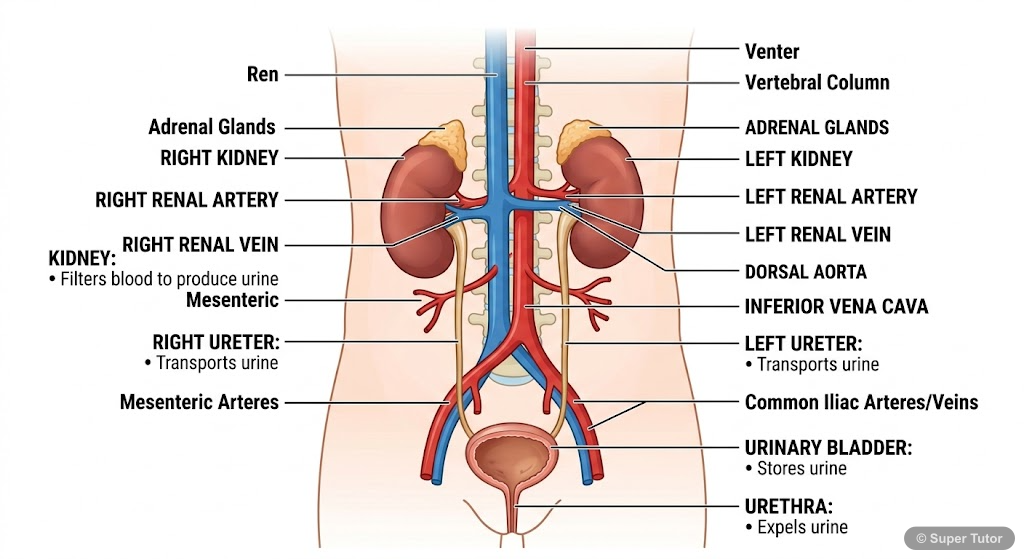
Learn better with visuals Super Tutor pairs illustrations like this with notes and quizzes for Excretion in Humans.
Important Questions from Excretion in Humans
Which tube connects the kidney to the urinary bladder?
Show answer
Ureter
Step 1: The excretory system has several parts connected to each other. Step 2: The ureter is a narrow tube that runs from the inner side of each kidney down to the urinary bladder. Step 3: The urethra is different — it leads from the urinary bladder to the outside of the body. Step 4: The renal artery carries blood into the kidney, and the collecting duct is a part inside the kidney. Step 5: Therefore, the tube that connects the kidney to the urinary bladder is the ureter.
What is the urinary bladder?
Show answer
A muscular bag that stores urine temporarily
Step 1: After urine is formed in the kidneys, it passes through the ureters. Step 2: The urine then collects in the urinary bladder. Step 3: The urinary bladder is a muscular bag situated in the lower abdomen that stores urine temporarily. Step 4: When the bladder is full, urine is expelled outside through the urethra. Step 5: Option A describes the urethra, Option C describes the kidney, and Option D describes sweat glands — so the correct answer is Option B.
What is the structural and functional unit of the kidney?
Show answer
Nephron
Step 1: Just like a neuron is the unit of the nervous system, the kidney has its own unit. Step 2: Inside each kidney, there are millions of microscopic tubular structures called nephrons (also called renal tubules). Step 3: Each nephron filters the blood, removes waste, and helps form urine — making it the working unit of the kidney. Step 4: A neuron is the unit of the nervous system, not the kidney. Ureters and renal pelvis are parts of the excretory system but not the functional unit of the kidney. Step 5: Therefore, the nephron is the structural and functional unit of the kidney.
Which waste substance is mainly formed by the breakdown of amino acids in the liver?
Show answer
Urea
Step 1: Our body breaks down excess amino acids (building blocks of proteins) in the liver. Step 2: This breakdown process produces a nitrogenous waste called urea. Step 3: Urea is carried through the blood to the kidneys, which then filter it out and remove it through urine. Step 4: Carbon dioxide is a waste product of respiration (not amino acid breakdown). Oxygen is not a waste product. Glucose is a useful sugar, not a waste. Step 5: Therefore, the correct answer is Urea.
+41 more questions on Excretion in Humans (ICSE Class 7 Biology)
Practise AllFrequently Asked Questions
What are the important topics in Excretion in Humans for ICSE Class 7 Biology?
How many important questions are there in Excretion in Humans?
Sources & Official References
Content is aligned to the official syllabus. Refer to the board website for the latest curriculum.
More resources for Excretion in Humans
For serious students
Get the full Excretion in Humans chapter — start free.
Quizzes, flashcards, an AI doubt solver and a study plan for ICSE Class 7 Biology. Free to start, no card needed.