Photosynthesis and Respiration — Important Questions
ICSE · Class 7 · Biology
43 important questions from Photosynthesis and Respiration for ICSE Class 7 Biology, with answers. Includes multiple choice questions.
Interactive on Super Tutor
Studying Photosynthesis and Respiration? Get the full interactive chapter.
Quizzes, flashcards, AI doubt-solver and a step-by-step study plan — built for important questions and more.
Free trial, no card needed.
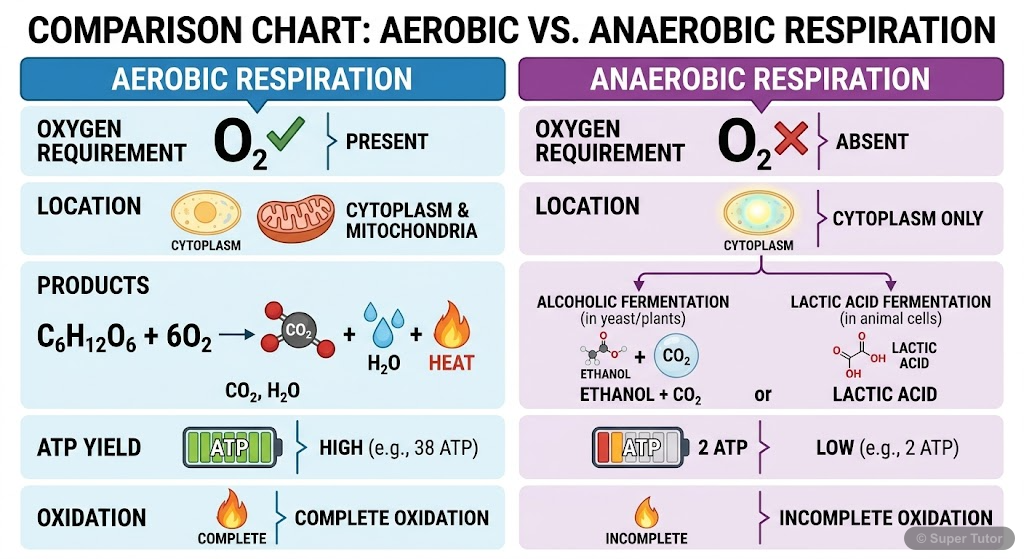
One of 4 illustrations for Photosynthesis and Respiration in Super Tutor — alongside flashcards, concept maps and practice questions.
Important Questions from Photosynthesis and Respiration
In the experiment to show that oxygen is released during photosynthesis using Hydrilla, a glowing splinter is inserted into the collected gas. What will happen and why?
Show answer
The splinter will glow brighter or relight because oxygen supports combustion
Step 1: During photosynthesis, Hydrilla (a water plant) releases oxygen gas as a by-product. Step 2: The gas bubbles collect in the inverted test tube by displacing water. Step 3: Oxygen is a gas that supports combustion (burning). A glowing splinter relights or glows brighter in the presence of oxygen — this is the standard test for oxygen. Step 4: Therefore, when the splinter is inserted, it relights/glows brighter, confirming the gas is oxygen. Step 5: Option A is wrong — CO₂ extinguishes flames, but Hydrilla releases O₂, not CO₂. Option C is wrong — no hydrogen is produced in photosynthesi
Glucose produced during photosynthesis cannot be transported quickly to other parts of the plant. Which sequence correctly describes what happens to this glucose?
Show answer
Glucose → stored as starch in leaf → reconverted to sucrose at night → transported via phloem to other parts
Step 1: Glucose is produced rapidly during photosynthesis but cannot be transported at the same speed. Step 2: So, multiple glucose molecules join together to form insoluble starch, which is stored temporarily in the leaf. Step 3: At night, this starch is reconverted into soluble sucrose. Step 4: Sucrose is then transported in solution through the phloem (not xylem) to different parts of the plant. Step 5: In stems and fruits, sucrose may again be stored as starch. Option B is wrong — food moves through phloem, not xylem (xylem carries water). Option C is wrong — glucose becomes sucrose/starch
In the experiment to show CO₂ production in germinating seeds (Activity 5), why are boiled (dead) seeds placed in Flask B along with an antiseptic?
Show answer
To serve as a control — proving that CO₂ comes only from living germinating seeds and not from bacterial activity
Step 1: Flask A has live germinating seeds; Flask B has dead (boiled) seeds with an antiseptic — this is the control setup. Step 2: Dead seeds cannot respire, so they will not produce CO₂. Step 3: The antiseptic (carbolic acid) is added to kill any bacteria on the dead seeds that might otherwise respire and produce CO₂, which would give a false positive result. Step 4: When Flask A's gas turns lime water milky (CO₂ present) but Flask B's gas does not, it confirms that the CO₂ came only from the respiration of living germinating seeds. Step 5: This is a classic use of a control experiment to is
Which statement correctly describes the relationship between the xylem and phloem in relation to photosynthesis?
Show answer
Xylem transports water and minerals from roots to leaves for photosynthesis; phloem transports sucrose (food) from leaves to all parts of the plant
Step 1: Plants have a vascular system made of two tissues — xylem and phloem. Step 2: Xylem transports water and minerals UPWARD from the roots to the leaves. This water is one of the raw materials needed for photosynthesis. Step 3: Phloem transports the food prepared during photosynthesis (in the form of sucrose) from the leaves to all other parts of the plant — downward and in all directions. Step 4: So xylem supplies the raw material (water), and phloem distributes the final product (food). Step 5: Options A and C are wrong — xylem does not carry glucose or food. Option D is wrong — xylem d
+39 more questions on Photosynthesis and Respiration (ICSE Class 7 Biology)
Practise AllFrequently Asked Questions
What are the important topics in Photosynthesis and Respiration for ICSE Class 7 Biology?
How many important questions are there in Photosynthesis and Respiration?
Sources & Official References
Content is aligned to the official syllabus. Refer to the board website for the latest curriculum.
More resources for Photosynthesis and Respiration
Practice Quiz
Test yourself with a quick quiz
Revision Notes
Key points for last-minute revision
Formula Sheet
The chapter's formulas in one place
Chapter Summary
Understand the chapter at a glance
Concept Maps
See how topics connect
Study Plan
Step-by-step plan for this chapter
Flashcards
Quick-fire cards for active recall
Syllabus
What topics to cover
For serious students
Get the full Photosynthesis and Respiration chapter — start free.
Quizzes, flashcards, an AI doubt solver and a study plan for ICSE Class 7 Biology. Free to start, no card needed.