The Periodic Table — Flashcards
ICSE · Class 9 · Chemistry
48 flashcards for The Periodic Table (ICSE Class 9 Chemistry) to test yourself on key terms and facts. Sample: "Why is classification of elements needed?"
Interactive on Super Tutor
Studying The Periodic Table? Get the full interactive chapter.
Quizzes, flashcards, AI doubt-solver and a step-by-step study plan — built for flashcards and more.
Free trial, no card needed.
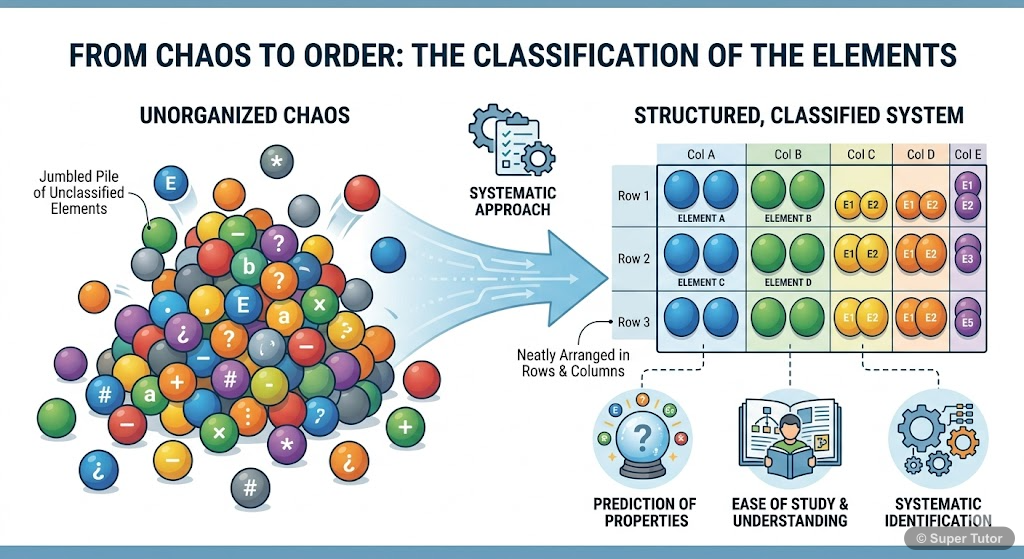
Learn better with visuals Super Tutor pairs illustrations like this with notes and quizzes for The Periodic Table.
Why is classification of elements needed?
Answer
Classification helps in studying elements in an organized way, relating their properties, and understanding how one element is connected to another.
What was the earliest basis used for classifying elements?
Answer
Early classification used factors such as density, malleability, ductility, and whether elements were metals or non-metals, but these were not satisfactory because they did not give a complete pattern…
What scientific basis was later found better for classifying elements?
Answer
Atomic mass was found to be a better basis because it does not vary under normal conditions and can be used to compare elements in a scientific way.
What is Dobereiner's law of triads?
Answer
"The atomic mass of the middle element of a triad was approximately equal to the arithmetic mean (average) of the atomic masses of the other two elements of that triad."…
Find the mean atomic mass for Ca and Ba in the triad Ca, Sr, Ba.
Answer
Formula: mean = (40 + 137) / 2 = 177 / 2 = 88.5. This is nearly equal to the atomic mass of Sr, which is 88.
Find the mean atomic mass for Cl and I in the triad Cl, Br, I.
Answer
Formula: mean = (35.5 + 127) / 2 = 162.5 / 2 = 81.25. This is nearly equal to the atomic mass of Br, which is 80.
Why did Dobereiner's law fail?
Answer
Dobereiner's law failed because it could not arrange all known elements into triads, and it did not work fully even within the same family, such as for F, Cl, and Br.
What is the failure shown by the halogen triad F, Cl, Br?
Answer
The mean of F and Br is 49.5, but Cl has atomic mass 35.5. So the middle element is not close to the average, showing the law does not hold here.
+40 more flashcards
Practise AllFrequently Asked Questions
What are the important topics in The Periodic Table for ICSE Class 9 Chemistry?
How many flashcards are available for The Periodic Table?
How should I revise The Periodic Table for Class 9 exams?
Sources & Official References
Content is aligned to the official syllabus. Refer to the board website for the latest curriculum.
More resources for The Periodic Table
Practice Quiz
Test yourself with a quick quiz
Important Questions
Exam-style questions with answers
Revision Notes
Key points for last-minute revision
Chapter Summary
Understand the chapter at a glance
Concept Maps
See how topics connect
Study Plan
Step-by-step plan for this chapter
Syllabus
What topics to cover
For serious students
Get the full The Periodic Table chapter — start free.
Quizzes, flashcards, an AI doubt solver and a study plan for ICSE Class 9 Chemistry. Free to start, no card needed.