Atomic Structure and Chemical Bonding — Flashcards
ICSE · Class 9 · Chemistry
44 flashcards for Atomic Structure and Chemical Bonding (ICSE Class 9 Chemistry) to test yourself on key terms and facts. Sample: "What is an atom?"
Interactive on Super Tutor
Studying Atomic Structure and Chemical Bonding? Get the full interactive chapter.
Quizzes, flashcards, AI doubt-solver and a step-by-step study plan — built for flashcards and more.
Free trial, no card needed.
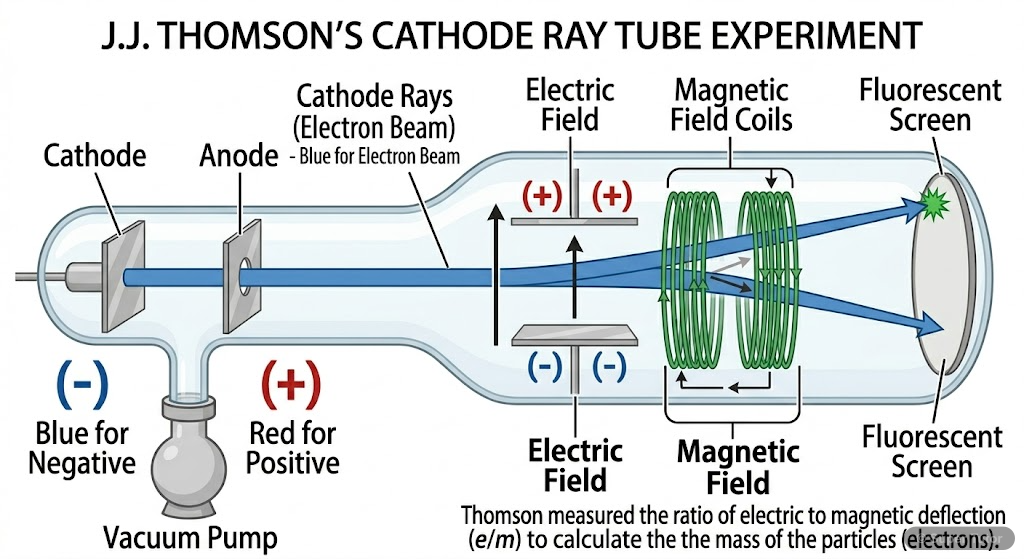
Learn better with visuals Super Tutor pairs illustrations like this with notes and quizzes for Atomic Structure and Chemical Bonding.
What is an atom?
Answer
An atom is the smallest particle of an element that exhibits all the properties of that element. It may or may not exist independently, but it takes part in every chemical reaction.
Who first gave the idea of minute particles of matter called paramanus?
Answer
Maharshi Kanada first proposed that matter consists of indestructible minute particles called paramanus, now called atoms.
What is the contribution of Democritus to atomic theory?
Answer
Democritus called the paramanu an atom, a Greek word meaning indivisible.
State the main idea of Dalton's atomic theory.
Answer
Dalton gave the first scientific theory of matter in 1808. He proposed that matter is made of very small indivisible atoms, and atoms take part in chemical reactions.
What are the three fundamental particles of an atom?
Answer
The three fundamental particles are electrons, protons, and neutrons.
What is the charge and position of an electron?
Answer
An electron has unit negative charge and is found outside the nucleus. Its symbol is -1e0. It has very small mass, about 1/1837 of a hydrogen atom.
What is the charge and position of a proton?
Answer
A proton has unit positive charge of 1.602×10^-19 coulombs. It is found in the nucleus. Its symbol is +1P1 and its mass is about 1 amu.
What is the charge and position of a neutron?
Answer
A neutron has no charge and is found in the nucleus. Its symbol is 0n1 and its mass is almost equal to the mass of a proton.
+36 more flashcards
Practise AllFrequently Asked Questions
What are the important topics in Atomic Structure and Chemical Bonding for ICSE Class 9 Chemistry?
How many flashcards are available for Atomic Structure and Chemical Bonding?
How should I revise Atomic Structure and Chemical Bonding for Class 9 exams?
Sources & Official References
Content is aligned to the official syllabus. Refer to the board website for the latest curriculum.
More resources for Atomic Structure and Chemical Bonding
Practice Quiz
Test yourself with a quick quiz
Important Questions
Exam-style questions with answers
Revision Notes
Key points for last-minute revision
Formula Sheet
The chapter's formulas in one place
Chapter Summary
Understand the chapter at a glance
Concept Maps
See how topics connect
Study Plan
Step-by-step plan for this chapter
Syllabus
What topics to cover
For serious students
Get the full Atomic Structure and Chemical Bonding chapter — start free.
Quizzes, flashcards, an AI doubt solver and a study plan for ICSE Class 9 Chemistry. Free to start, no card needed.