Atomic Structure and Chemical Bonding — Concept Maps
ICSE · Class 9 · Chemistry
4 concept maps of Atomic Structure and Chemical Bonding for ICSE Class 9 Chemistry, each also written out as a text outline.
Interactive on Super Tutor
Studying Atomic Structure and Chemical Bonding? Get the full interactive chapter.
Quizzes, flashcards, AI doubt-solver and a step-by-step study plan — built for concept maps and more.
Free trial, no card needed.
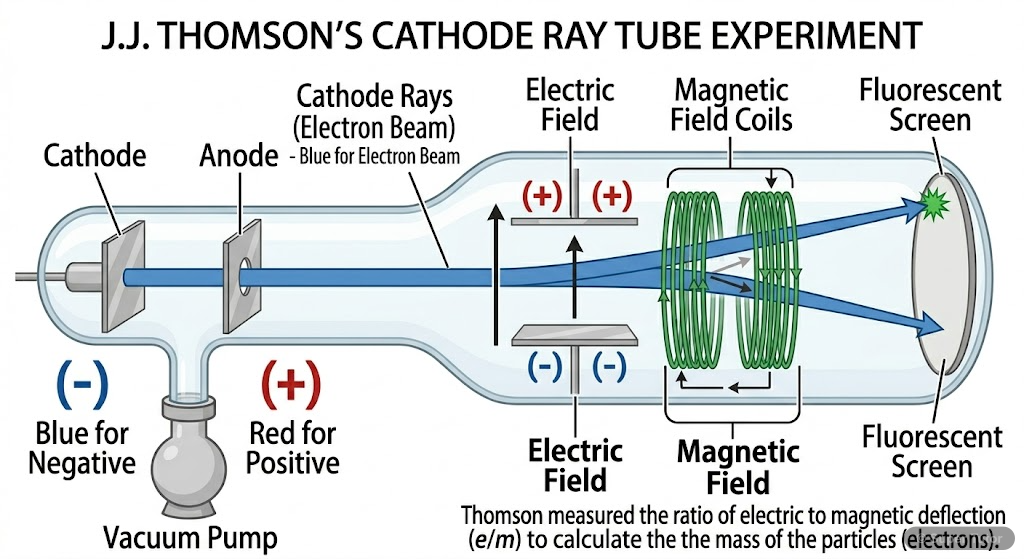
Learn better with visuals Super Tutor pairs illustrations like this with notes and quizzes for Atomic Structure and Chemical Bonding.
Atomic Structure and Chemical Bonding — Complete Concept Map
The map in words
- Atomic Structure and Bonding
- Sub-Atomic Particles
- Electron
- Charge minus 1
- Mass 1/1840 amu
- Outside nucleus
- Discovered by Thomson
- Proton
- Charge plus 1
- Mass 1 amu
- In nucleus
- Discovered by Goldstein
- Neutron
- Charge zero
- Mass 1 amu
- In nucleus
- Discovered by Chadwick
- Electron
- Atomic Models
- Thomson Plum Pudding
- Positive sphere
- Electrons embedded
- Rutherford Nuclear Model
- Dense positive nucleus
- Electrons orbit around
- Alpha scattering experiment
- Bohr Model 1913
- Fixed energy shells
- K L M N shells
- 2n squared rule
- Thomson Plum Pudding
- Key Numbers
- Atomic Number Z
- Equals protons
- Equals electrons
- Mass Number A
- Protons plus neutrons
- Neutrons
- Equals A minus Z
- Atomic Number Z
- Isotopes
- Same Z different A
- Hydrogen 3 isotopes
- Protium 0 neutrons
- Deuterium 1 neutron
- Tritium 2 neutrons
- Chlorine 2 isotopes
- Cl-35 ratio 75 percent
- Cl-37 ratio 25 percent
- Average mass of Cl = 35.5
- Chemical Bonding
- Octet Rule
- 8 electrons outermost shell
- Noble gas configuration
- Duplet Rule
- 2 electrons for H and He
- Ionic Bond
- Electron transfer
- Metal plus Non-metal
- NaCl MgCl2 CaO
- Covalent Bond
- Electron sharing
- Non-metal plus Non-metal
- Single Double Triple
- Octet Rule
- Sub-Atomic Particles
Atomic Structure — Complete Overview
The map in words
- Atomic Structure
- History
- Kanada 6th BC
- Paramanu concept
- Democritus 460 BC
- Atom meaning indivisible
- Dalton 1808
- First scientific theory
- Kanada 6th BC
- Sub-atomic Particles
- Electron
- Negative charge minus 1
- Mass 1 over 1840 amu
- Outside nucleus
- Thomson cathode rays
- Proton
- Positive charge plus 1
- Mass 1 amu
- Inside nucleus
- Goldstein canal rays
- Neutron
- No charge zero
- Mass 1 amu
- Inside nucleus
- Chadwick 1932
- Electron
- Atomic Models
- Thomson
- Plum pudding
- Rutherford 1911
- Dense nucleus
- Electrons orbit
- Cannot explain stability
- Bohr 1913
- Fixed energy shells KLMN
- No energy loss in orbit
- Explains stability
- Thomson
- Atomic Numbers
- Atomic number Z
- Protons equals electrons
- Mass number A
- Protons plus neutrons
- Neutrons equals A minus Z
- Atomic number Z
- Electronic Configuration
- Rule 2n squared
- K shell 2 max
- L shell 8 max
- M shell 18 max but outermost max 8
- Isotopes
- Same Z different A
- Same chemical properties
- Different physical properties
- Examples H C Cl
- History
Complete Chapter Concept Map: Atomic Structure and Chemical Bonding
The map in words
- root((Atomic Structure
- and Chemical Bonding))
- Sub-atomic Particles
- Electron
- Discovered by Thomson
- Charge minus 1
- Mass 1 by 1840 amu
- Proton
- Discovered by Goldstein
- Charge plus 1
- Mass 1 amu
- Neutron
- Discovered by Chadwick
- No charge
- Mass 1 amu
- Electron
- Atomic Models
- Dalton Model
- Indivisible atom
- Thomson Model
- Plum Pudding
- Rutherford Model
- Nuclear Model
- Electrons in orbits
- Bohr Model
- Fixed energy shells
- K L M N shells
- Dalton Model
- Atomic Number and Mass Number
- Atomic Number Z
- Number of protons
- Number of electrons
- Mass Number A
- Protons plus neutrons
- Neutrons
- A minus Z
- Atomic Number Z
- Electronic Configuration
- 2n squared rule
- Shell capacities
- Bohr Bury Scheme
- Valence electrons
- Octet Rule
- Noble gases stable
- 8 electrons in valence shell
- Duplet for H and He
- Drives chemical bonding
- Isotopes
- Same Z different A
- Differ in neutrons
- Hydrogen isotopes
- Protium
- Deuterium
- Tritium
- Carbon isotopes
- C 12 C 13 C 14
- Chlorine isotopes
- Cl 35 Cl 37
- Fractional atomic mass
- Chemical Bonding
- Electrovalent Bond
- Electron transfer
- Metal to non-metal
- Cation formed
- Anion formed
- NaCl MgCl2 CaO
- Covalent Bond
- Electron sharing
- Non-metal to non-metal
- Single bond
- H2 HCl CH4
- Double bond
- O2
- Triple bond
- N2
- Non-polar molecules
- H2 Cl2 CCl4
- Polar molecules
- HCl H2O NH3
- Electrovalent Bond
- Sub-atomic Particles
Atoms form the basis of matter, and chemical bonding explains how atoms combine to become stable
The map in words
- Atoms form the basis of matter, and chemical bonding explains how atoms combine to become stable
- Historical ideas about matter
- Sub-atomic particles
- Discovery of particles
- Atomic models
- Atomic number and mass number
- Electron distribution
- Valence electrons and valency
- Octet and duplet rule
Explore these maps interactively
Explore DiagramsFrequently Asked Questions
What are the important topics in Atomic Structure and Chemical Bonding for ICSE Class 9 Chemistry?
What do the concept maps for Atomic Structure and Chemical Bonding show?
How should I revise Atomic Structure and Chemical Bonding for Class 9 exams?
Sources & Official References
Content is aligned to the official syllabus. Refer to the board website for the latest curriculum.
More resources for Atomic Structure and Chemical Bonding
Practice Quiz
Test yourself with a quick quiz
Important Questions
Exam-style questions with answers
Revision Notes
Key points for last-minute revision
Formula Sheet
The chapter's formulas in one place
Chapter Summary
Understand the chapter at a glance
Study Plan
Step-by-step plan for this chapter
Flashcards
Quick-fire cards for active recall
Syllabus
What topics to cover
For serious students
Get the full Atomic Structure and Chemical Bonding chapter — start free.
Quizzes, flashcards, an AI doubt solver and a study plan for ICSE Class 9 Chemistry. Free to start, no card needed.