Atomic Structure and Chemical Bonding — Chapter Summary
ICSE · Class 9 · Chemistry
Summary of Atomic Structure and Chemical Bonding for ICSE Class 9 Chemistry. Part of the ICSE Class 9 Chemistry syllabus.
Interactive on Super Tutor
Studying Atomic Structure and Chemical Bonding? Get the full interactive chapter.
Quizzes, flashcards, AI doubt-solver and a step-by-step study plan — built for chapter summary and more.
Free trial, no card needed.
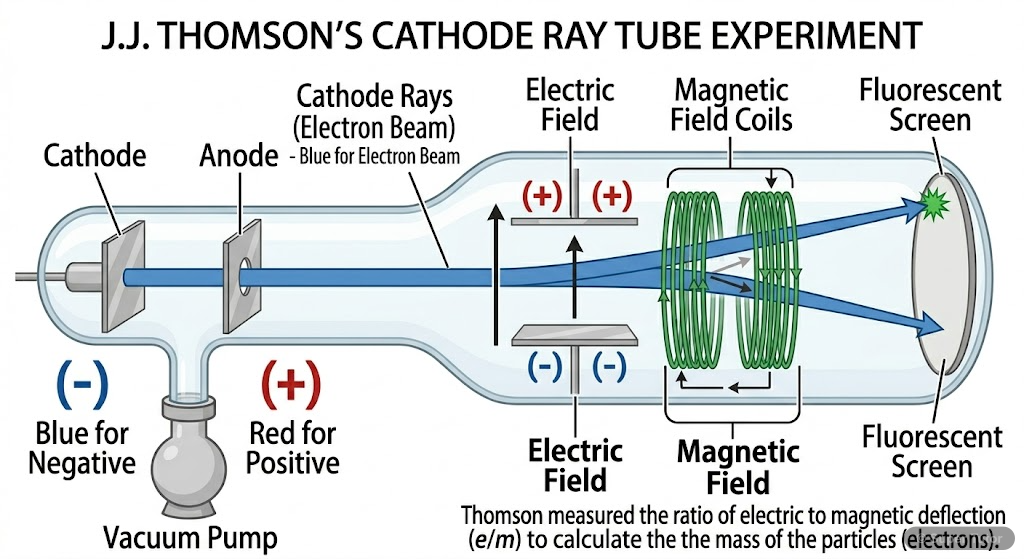
Learn better with visuals Super Tutor pairs illustrations like this with notes and quizzes for Atomic Structure and Chemical Bonding.
Overview
Atomic structure explains how matter is built from atoms and subatomic particles. Chemical bonding explains why atoms join to form stable molecules and compounds. The chapter connects the history of atomic ideas, discovery of electrons, protons, and neutrons, electronic configuration, atomic number,
Key Concepts
An element is made up
An element is made up of only one type of atoms. An atom is the smallest particle of an element that exhibits all the properties of that element.
Atoms contain electrons
Atoms contain electrons, protons, and neutrons. Electrons are negatively charged and lie outside the nucleus. Protons are positively charged and lie i
Atomic number equals the number
Atomic number equals the number of protons and, in a neutral atom, the number of electrons. Mass number is the total number of protons and neutrons in
Electrons are arranged in shells
Electrons are arranged in shells or energy levels. The maximum number of electrons in a shell is given by 2n2, where n is the shell number. The outerm
Valence electrons are the electrons
Valence electrons are the electrons in the outermost shell. Valency is the combining capacity of an atom. For elements with 1, 2, or 3 valence electro
Learning Objectives
- Understand the idea of atom and element
- Recall the discoveries of electron, proton, neutron, nucleus, and atomic models
- Use atomic number, mass number, and electronic configuration correctly
- Apply the 2n2 rule for shell distribution
- Explain valency, octet rule, and duplet rule
Frequently Asked Questions
What are the important topics in Atomic Structure and Chemical Bonding for ICSE Class 9 Chemistry?
How should I revise Atomic Structure and Chemical Bonding for Class 9 exams?
Sources & Official References
Content is aligned to the official syllabus. Refer to the board website for the latest curriculum.
More resources for Atomic Structure and Chemical Bonding
Practice Quiz
Test yourself with a quick quiz
Important Questions
Exam-style questions with answers
Revision Notes
Key points for last-minute revision
Formula Sheet
The chapter's formulas in one place
Concept Maps
See how topics connect
Study Plan
Step-by-step plan for this chapter
Flashcards
Quick-fire cards for active recall
Syllabus
What topics to cover
For serious students
Get the full Atomic Structure and Chemical Bonding chapter — start free.
Quizzes, flashcards, an AI doubt solver and a study plan for ICSE Class 9 Chemistry. Free to start, no card needed.