Atomic Structure and Chemical Bonding — Syllabus
ICSE · Class 9 · Chemistry
What Atomic Structure and Chemical Bonding covers in ICSE Class 9 Chemistry: 4 topics, for the 2026-27 session.
Interactive on Super Tutor
Studying Atomic Structure and Chemical Bonding? Get the full interactive chapter.
Quizzes, flashcards, AI doubt-solver and a step-by-step study plan — built for syllabus and more.
Free trial, no card needed.
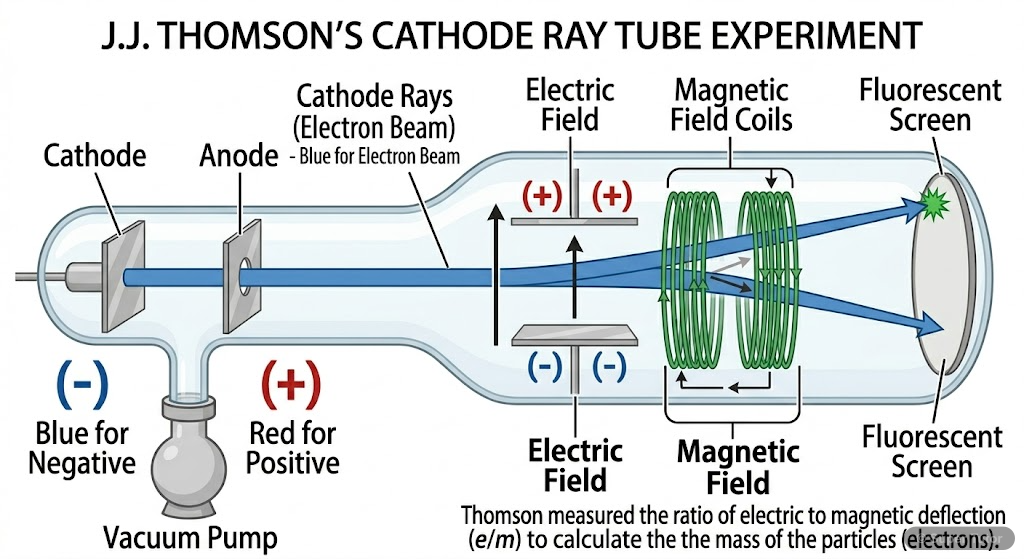
Learn better with visuals Super Tutor pairs illustrations like this with notes and quizzes for Atomic Structure and Chemical Bonding.
Topics in Atomic Structure and Chemical Bonding
1. Early ideas and discovery of subatomic particles
- Maharshi Kanada first proposed that matter consists of indestructible minute particles called paramanus.
- Democritus called the paramanu an atom, meaning indivisible.
- John Dalton gave the first scientific theory about matter in 1808.
2. Structure of the atom
- An atom has two main parts: nucleus and extra-nuclear space.
- The nucleus is the central part and contains protons and neutrons.
- Electrons revolve around the nucleus in orbits or shells.
3. Fundamental particles of the atom
- Electron is a negatively charged fundamental particle found outside the nucleus.
- Proton is a positively charged fundamental particle found in the nucleus.
- Neutron is a neutral fundamental particle found in the nucleus.
4. Atomic models and discovery of nucleus
- Thomson's plum pudding model described the atom as a sphere of uniform positive charge with electrons embedded in it.
- Rutherford conducted the alpha-particle scattering experiment using gold foil.
- Most alpha particles passed straight through, showing that an atom has a lot of empty space.
Key Concepts
Central concept: Atoms form the basis of matter, and chemical bonding explains how atoms combine to become stable
Work through every topic in Atomic Structure and Chemical Bonding with notes and quizzes
Start This ChapterFrequently Asked Questions
What are the important topics in Atomic Structure and Chemical Bonding for ICSE Class 9 Chemistry?
How should I revise Atomic Structure and Chemical Bonding for Class 9 exams?
Sources & Official References
Content is aligned to the official syllabus. Refer to the board website for the latest curriculum.
More resources for Atomic Structure and Chemical Bonding
Practice Quiz
Test yourself with a quick quiz
Important Questions
Exam-style questions with answers
Revision Notes
Key points for last-minute revision
Formula Sheet
The chapter's formulas in one place
Chapter Summary
Understand the chapter at a glance
Concept Maps
See how topics connect
Study Plan
Step-by-step plan for this chapter
Flashcards
Quick-fire cards for active recall
For serious students
Get the full Atomic Structure and Chemical Bonding chapter — start free.
Quizzes, flashcards, an AI doubt solver and a study plan for ICSE Class 9 Chemistry. Free to start, no card needed.