Transformation of Sentences — Flashcards
ICSE · Class 9 · English Language - Archer
32 flashcards for Transformation of Sentences (ICSE Class 9 English Language - Archer) to test yourself on key terms and facts. Sample: "What is a phrase?"
Interactive on Super Tutor
Studying Transformation of Sentences? Get the full interactive chapter.
Quizzes, flashcards, AI doubt-solver and a step-by-step study plan — built for flashcards and more.
Free trial, no card needed.
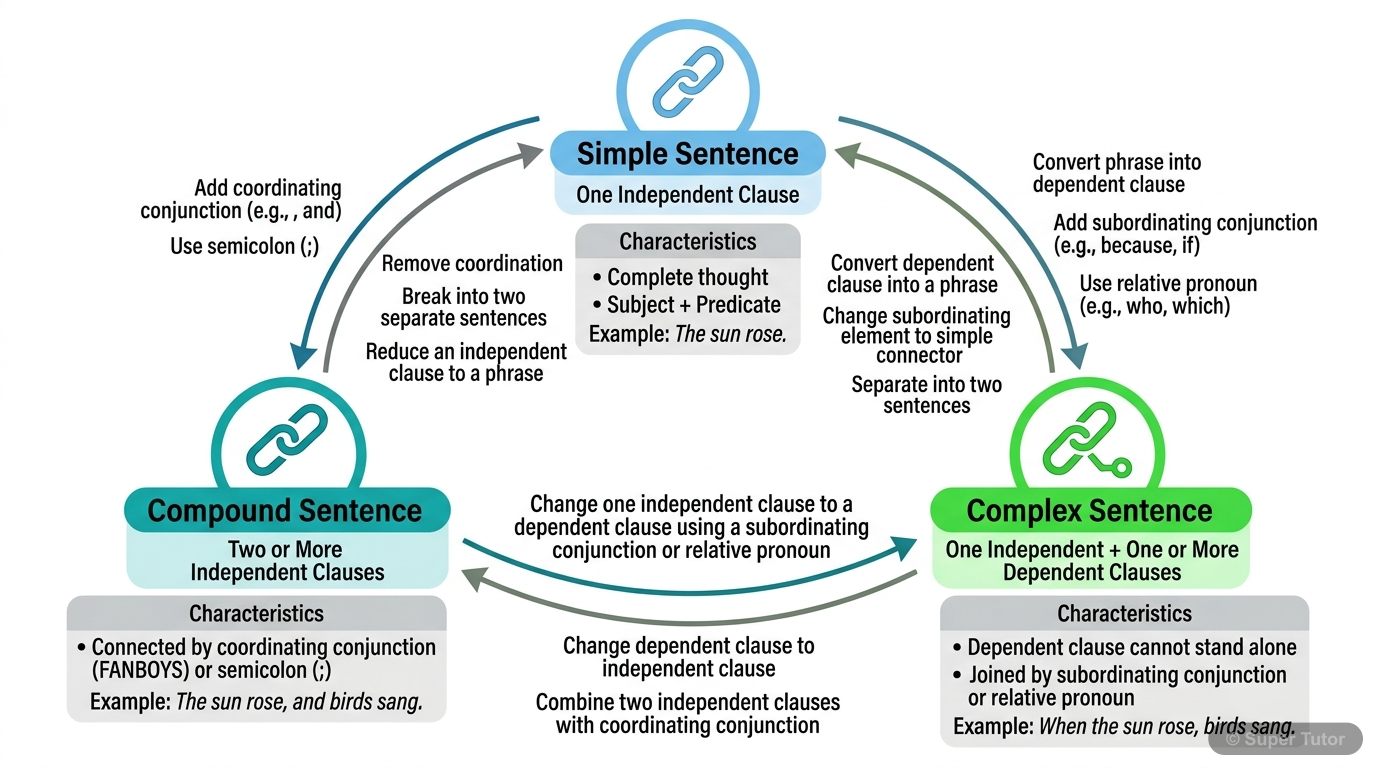
Learn better with visuals Super Tutor pairs illustrations like this with notes and quizzes for Transformation of Sentences.
What is a phrase?
Answer
A phrase is a group of words that does not have any verb or has a non-finite verb and gives only partial information. A phrase adds meaning to a sentence but cannot make a sentence on its own. Example…
What is a clause?
Answer
A clause is a group of words that contains a subject and a finite verb. It may be independent or dependent. Example: 'I will follow' is a clause because it has a subject and a finite verb.
Why can a clause make a sentence but a phrase cannot?
Answer
A clause contains a subject and a finite verb, so it can express a complete thought if it is independent. A phrase gives only partial information and cannot stand alone as a sentence.
What is an independent clause?
Answer
An independent clause, also called a main clause, is a clause that can stand on its own and function as a sentence. It has complete meaning by itself.
What is a dependent clause?
Answer
A dependent clause, also called a subordinate clause, does not make complete sense by itself. It needs to be connected with the main clause by a subordinating conjunction to make complete sense.
What are noun clauses?
Answer
Noun clauses are subordinate clauses that act as nouns. They begin with words such as how, that, if, what, whatever, when, where, whether, which, whichever, who, whoever, whom, whomever, and why.
What are adjective clauses?
Answer
Adjective clauses are subordinate clauses that describe nouns. They begin with words such as that, when, where, who, whom, whose, and which.
What are adverb clauses?
Answer
Adverb clauses are subordinate clauses that begin with words such as while, after, when, before, since, although, even though, as, because, so that, so, as though, where, wherever, if, unless, until, …
+24 more flashcards
Practise AllFrequently Asked Questions
What are the important topics in Transformation of Sentences for ICSE Class 9 English Language - Archer?
How many flashcards are available for Transformation of Sentences?
How should I revise Transformation of Sentences for Class 9 exams?
Sources & Official References
Content is aligned to the official syllabus. Refer to the board website for the latest curriculum.
More resources for Transformation of Sentences
Practice Quiz
Test yourself with a quick quiz
Important Questions
Exam-style questions with answers
Revision Notes
Key points for last-minute revision
Chapter Summary
Understand the chapter at a glance
Concept Maps
See how topics connect
Study Plan
Step-by-step plan for this chapter
Syllabus
What topics to cover
For serious students
Get the full Transformation of Sentences chapter — start free.
Quizzes, flashcards, an AI doubt solver and a study plan for ICSE Class 9 English Language - Archer. Free to start, no card needed.