Isosceles Triangles — Chapter Summary
ICSE · Class 9 · Mathematics
Summary of Isosceles Triangles for ICSE Class 9 Mathematics. Key concepts: A triangle, If all the sides of and If two sides of a triangle.
Interactive on Super Tutor
Studying Isosceles Triangles? Get the full interactive chapter.
Quizzes, flashcards, AI doubt-solver and a step-by-step study plan — built for chapter summary and more.
Free trial, no card needed.
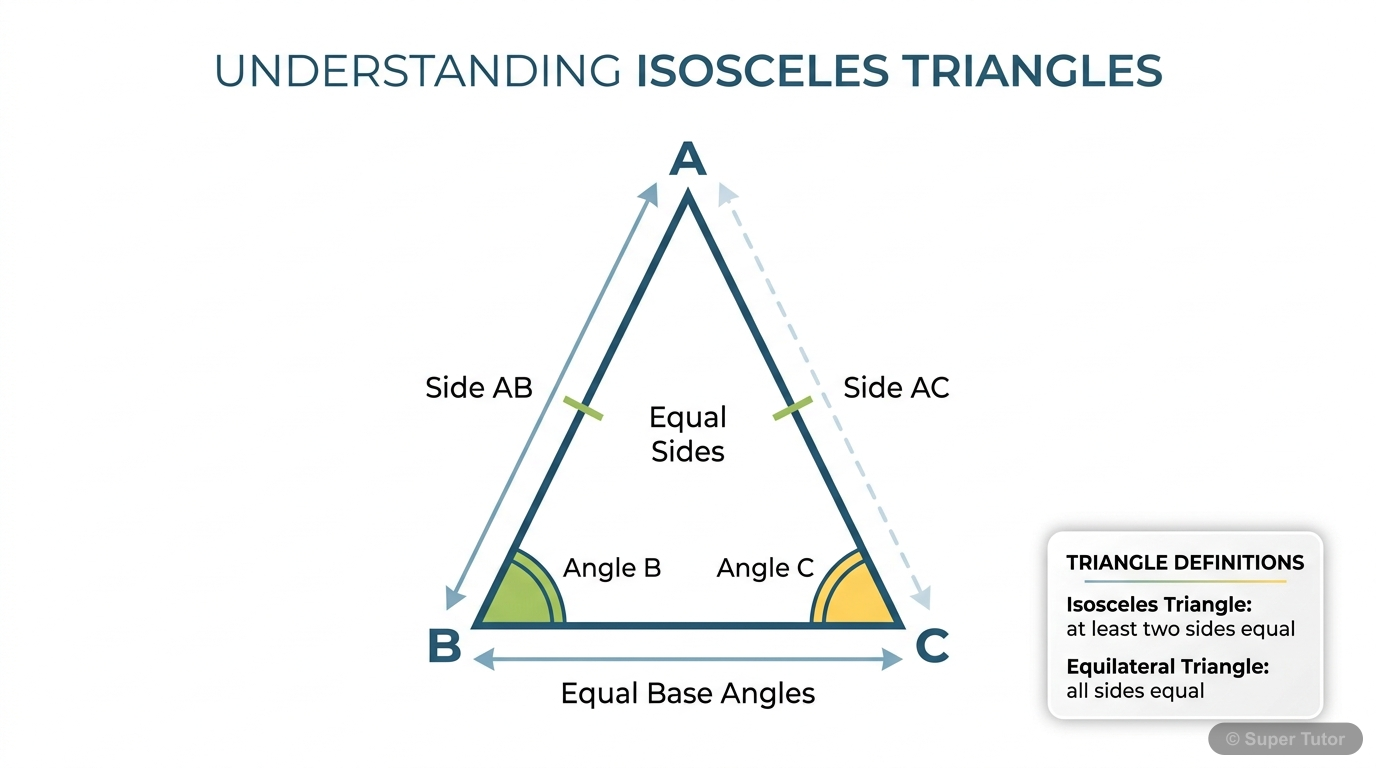
Learn better with visuals Super Tutor pairs illustrations like this with notes and quizzes for Isosceles Triangles.
Overview
An isosceles triangle is a triangle with at least two equal sides. An equilateral triangle has all three sides equal and always satisfies the properties of an isosceles triangle. The chapter develops the main facts of isosceles triangles through angle-side relationships and congruence proofs.
Key Concepts
A triangle
A triangle, with atleast two sides equal to each other, is called an isosceles triangle.
If all the sides of
If all the sides of a triangle are equal to each other, it is called an equilateral triangle. An equilateral triangle satisfies all the properties of
If two sides of a triangle
If two sides of a triangle are equal, the angles opposite to them are also equal. For triangle ABC with AB = AC, drawing AD perpendicular to BC helps
If two angles of a triangle
If two angles of a triangle are equal, the sides opposite to them are also equal. For triangle ABC with angle B = angle C, drawing AD perpendicular to
In an isosceles triangle
In an isosceles triangle, the two equal sides meet at the vertex, and the side opposite them is the base. The angles opposite the equal sides are the
Learning Objectives
- Identify an isosceles triangle and an equilateral triangle.
- Use the fact that equal sides of a triangle give equal opposite angles.
- Use the converse fact that equal angles of a triangle give equal opposite sides.
- Apply triangle congruence to prove results in isosceles triangles.
- Use key properties of isosceles triangles to solve angle and length problems.
Frequently Asked Questions
What are the important topics in Isosceles Triangles for ICSE Class 9 Mathematics?
How should I revise Isosceles Triangles for Class 9 exams?
Sources & Official References
Content is aligned to the official syllabus. Refer to the board website for the latest curriculum.
More resources for Isosceles Triangles
Practice Quiz
Test yourself with a quick quiz
Important Questions
Exam-style questions with answers
Revision Notes
Key points for last-minute revision
Formula Sheet
The chapter's formulas in one place
Concept Maps
See how topics connect
Study Plan
Step-by-step plan for this chapter
Flashcards
Quick-fire cards for active recall
Syllabus
What topics to cover
For serious students
Get the full Isosceles Triangles chapter — start free.
Quizzes, flashcards, an AI doubt solver and a study plan for ICSE Class 9 Mathematics. Free to start, no card needed.