Pythagoras Theorem — Chapter Summary
ICSE · Class 9 · Mathematics
Summary of Pythagoras Theorem for ICSE Class 9 Mathematics. Key concepts: In a right, If in any triangle and For a right.
Interactive on Super Tutor
Studying Pythagoras Theorem? Get the full interactive chapter.
Quizzes, flashcards, AI doubt-solver and a step-by-step study plan — built for chapter summary and more.
Free trial, no card needed.
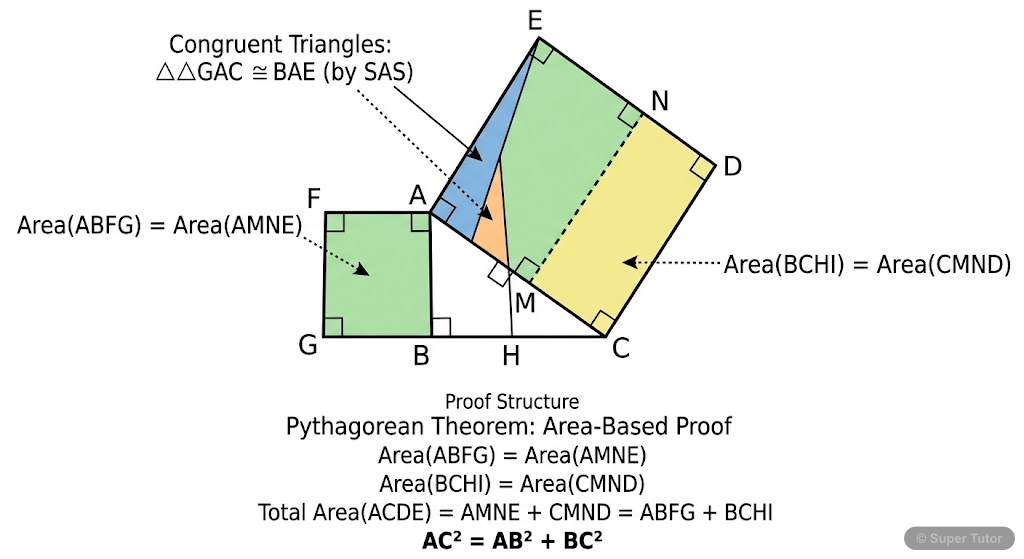
One of 6 illustrations for Pythagoras Theorem in Super Tutor — alongside flashcards, concept maps and practice questions.
Overview
Pythagoras Theorem gives a fixed relation between the three sides of a right-angled triangle. The hypotenuse is always the largest side, and its square is equal to the sum of the squares of the other two sides. The theorem also has a converse, which helps identify a right-angled triangle from side l
Key Concepts
In a right
In a right-angled triangle, the square on the hypotenuse is equal to the sum of the squares on the remaining two sides. For triangle ABC with angle AB
If in any triangle
If in any triangle, the square on the largest side is equal to the sum of the squares on the other two sides, then the triangle is right-angled and th
For a right
For a right-angled triangle ABC, squares are drawn on the three sides. Using equal areas of congruent triangles and the relation between triangle area
Drawing a perpendicular from the right
Drawing a perpendicular from the right angle to the hypotenuse creates two smaller triangles similar to the original triangle. From proportional sides
If a^2 + b^2 = c^2
If a^2 + b^2 = c^2 for positive numbers a, b, and c, then a, b, and c are called Pythagorean triplets. A standard example is 3, 4, 5 because 3^2 + 4^2
Learning Objectives
- State Pythagoras Theorem and its converse correctly
- Use the theorem to find unknown sides in right-angled triangles
- Recognize Pythagorean triplets quickly
- Classify triangles as right-angled, obtuse-angled, or acute-angled using side lengths
- Apply the theorem in ladder, geometry, and distance-based problems
Frequently Asked Questions
What are the important topics in Pythagoras Theorem for ICSE Class 9 Mathematics?
How should I revise Pythagoras Theorem for Class 9 exams?
Sources & Official References
Content is aligned to the official syllabus. Refer to the board website for the latest curriculum.
More resources for Pythagoras Theorem
Practice Quiz
Test yourself with a quick quiz
Important Questions
Exam-style questions with answers
Revision Notes
Key points for last-minute revision
Formula Sheet
The chapter's formulas in one place
Concept Maps
See how topics connect
Study Plan
Step-by-step plan for this chapter
Flashcards
Quick-fire cards for active recall
Syllabus
What topics to cover
For serious students
Get the full Pythagoras Theorem chapter — start free.
Quizzes, flashcards, an AI doubt solver and a study plan for ICSE Class 9 Mathematics. Free to start, no card needed.