Complementary Angles — Chapter Summary
ICSE · Class 9 · Mathematics
Summary of Complementary Angles for ICSE Class 9 Mathematics. Key concepts: Two acute angles are, The complement of an acute and sin(90° − θ) = cos θ.
Interactive on Super Tutor
Studying Complementary Angles? Get the full interactive chapter.
Quizzes, flashcards, AI doubt-solver and a step-by-step study plan — built for chapter summary and more.
Free trial, no card needed.
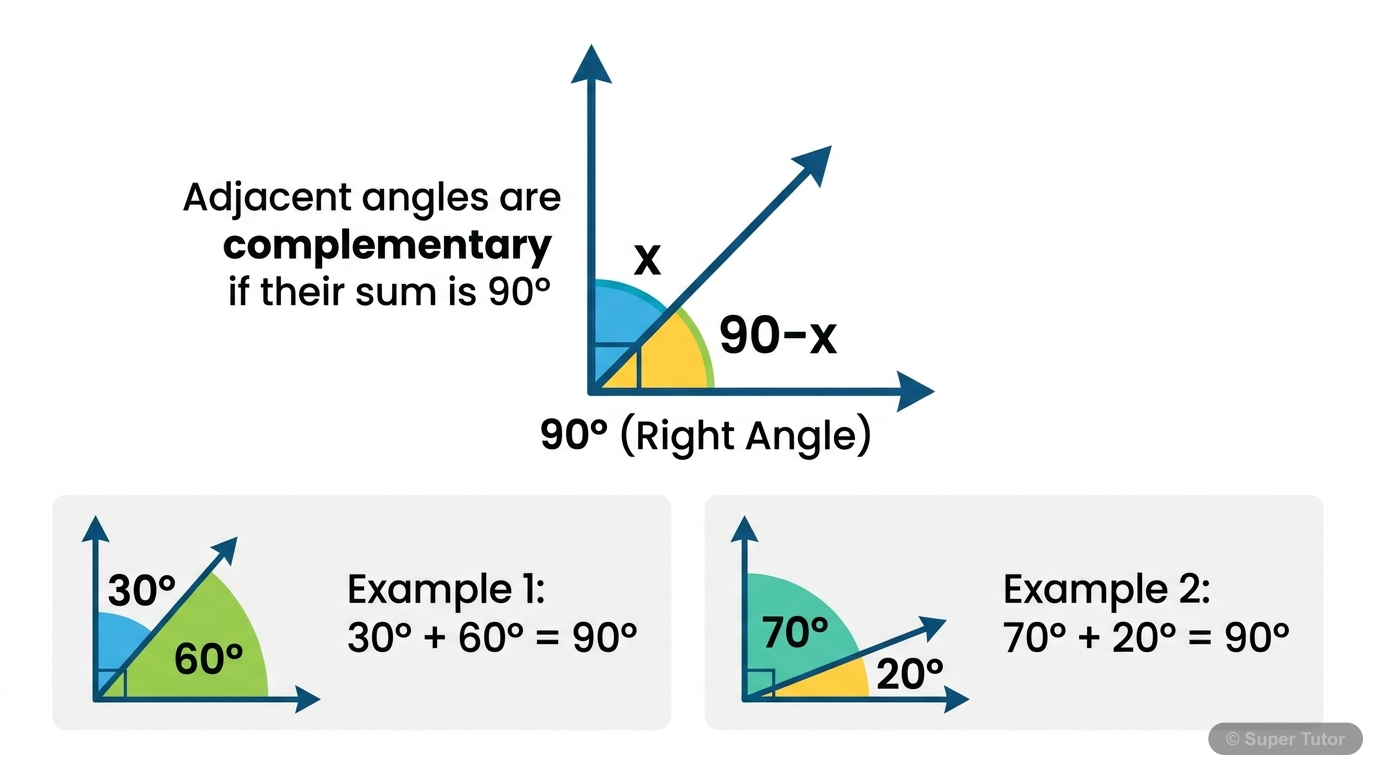
One of 3 illustrations for Complementary Angles in Super Tutor — alongside flashcards, concept maps and practice questions.
Overview
Complementary angles are two acute angles whose sum is 90°. The complement of an angle θ is (90 − θ)°. In a right triangle, the two acute angles are complementary, and this idea creates the co-function relations between trigonometric ratios. These relations make it possible to replace one trigonomet
Key Concepts
Two acute angles are complementary if
Two acute angles are complementary if their sum is 90°. Examples include 30° and 60°, 70° and 20°, and x° and (90 − x)°.
The complement of an acute angle
The complement of an acute angle θ is (90 − θ)°. For example, the complement of 48° is 42°.
sin(90° − θ) = cos θ
sin(90° − θ) = cos θ and cos(90° − θ) = sin θ. In right triangle ABC with ∠B = 90° and ∠ACB = θ, the angle ∠CAB is 90° − θ, which leads to this identi
tan(90° − θ) = cot θ
tan(90° − θ) = cot θ and cot(90° − θ) = tan θ.
cosec(90° − θ) = sec θ
cosec(90° − θ) = sec θ and sec(90° − θ) = cosec θ.
Learning Objectives
- Define complementary angles correctly.
- Find the complement of a given acute angle.
- Use the right triangle model to connect complementary angles with trigonometric ratios.
- Apply the complementary identities for sine, cosine, tangent, cotangent, secant, and cosecant.
- Solve and verify trigonometric expressions using complementary angle relations.
Frequently Asked Questions
What are the important topics in Complementary Angles for ICSE Class 9 Mathematics?
How should I revise Complementary Angles for Class 9 exams?
Sources & Official References
Content is aligned to the official syllabus. Refer to the board website for the latest curriculum.
More resources for Complementary Angles
Practice Quiz
Test yourself with a quick quiz
Important Questions
Exam-style questions with answers
Revision Notes
Key points for last-minute revision
Formula Sheet
The chapter's formulas in one place
Concept Maps
See how topics connect
Study Plan
Step-by-step plan for this chapter
Flashcards
Quick-fire cards for active recall
Syllabus
What topics to cover
For serious students
Get the full Complementary Angles chapter — start free.
Quizzes, flashcards, an AI doubt solver and a study plan for ICSE Class 9 Mathematics. Free to start, no card needed.