Pressure in Fluids and Atmospheric Pressure — Flashcards
ICSE · Class 9 · Physics
35 flashcards for Pressure in Fluids and Atmospheric Pressure (ICSE Class 9 Physics) to test yourself on key terms and facts.
Interactive on Super Tutor
Studying Pressure in Fluids and Atmospheric Pressure? Get the full interactive chapter.
Quizzes, flashcards, AI doubt-solver and a step-by-step study plan — built for flashcards and more.
Free trial, no card needed.
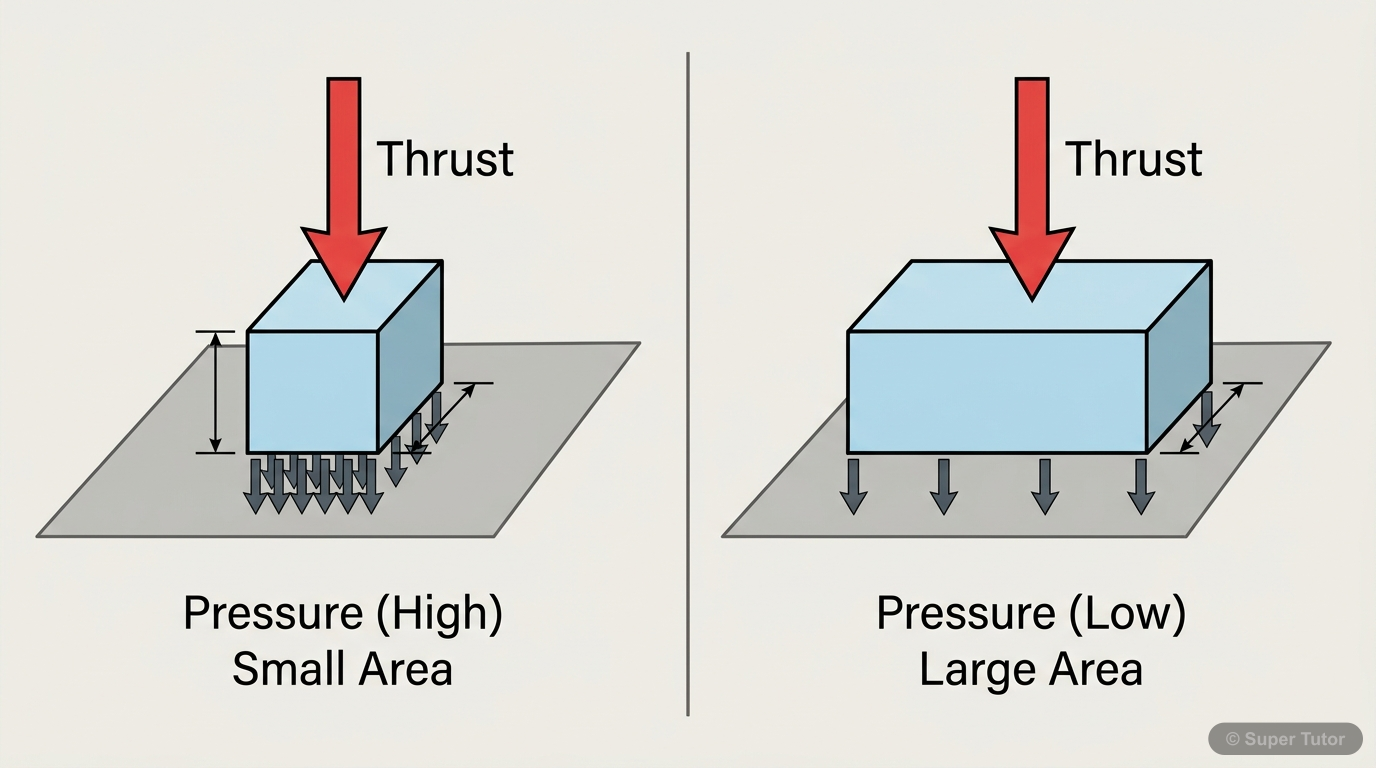
Learn better with visuals Super Tutor pairs illustrations like this with notes and quizzes for Pressure in Fluids and Atmospheric Pressure.
State the definition of thrust and pressure.
Answer
Thrust is the force acting normally on a surface. Pressure is the thrust per unit area of surface. Formula: P = F/A. Units: thrust in newton, pressure in pascal.
A force of 20 N acts normally on an area of 4 m². Find the pressure.
Answer
Given: F = 20 N, A = 4 m². Formula: P = F/A. Step 1: P = 20/4 N m⁻². Step 2: P = 5 N m⁻². Answer: 5 Pa.
A thrust of 600 N acts on an area of 0.5 m². Find the pressure.
Answer
Given: F = 600 N, A = 0.5 m². Formula: P = F/A. Step 1: P = 600/0.5 N m⁻². Step 2: P = 1200 N m⁻². Answer: 1200 Pa.
Why does a sharp knife cut better than a blunt knife?
Answer
A sharp knife has a smaller area of contact. For the same thrust, smaller area gives greater pressure. Greater pressure helps cutting more easily. A pointed pin works on the same principle.
A brick exerts a thrust of 4 kgf on the ground. Its base area is 50 cm². Find the pressure.
Answer
Given: Thrust = 4 kgf, Area = 50 cm². Formula: Pressure = Thrust/Area. Step 1: P = 4/50 kgf cm⁻². Step 2: P = 0.08 kgf cm⁻². Answer: 0.08 kgf cm⁻².
A brick exerts a thrust of 4 kgf on the ground. Its base area is 200 cm². Find the pressure.
Answer
Given: Thrust = 4 kgf, Area = 200 cm². Formula: Pressure = Thrust/Area. Step 1: P = 4/200 kgf cm⁻². Step 2: P = 0.02 kgf cm⁻². Answer: 0.02 kgf cm⁻².
State the S.I. unit of pressure and define one pascal.
Answer
The S.I. unit of pressure is pascal, symbol Pa. One pascal is the pressure exerted on a surface of area 1 m² by a force of 1 N acting normally on it. So, 1 Pa = 1 N m⁻².
Convert 1 dyne cm⁻² into N m⁻².
Answer
Conversion: 1 dyne cm⁻² = 0.1 N m⁻². Answer: 0.1 N m⁻².
+27 more flashcards
Practise AllFrequently Asked Questions
What are the important topics in Pressure in Fluids and Atmospheric Pressure for ICSE Class 9 Physics?
How many flashcards are available for Pressure in Fluids and Atmospheric Pressure?
How should I revise Pressure in Fluids and Atmospheric Pressure for Class 9 exams?
Sources & Official References
Content is aligned to the official syllabus. Refer to the board website for the latest curriculum.
More resources for Pressure in Fluids and Atmospheric Pressure
Practice Quiz
Test yourself with a quick quiz
Important Questions
Exam-style questions with answers
Revision Notes
Key points for last-minute revision
Formula Sheet
The chapter's formulas in one place
Chapter Summary
Understand the chapter at a glance
Concept Maps
See how topics connect
Study Plan
Step-by-step plan for this chapter
Syllabus
What topics to cover
For serious students
Get the full Pressure in Fluids and Atmospheric Pressure chapter — start free.
Quizzes, flashcards, an AI doubt solver and a study plan for ICSE Class 9 Physics. Free to start, no card needed.