Laws of Motion — Flashcards
ICSE · Class 9 · Physics
35 flashcards for Laws of Motion (ICSE Class 9 Physics) to test yourself on key terms and facts. Sample: "State the general definition of force."
Interactive on Super Tutor
Studying Laws of Motion? Get the full interactive chapter.
Quizzes, flashcards, AI doubt-solver and a step-by-step study plan — built for flashcards and more.
Free trial, no card needed.
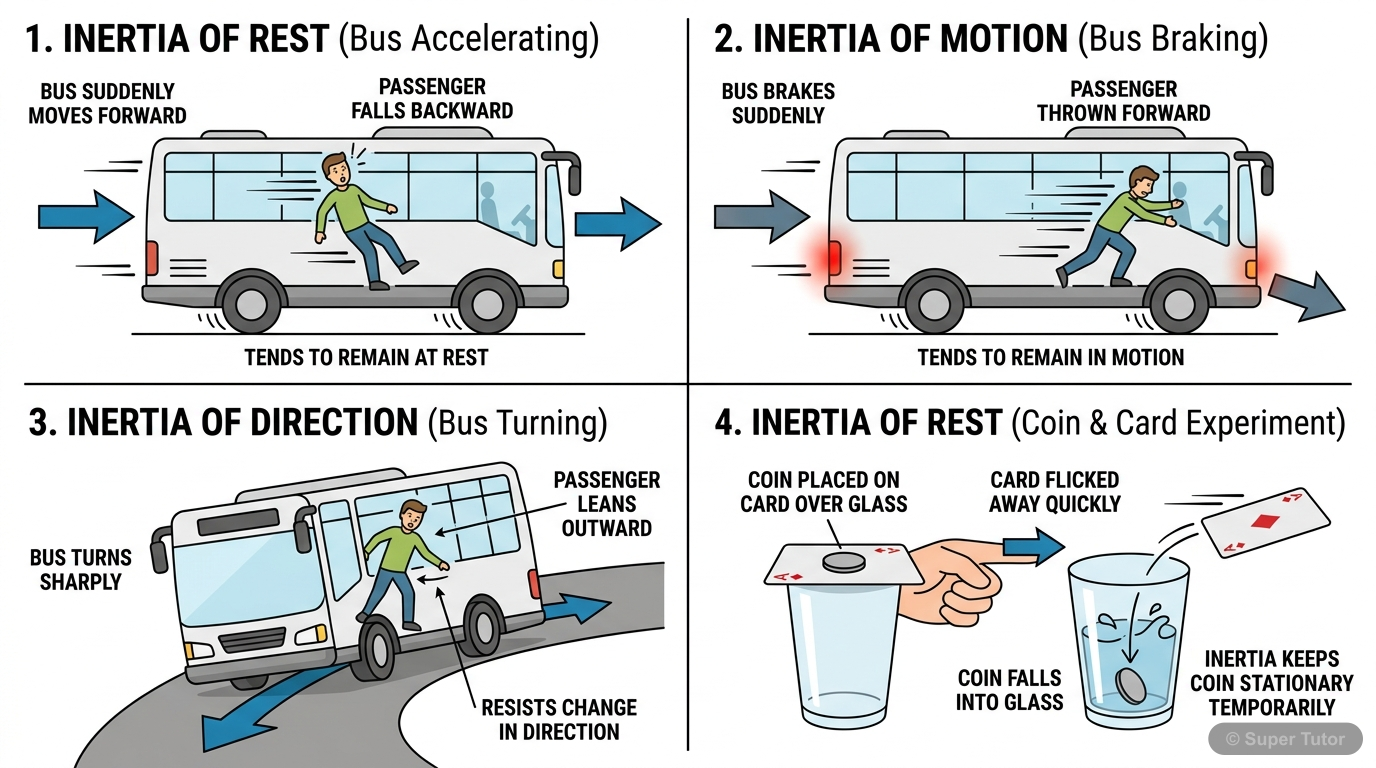
One of 25 illustrations for Laws of Motion in Super Tutor — alongside flashcards, concept maps and practice questions.
State the general definition of force.
Answer
Force is that physical cause which changes or tends to change either the size or the shape or the state of rest or of motion of the body.
What are contact forces? Name four examples.
Answer
Contact forces are applied on bodies by making a physical contact. Examples: frictional force, normal reaction force, tension force in a string, and force exerted during collision.
What are non-contact forces? Name three examples.
Answer
Non-contact forces are experienced by bodies even without being physically touched. Examples: gravitational force, electrostatic force, and magnetic force.
Why is gravitational force always attractive, while electrostatic and magnetic forces can be attractive or repulsive?
Answer
Gravitational force is always attractive because masses attract each other. Electrostatic force depends on charges: unlike charges attract and like charges repel. Magnetic force depends on poles: unli…
State Newton's first law of motion.
Answer
According to Newton's first law of motion, if a body is in a state of rest, it will remain in the state of rest and if it is in the state of motion, it will remain moving in the same direction with th…
What is inertia?
Answer
Inertia is the property of an object by virtue of which it neither changes its state nor it tends to change the state. It is the inherent property of each object.
Why does a passenger in a train tend to fall backward when the train suddenly starts?
Answer
This happens due to inertia of rest. The lower part of the body moves with the train first, but the upper part tends to remain at rest for a short time. Because of this, the person leans backward. Thi…
Why does a cyclist continue moving for some distance after pedalling stops?
Answer
This happens due to inertia of motion. The bicycle keeps moving with the same speed for a short time, but friction between the tyres and the road slowly stops it. If friction were absent, the bicycle …
+27 more flashcards
Practise AllFrequently Asked Questions
What are the important topics in Laws of Motion for ICSE Class 9 Physics?
How many flashcards are available for Laws of Motion?
How should I revise Laws of Motion for Class 9 exams?
Sources & Official References
Content is aligned to the official syllabus. Refer to the board website for the latest curriculum.
More resources for Laws of Motion
Practice Quiz
Test yourself with a quick quiz
Important Questions
Exam-style questions with answers
Revision Notes
Key points for last-minute revision
Formula Sheet
The chapter's formulas in one place
Chapter Summary
Understand the chapter at a glance
Concept Maps
See how topics connect
Study Plan
Step-by-step plan for this chapter
Syllabus
What topics to cover
For serious students
Get the full Laws of Motion chapter — start free.
Quizzes, flashcards, an AI doubt solver and a study plan for ICSE Class 9 Physics. Free to start, no card needed.