Electricity — NCERT Solutions
Madhya Pradesh Board · Class 10 · Science
NCERT Solutions for Electricity, Madhya Pradesh Board Class 10 Science: 40 textbook questions solved step by step. Covers Questions and Exercises.
Interactive on Super Tutor
Studying Electricity? Get the full interactive chapter.
Quizzes, flashcards, AI doubt-solver and a step-by-step study plan — built for NCERT solutions and more.
Free trial, no card needed.
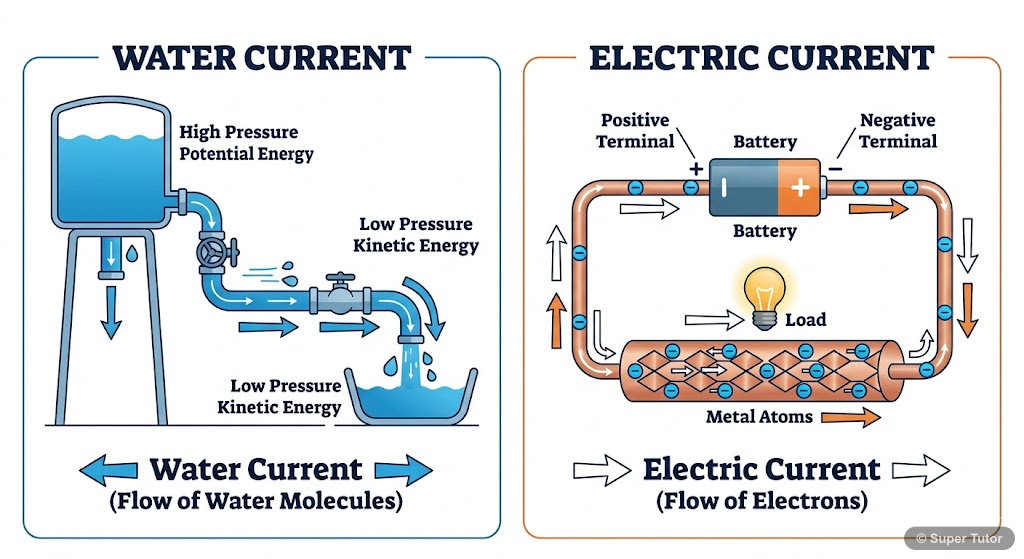
One of 19 illustrations for Electricity in Super Tutor — alongside flashcards, concept maps and practice questions.
The first 20 solutions are open to read. The other 20 are free with a Super Tutor account.
Questions
1What does an electric circuit mean?Show solution
An electric circuit means a continuous and closed path for the flow of electric charges (current). If the path is broken anywhere, current stops flowing.
2Define the unit of current.Show solution
The SI unit of electric current is ampere (A). 1 ampere is the current when 1 coulomb of charge flows in 1 second; that is, .
3Calculate the number of electrons constituting one coulomb of charge.Show solution
Since 1 coulomb is equivalent to the charge contained in nearly electrons, the number of electrons constituting 1 C of charge is about that value.
Questions
1Name a device that helps to maintain a potential difference across a conductor.Show solution
A battery (or a cell) produces and maintains the potential difference across a conductor, which sets charges in motion.
2What is meant by saying that the potential difference between two points is 1 V?Show solution
Potential difference is . So if the potential difference between two points is 1 V, then 1 J of work is required to move 1 C of charge from one point to the other.
3How much energy is given to each coulomb of charge passing through a 6 V battery?Show solution
A potential difference of 6 V means 6 J of energy is given to each 1 C of charge, because . So energy per coulomb = 6 J.
Questions
1On what factors does the resistance of a conductor depend?Show solution
The resistance of a conductor depends on:
- its length,
- its area of cross-section,
- the nature of its material.
The chapter also states that resistance and resistivity vary with temperature.
2Will current flow more easily through a thick wire or a thin wire of the same material, when connected to the same source? Why?Show solution
Current flows more easily through a thick wire of the same material. A thicker wire has a larger area of cross-section, so its resistance is less. Since , the thicker wire offers less opposition to current.
3Let the resistance of an electrical component remains constant while the potential difference across the two ends of the component decreases to half of its former value. What change will occur in the current through it?Show solution
By Ohm's law, . If resistance remains constant and the potential difference is halved, the current also becomes half of its former value.
4Why are coils of electric toasters and electric irons made of an alloy rather than a pure metal?Show solution
Coils of electric toasters and irons are made of an alloy rather than a pure metal because alloys:
- have higher resistivity,
- can withstand high temperatures without oxidising/burning readily,
- are suitable for producing heat efficiently.
5Use the data in Table 11.2 to answer the following -Show solution
From Table 11.2:
- Iron has resistivity
- Mercury has resistivity
A lower resistivity means a better conductor. So:
- Iron is the better conductor among the two.
- The best conductor in the table is silver because it has the lowest resistivity ().
Questions
1Draw a schematic diagram of a circuit consisting of a battery of three cells of 2 V each, a 5 resistor, an 8 resistor, and a 12 resistor, and a plug key, all connected in series.Show solution
The circuit should have the three cells in series with the 5 Ω, 8 Ω, and 12 Ω resistors also in series, along with a plug key in the same path.
A schematic form is:
Battery of 3 cells (2 V each) → key → 5 Ω resistor → 8 Ω resistor → 12 Ω resistor → back to battery
All components are connected end to end in one loop.
2Redraw the circuit of Question 1, putting in an ammeter to measure the current through the resistors and a voltmeter to measure the potential difference across the 12 resistor. What would be the readings in the ammeter and the voltmeter?Show solution
First find the total resistance in series:
The battery has three cells of 2 V each, so total voltage:
Current in the circuit:
So the ammeter reading is 0.24 A.
Potential difference across the 12 Ω resistor:
So the voltmeter reading is 2.88 V.
Questions
1Judge the equivalent resistance when the following are connected in parallel – (a) 1 Ω and 10⁶ Ω, (b) 1 Ω and 10³ Ω, and 10⁶ Ω.Show solution
For resistors in parallel, equivalent resistance is always less than the smallest resistance.
(a) and
Since one resistor is very large, the equivalent resistance is almost .
(b) , , and
Again, the 1 Ω resistor dominates, so the equivalent resistance is slightly less than 1 Ω, but approximately 1 Ω.
2An electric lamp of 100 Ω, a toaster of resistance 50 Ω, and a water filter of resistance 500 Ω are connected in parallel to a 220 V source. What is the resistance of an electric iron connected to the same source that takes as much current as all three appliances, and what is the current through it?Show solution
In parallel, each appliance gets the same voltage, and currents add.
Current drawn by each appliance:
Total current:
If the iron takes the same current as all three together, then at 220 V:
So the electric iron has resistance 31.25 Ω and current 7.04 A.
3What are the advantages of connecting electrical devices in parallel with the battery instead of connecting them in series?Show solution
Advantages of parallel connection:
- Each device gets the same potential difference as the battery.
- Devices can be operated independently.
- If one device fails, the others continue working.
- The current is divided according to the resistance of each device, so each gadget can take the current it needs.
4How can three resistors of resistances 2 Ω, 3 Ω, and 6 Ω be connected to give a total resistance of (a) 4 Ω, (b) 1 Ω?Show solution
We need to use 2 Ω, 3 Ω, and 6 Ω resistors.
(a) Total resistance 4 Ω
Connect 3 Ω and 6 Ω in parallel:
Then connect this 2 Ω in series with the 2 Ω resistor:
(b) Total resistance 1 Ω
Connect all three in parallel:
5What is (a) the highest, (b) the lowest total resistance that can be secured by combinations of four coils of resistance 4 Ω, 8 Ω, 12 Ω, 24 Ω?Show solution
- The highest resistance is obtained when all resistors are connected in series:
- The lowest resistance is obtained when all are connected in parallel:
So,
Therefore, the answers are 48 Ω and 2 Ω.
Questions
1Why does the cord of an electric heater not glow while the heating element does?Show solution
The cord does not glow because it has very low resistance and is made thicker so that it does not get heated much. The heating element has high resistance and therefore produces a large amount of heat when current flows through it.
2Compute the heat generated while transferring 96000 coulomb of charge in one hour through a potential difference of 50 V.Show solution
Use Joule’s law:
Given and ,
So the heat generated is J.
Free with a Super Tutor account
Questions
Free with a Super Tutor account
Free with a Super Tutor account
Exercises
Free with a Super Tutor account
Free with a Super Tutor account
Free with a Super Tutor account
Free with a Super Tutor account
Free with a Super Tutor account
Free with a Super Tutor account
Free with a Super Tutor account
Free with a Super Tutor account
Free with a Super Tutor account
Free with a Super Tutor account
Free with a Super Tutor account
Free with a Super Tutor account
Free with a Super Tutor account
Free with a Super Tutor account
Free with a Super Tutor account
Free with a Super Tutor account
Free with a Super Tutor account
20 more solved questions in Electricity
They are free with a Super Tutor account, along with practice quizzes and flashcards for this chapter. Free to start, no card needed.
Frequently Asked Questions
What are the important topics in Electricity for Madhya Pradesh Board Class 10 Science?
Are these NCERT Solutions for Electricity free?
How should I revise Electricity for the Madhya Pradesh Board Class 10 board exam?
Sources & Official References
Content is aligned to the official syllabus. Refer to the board website for the latest curriculum.
More resources for Electricity
Practice Quiz
Test yourself with a quick quiz
Important Questions
Exam-style questions with answers
Revision Notes
Key points for last-minute revision
Formula Sheet
The chapter's formulas in one place
Chapter Summary
Understand the chapter at a glance
Concept Maps
See how topics connect
Study Plan
Step-by-step plan for this chapter
Flashcards
Quick-fire cards for active recall
Syllabus
What topics to cover
For serious students
Get the full Electricity chapter — start free.
Quizzes, flashcards, an AI doubt solver and a study plan for Madhya Pradesh Board Class 10 Science. Free to start, no card needed.