Metals and Non-metals — Revision Notes
Madhya Pradesh Board · Class 10 · Science
Metals and Non-metals revision notes for Madhya Pradesh Board Class 10 Science: 4 topics in quick points. Includes Physical Properties of Metals, Chemical.
Interactive on Super Tutor
Studying Metals and Non-metals? Get the full interactive chapter.
Quizzes, flashcards, AI doubt-solver and a step-by-step study plan — built for revision notes and more.
Free trial, no card needed.
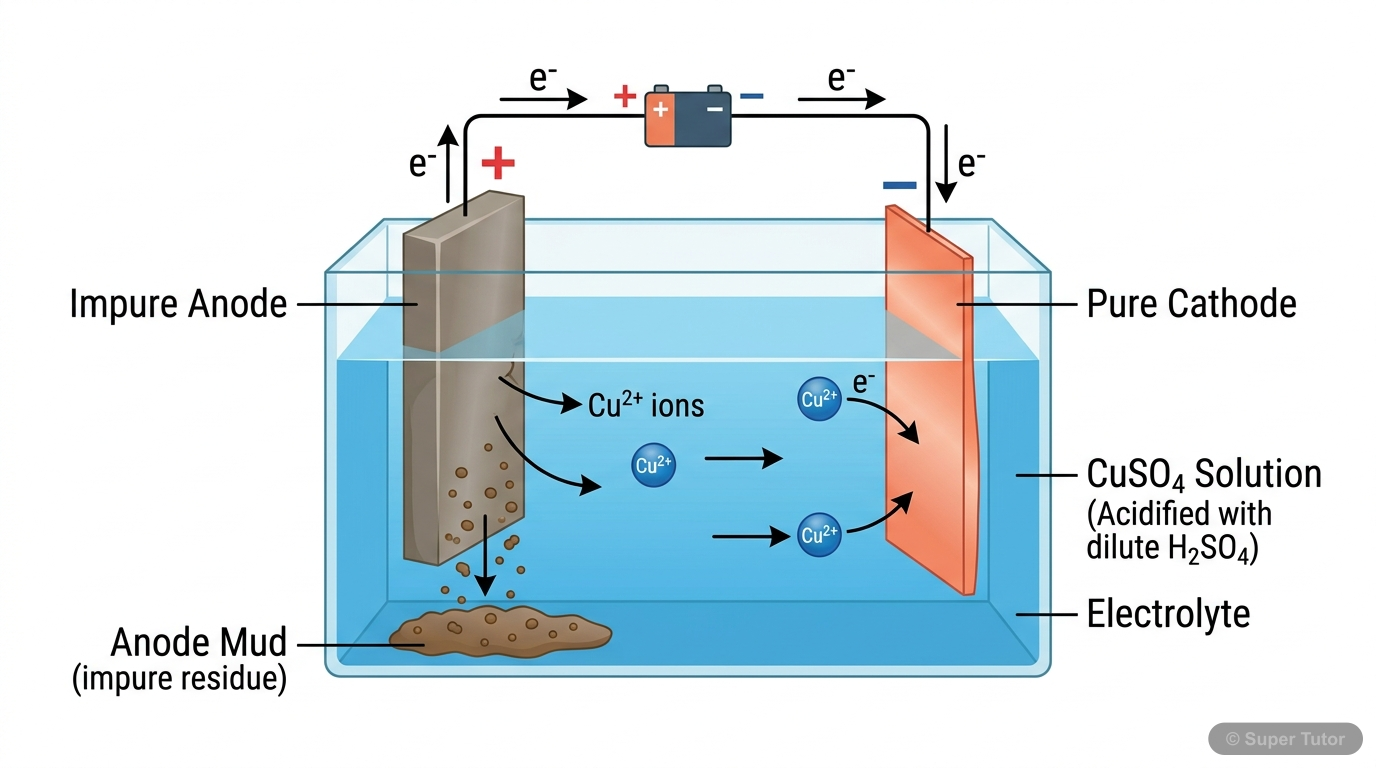
Learn better with visuals Super Tutor pairs illustrations like this with notes and quizzes for Metals and Non-metals.
Key Topics to Revise
1. Physical Properties of Metals and Non-metals
- Metals, in their pure state, have a shining surface. This property is called metallic lustre.
- Metals are generally hard, but hardness varies from metal to metal.
- Alkali metals such as sodium and potassium are so soft that they can be cut with a knife.
2. Chemical Properties of Metals
- Metals combine with oxygen to form metal oxides.
- General metal-oxygen reaction: Metal + Oxygen → Metal oxide.
- Most metal oxides are basic in nature.
3. Ionic Compounds and Their Properties
- When a metal transfers electrons to a non-metal, ionic compounds are formed.
- Sodium forms Na+ by losing one electron.
- Magnesium forms Mg2+ by losing two electrons.
4. Occurrence, Extraction, Refining, and Corrosion
- The earth's crust is the major source of metals.
- Elements or compounds occurring naturally in the earth's crust are called minerals.
- Minerals from which metal can be profitably extracted are called ores.
Get complete notes with diagrams and examples
Full NotesKey Concepts
Frequently Asked Questions
What are the important topics in Metals and Non-metals for Madhya Pradesh Board Class 10 Science?
How should I revise Metals and Non-metals for the Madhya Pradesh Board Class 10 board exam?
Sources & Official References
Content is aligned to the official syllabus. Refer to the board website for the latest curriculum.
More resources for Metals and Non-metals
Practice Quiz
Test yourself with a quick quiz
Important Questions
Exam-style questions with answers
Formula Sheet
The chapter's formulas in one place
Chapter Summary
Understand the chapter at a glance
Concept Maps
See how topics connect
Study Plan
Step-by-step plan for this chapter
Flashcards
Quick-fire cards for active recall
Syllabus
What topics to cover
NCERT Solutions
Every textbook question solved step by step
For serious students
Get the full Metals and Non-metals chapter — start free.
Quizzes, flashcards, an AI doubt solver and a study plan for Madhya Pradesh Board Class 10 Science. Free to start, no card needed.