Metals and Non-metals — NCERT Solutions
Madhya Pradesh Board · Class 10 · Science
NCERT Solutions for Metals and Non-metals, Madhya Pradesh Board Class 10 Science: 30 textbook questions solved step by step.
Interactive on Super Tutor
Studying Metals and Non-metals? Get the full interactive chapter.
Quizzes, flashcards, AI doubt-solver and a step-by-step study plan — built for NCERT solutions and more.
Free trial, no card needed.
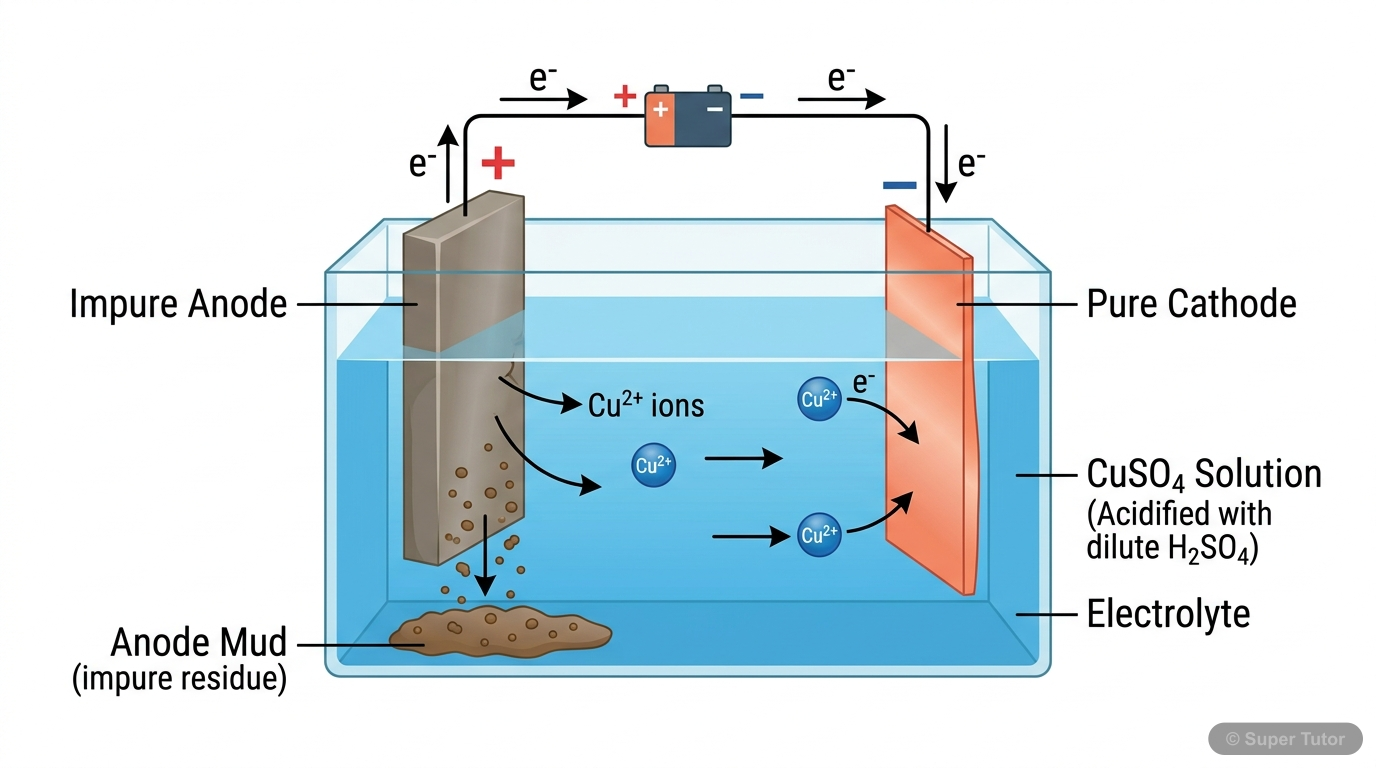
Learn better with visuals Super Tutor pairs illustrations like this with notes and quizzes for Metals and Non-metals.
The first 15 solutions are open to read. The other 15 are free with a Super Tutor account.
Questions
1Give an example of a metal which
(i) is a liquid at room temperature.
(ii) can be easily cut with a knife.
(iii) is the best conductor of heat.
(iv) is a poor conductor of heat.Show solution
From the chapter:
- Mercury is the only metal mentioned as liquid at room temperature.
- Sodium is so soft that it can be cut with a knife.
- The best conductors of heat are silver and copper; choosing one example, silver.
- Lead is mentioned as a poor conductor of heat.
2Explain the meanings of malleable and ductile.Show solution
Malleable means a substance, especially a metal, can be beaten into thin sheets.
Ductile means a substance can be drawn into thin wires.
Questions
1Why is sodium kept immersed in kerosene oil?Show solution
Sodium is kept immersed in kerosene oil because it reacts very vigorously with oxygen and water in air. Keeping it under kerosene prevents contact with air and moisture, so it does not catch fire accidentally.
2Write equations for the reactions of
(i) iron with steam
(ii) calcium and potassium with waterShow solution
(i) Iron with steam:
(ii) Calcium with water:
Potassium with water:
3Samples of four metals A, B, C and D were taken and added to the following solution one by one. The results obtained have been tabulated as follows.
| Metal | Iron(II) sulphate | Copper(II) sulphate | Zinc sulphate | Silver nitrate |
|---|---|---|---|---|
| A | No reaction | Displacement | | |
| B | Displacement | | No reaction | |
| C | No reaction | No reaction | No reaction | Displacement |
| D | No reaction | No reaction | No reaction | No reaction |
Use the Table above to answer the following questions about metals A, B, C and D.
(i) Which is the most reactive metal?
(ii) What would you observe if B is added to a solution of Copper(II) sulphate?
(iii) Arrange the metals A, B, C and D in the order of decreasing reactivity.Show solution
From the table:
- B displaces iron from iron(II) sulphate, so B is more reactive than iron.
- A displaces copper from copper(II) sulphate but does not react with iron(II) sulphate, so A is less reactive than iron but more reactive than copper.
- C displaces silver from silver nitrate but not iron, copper or zinc salts, so C is less reactive than copper but more reactive than silver.
- D does not displace any metal, so it is the least reactive.
Therefore, the most reactive metal is B and the decreasing order is B > A > C > D.
If B is added to copper(II) sulphate, it will displace copper from the solution.
4Which gas is produced when dilute hydrochloric acid is added to a reactive metal? Write the chemical reaction when iron reacts with dilute H₂SO₄.Show solution
When a reactive metal reacts with dilute hydrochloric acid, hydrogen gas is produced.
For iron with dilute sulphuric acid:
5What would you observe when zinc is added to a solution of iron(II) sulphate? Write the chemical reaction that takes place.Show solution
Zinc does not react with iron(II) sulphate? No — zinc is more reactive than iron, so it displaces iron from iron(II) sulphate.
Observation: the pale green solution of iron(II) sulphate changes, and iron gets deposited while zinc sulphate solution forms.
Reaction:
Questions
1(i) Write the electron-dot structures for sodium, oxygen and magnesium.
(ii) Show the formation of Na₂O and MgO by the transfer of electrons.
(iii) What are the ions present in these compounds?Show solution
(i) Electron-dot structures:
- Sodium: Na·
- Oxygen: :O: with 6 valence electrons
- Magnesium: Mg··
(ii) Formation by transfer of electrons:
- Sodium loses 1 electron each to two oxygen-related atoms in forming sodium oxide.
- Magnesium loses 2 electrons to oxygen.
For Na₂O:
- Two sodium atoms each lose one electron.
- Oxygen gains two electrons.
- So the ions formed are 2Na⁺ and O²⁻.
For MgO:
- Magnesium loses two electrons.
- Oxygen gains two electrons.
- So the ions formed are Mg²⁺ and O²⁻.
(iii) Ions present:
- In Na₂O: Na⁺ and O²⁻
- In MgO: Mg²⁺ and O²⁻
2Why do ionic compounds have high melting points?Show solution
Ionic compounds have high melting points because there is a strong electrostatic force of attraction between the oppositely charged ions. A large amount of energy is needed to overcome these forces and separate the ions.
Questions
1Define the following terms.
(i) Mineral (ii) Ore (iii) GangueShow solution
From the chapter:
- Minerals are the elements or compounds that occur naturally in the earth's crust.
- Ores are those minerals from which a metal can be extracted profitably.
- Gangue means the unwanted impurities like soil and sand present with the ore.
2Name two metals which are found in nature in the free state.Show solution
The chapter says that gold and silver are found in the free state in nature. Copper is also mentioned, but the question asks for two metals, so gold and silver are correct examples.
3What chemical process is used for obtaining a metal from its oxide?Show solution
The chapter states that obtaining metals from their compounds is a reduction process. When a metal oxide is converted into a metal, the oxygen is removed, so the process is reduction.
Questions
1Metallic oxides of zinc, magnesium and copper were heated with the following metals.
| Metal | Zinc | Magnesium | Copper |
|---|---|---|---|
| Zinc oxide | | | |
| Magnesium oxide | | | |
| Copper oxide | | | |
In which cases will you find displacement reactions taking place?Show solution
A more reactive metal displaces a less reactive metal from its oxide. From the reactivity order Mg > Zn > Cu:
- Mg can displace Zn from zinc oxide.
- Mg can displace Cu from copper oxide.
- Zn can displace Cu from copper oxide.
- No displacement occurs where the added metal is less reactive than the metal in the oxide.
So displacement reactions occur in:
- ZnO + Mg
- CuO + Zn
- CuO + Mg
2Which metals do not corrode easily?Show solution
The chapter says that silver and gold do not react with oxygen even at high temperatures, and metals like gold, silver, platinum and copper are found in the free state because the least reactive ones are not easily corroded. The commonly expected answer is gold and platinum.
Exercises
1Which of the following pairs will give displacement reactions?Show solution
A displacement reaction occurs when a more reactive metal displaces a less reactive metal from its salt solution.
From the reactivity series, copper is more reactive than silver, so copper can displace silver from AgNO₃.
- (a) Copper cannot displace sodium from NaCl.
- (b) Aluminium is more reactive than zinc, so it can displace zinc from MgCl₂? No, magnesium is not in the pair; aluminium cannot displace magnesium.
- (c) Silver is less reactive than iron, so no reaction.
- (d) Copper displaces silver from AgNO₃.
Thus, the correct pair is AgNO₃ solution and copper metal.
Free with a Super Tutor account
Free with a Super Tutor account
Free with a Super Tutor account
Free with a Super Tutor account
Free with a Super Tutor account
Free with a Super Tutor account
Free with a Super Tutor account
(a) What will be the action of gas on
(i) dry litmus paper?
(ii) moist litmus paper?
(b) Write a balanced chemical equation for the reaction taking place.
Free with a Super Tutor account
Free with a Super Tutor account
Free with a Super Tutor account
(a) Platinum, gold and silver are used to make jewellery.
(b) Sodium, potassium and lithium are stored under oil.
(c) Aluminium is a highly reactive metal, yet it is used to make utensils for cooking.
(d) Carbonate and sulphide ores are usually converted into oxides during the process of extraction.
Free with a Super Tutor account
Free with a Super Tutor account
Free with a Super Tutor account
Free with a Super Tutor account
Free with a Super Tutor account
15 more solved questions in Metals and Non-metals
They are free with a Super Tutor account, along with practice quizzes and flashcards for this chapter. Free to start, no card needed.
Frequently Asked Questions
What are the important topics in Metals and Non-metals for Madhya Pradesh Board Class 10 Science?
Are these NCERT Solutions for Metals and Non-metals free?
How should I revise Metals and Non-metals for the Madhya Pradesh Board Class 10 board exam?
Sources & Official References
Content is aligned to the official syllabus. Refer to the board website for the latest curriculum.
More resources for Metals and Non-metals
Practice Quiz
Test yourself with a quick quiz
Important Questions
Exam-style questions with answers
Revision Notes
Key points for last-minute revision
Formula Sheet
The chapter's formulas in one place
Chapter Summary
Understand the chapter at a glance
Concept Maps
See how topics connect
Study Plan
Step-by-step plan for this chapter
Flashcards
Quick-fire cards for active recall
Syllabus
What topics to cover
For serious students
Get the full Metals and Non-metals chapter — start free.
Quizzes, flashcards, an AI doubt solver and a study plan for Madhya Pradesh Board Class 10 Science. Free to start, no card needed.