Gender, Religion and Caste — Chapter Summary
Madhya Pradesh Board · Class 10 · Social Science
Summary of Gender, Religion and Caste for Madhya Pradesh Board Class 10 Social Science. Part of the Madhya Pradesh Board Class 10 Social Science syllabus.
Interactive on Super Tutor
Studying Gender, Religion and Caste? Get the full interactive chapter.
Quizzes, flashcards, AI doubt-solver and a step-by-step study plan — built for chapter summary and more.
Free trial, no card needed.
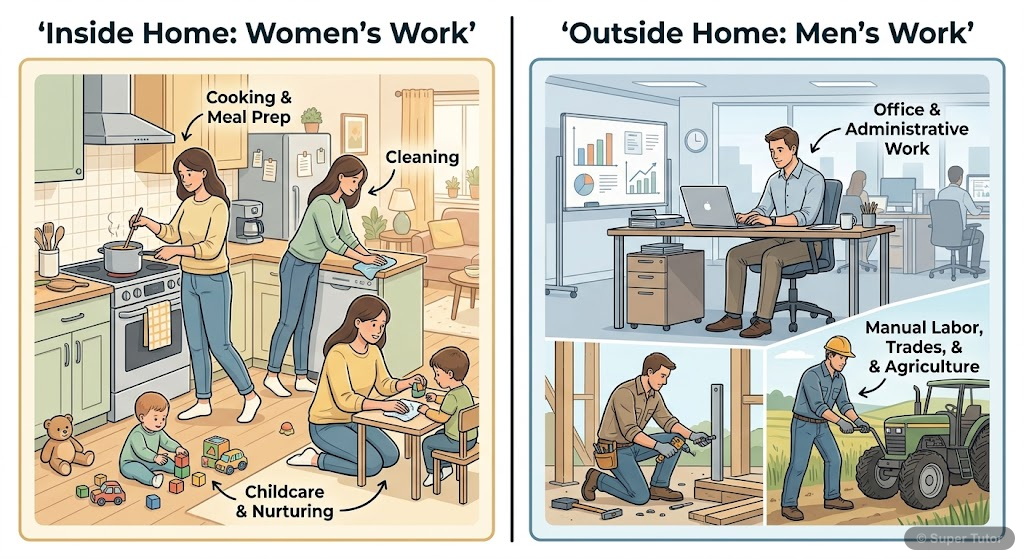
One of 10 illustrations for Gender, Religion and Caste in Super Tutor — alongside flashcards, concept maps and practice questions.
Overview
Social divisions based on gender, religion and caste shape democracy in different ways. Gender division is universal, religious division is widespread, and caste division is special to India. Some expressions of these divisions support equality and representation, while others create discrimination,
Key Concepts
Gender division is a form
Gender division is a form of social division seen everywhere. It is not based on biology but on social expectations and stereotypes. Boys and girls ar
Sexual division of labour means all
Sexual division of labour means all work inside the home is done by women or organised by them through domestic helpers, while men usually do work out
Patriarchy literally means rule by father
Patriarchy literally means rule by father. It is a system that values men more and gives them power over women.
A feminist is a woman
A feminist is a woman or a man who believes in equal rights and opportunities for women and men.
Family laws deal with marriage
Family laws deal with marriage, divorce, adoption and inheritance. Different family laws apply to followers of different religions.
Learning Objectives
- Understand gender division as a social division based on social expectations and stereotypes, not biology.
- Explain how domestic work, education and paid work reflect inequality between men and women.
- Recognise the political significance of women’s movements and women’s representation in law-making bodies.
- Understand the relation between religion and politics in a secular state.
- Distinguish between healthy religious expression and communalism.
Frequently Asked Questions
What are the important topics in Gender, Religion and Caste for Madhya Pradesh Board Class 10 Social Science?
How should I revise Gender, Religion and Caste for the Madhya Pradesh Board Class 10 board exam?
Sources & Official References
Content is aligned to the official syllabus. Refer to the board website for the latest curriculum.
More resources for Gender, Religion and Caste
Practice Quiz
Test yourself with a quick quiz
Important Questions
Exam-style questions with answers
Revision Notes
Key points for last-minute revision
Concept Maps
See how topics connect
Study Plan
Step-by-step plan for this chapter
Flashcards
Quick-fire cards for active recall
Syllabus
What topics to cover
NCERT Solutions
Every textbook question solved step by step
For serious students
Get the full Gender, Religion and Caste chapter — start free.
Quizzes, flashcards, an AI doubt solver and a study plan for Madhya Pradesh Board Class 10 Social Science. Free to start, no card needed.