Money and Credit — Chapter Summary
Madhya Pradesh Board · Class 10 · Social Science
Summary of Money and Credit for Madhya Pradesh Board Class 10 Social Science. Part of the Madhya Pradesh Board Class 10 Social Science syllabus.
Interactive on Super Tutor
Studying Money and Credit? Get the full interactive chapter.
Quizzes, flashcards, AI doubt-solver and a step-by-step study plan — built for chapter summary and more.
Free trial, no card needed.
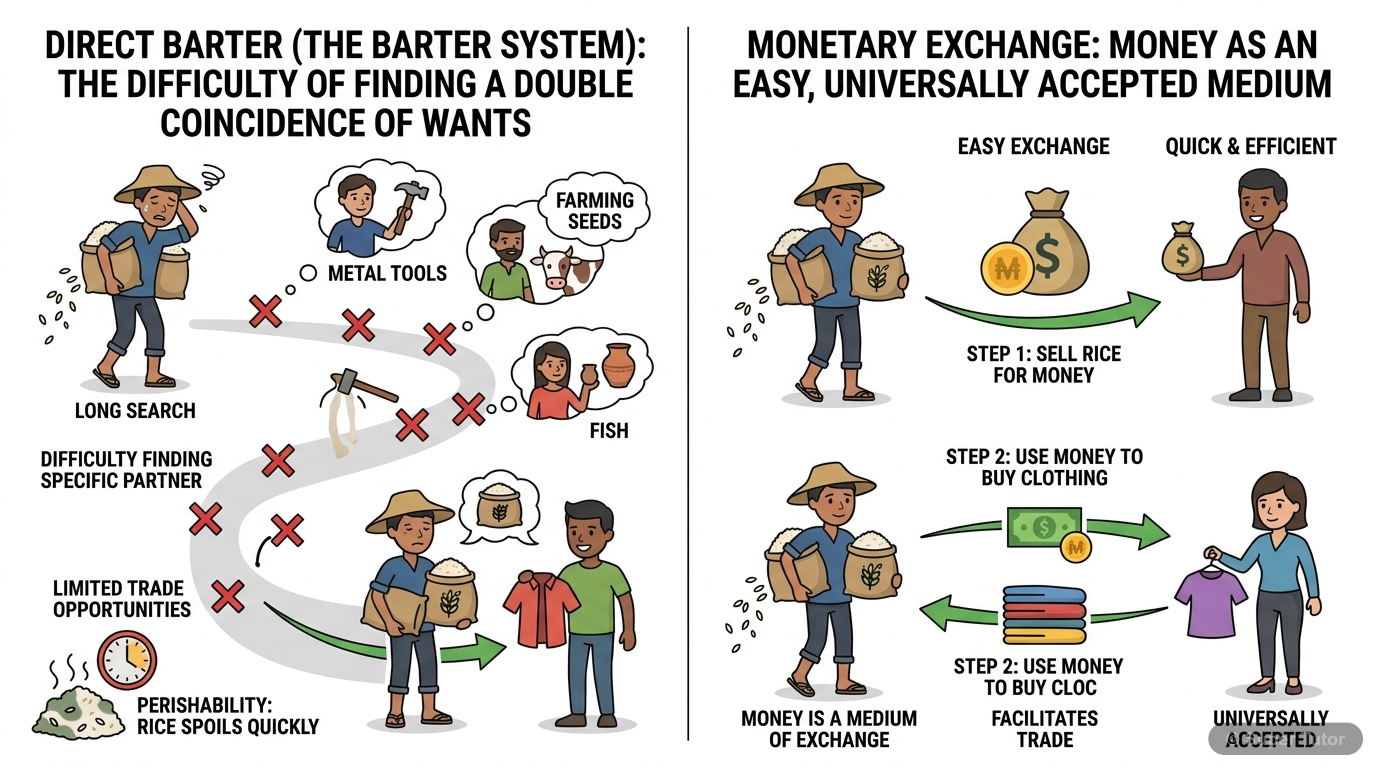
Learn better with visuals Super Tutor pairs illustrations like this with notes and quizzes for Money and Credit.
Overview
Money and credit are central to everyday economic life. Money makes exchange easier by acting as a medium of exchange, while credit helps people and businesses meet immediate needs and repay later. The chapter explains how modern money is linked to banks, how loans work, why terms of credit matter,
Key Concepts
In barter
In barter, goods are exchanged directly without money. This works only when both sides want what the other offers at the same time. This matching of w
Money is accepted in exchange
Money is accepted in exchange for goods and services, and then used to buy what is needed. It removes the need for direct matching of wants.
Grains and cattle were early forms
Grains and cattle were early forms of money. Gold, silver, and copper coins came later. Modern money includes currency notes, coins, and demand deposi
Currency notes and coins are modern
Currency notes and coins are modern money. The Reserve Bank of India issues currency notes on behalf of the central government. No individual in India
Money kept in bank accounts
Money kept in bank accounts that can be withdrawn on demand is called demand deposits. Cheques allow payments directly from one bank account to anothe
Learning Objectives
- Understand why money is used in exchange instead of barter.
- Identify early, metallic, and modern forms of money.
- Explain the role of the Reserve Bank of India in issuing currency.
- Describe demand deposits and cheque payments.
- Understand how banks use deposits to give loans.
Frequently Asked Questions
What are the important topics in Money and Credit for Madhya Pradesh Board Class 10 Social Science?
How should I revise Money and Credit for the Madhya Pradesh Board Class 10 board exam?
Sources & Official References
Content is aligned to the official syllabus. Refer to the board website for the latest curriculum.
More resources for Money and Credit
Practice Quiz
Test yourself with a quick quiz
Important Questions
Exam-style questions with answers
Revision Notes
Key points for last-minute revision
Concept Maps
See how topics connect
Study Plan
Step-by-step plan for this chapter
Flashcards
Quick-fire cards for active recall
Syllabus
What topics to cover
NCERT Solutions
Every textbook question solved step by step
For serious students
Get the full Money and Credit chapter — start free.
Quizzes, flashcards, an AI doubt solver and a study plan for Madhya Pradesh Board Class 10 Social Science. Free to start, no card needed.