Gender, Religion and Caste — NCERT Solutions
Madhya Pradesh Board · Class 10 · Social Science
NCERT Solutions for Gender, Religion and Caste, Madhya Pradesh Board Class 10 Social Science: 12 textbook questions solved step by step.
Interactive on Super Tutor
Studying Gender, Religion and Caste? Get the full interactive chapter.
Quizzes, flashcards, AI doubt-solver and a step-by-step study plan — built for NCERT solutions and more.
Free trial, no card needed.
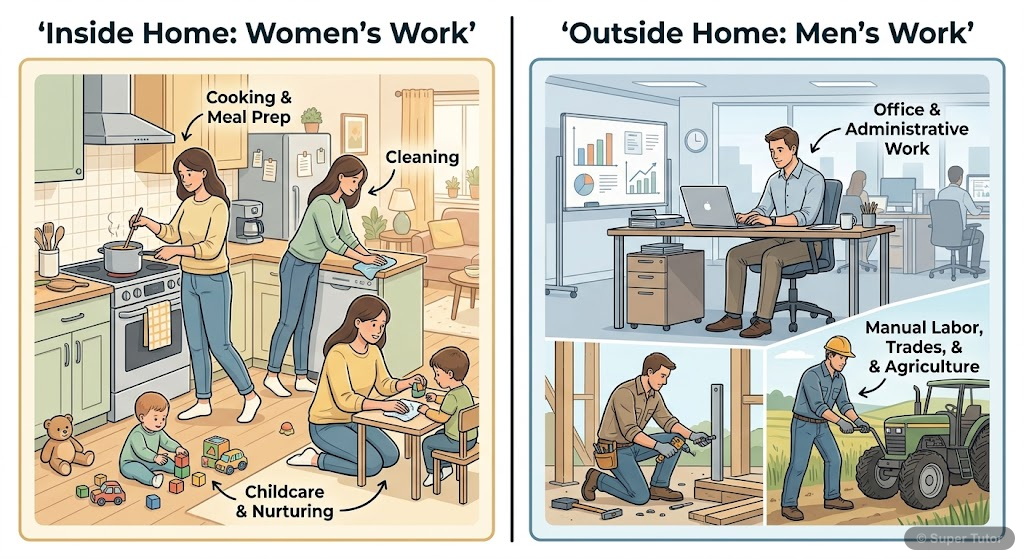
One of 10 illustrations for Gender, Religion and Caste in Super Tutor — alongside flashcards, concept maps and practice questions.
The first 6 solutions are open to read. The other 6 are free with a Super Tutor account.
Exercise Questions — Gender, Religion and Caste (Class 10 Political Science)
1Mention different aspects of life in which women are discriminated or disadvantaged in India.Show solution
Given/Context: The question asks about various areas where women face discrimination or disadvantage in India.
Answer:
Women in India face discrimination and disadvantage in the following aspects of life:
- Education: The literacy rate among women is significantly lower than that of men. Girls are often pulled out of school early due to social and economic reasons.
- Employment and Wages: Women constitute a much smaller proportion of the paid workforce. Even when they do work, they are paid less than men for the same work.
- Safety and Security: Women face various forms of violence — domestic violence, sexual harassment, and crimes against women are widespread.
- Sex Ratio: The child sex ratio (number of girls per 1000 boys) is declining due to sex-selective abortions and neglect of the girl child, reflecting a strong preference for sons.
- Property and Inheritance: Traditionally, women have had limited rights over ancestral property, though legal provisions now exist.
- Political Representation: Women are severely under-represented in legislative bodies such as the Lok Sabha and State Assemblies.
- Household Work: A large share of domestic and care work (cooking, cleaning, raising children) is performed by women, but this work is not paid and is socially undervalued.
Conclusion: Despite constitutional guarantees of equality, women continue to face deep-rooted discrimination across social, economic, and political spheres in India.
2State different forms of communal politics with one example each.Show solution
Given/Context: The question asks about the various forms in which communalism manifests in politics.
Answer:
Communal politics takes the following forms:
- Expression of communal superiority in everyday beliefs: When people believe that their religion is superior to others and that followers of their religion form a separate political community.
Example: Propaganda that one religious community's interests must be protected over others.
- Communal political mobilisation: When religious identities, symbols, and emotions are used to appeal to voters during elections.
Example: Political parties appealing to a particular religious community for votes by promising to protect their religious interests.
- Communal violence, riots, and massacre: When communal thinking leads to conflict between communities.
Example: The communal riots that have occurred in various parts of India (e.g., the 1984 anti-Sikh riots or the 2002 Gujarat riots).
- Demand for a separate nation on religious lines (most extreme form): When a religious community demands a separate country.
Example: The demand for Pakistan based on the two-nation theory before 1947.
Conclusion: Communal politics is dangerous for democracy as it divides citizens on religious lines and threatens national unity.
3State how caste inequalities are still continuing in India.Show solution
Given/Context: The question asks about the persistence of caste-based inequalities in contemporary India.
Answer:
Despite constitutional provisions and social reform movements, caste inequalities continue in India in the following ways:
- Caste-based occupation: Even today, the caste system continues to influence the kind of work people do. Dalits and lower-caste communities are often forced into menial, low-paying, and degrading occupations.
- Economic inequality: Upper-caste groups tend to own more land and have better access to education and economic opportunities, while lower-caste groups remain economically disadvantaged.
- Untouchability: Although untouchability is constitutionally abolished, it is still practised in many rural areas. Dalits face discrimination in accessing public spaces, temples, water sources, etc.
- Inter-caste marriages: Social barriers against inter-caste marriages remain strong. Honour killings and social ostracism of couples who marry outside their caste are still reported.
- Educational and social discrimination: Students from lower castes often face discrimination in schools and colleges.
- Political mobilisation on caste lines: Caste identities are used to mobilise voters, reinforcing caste divisions.
Conclusion: While the Constitution guarantees equality, caste inequalities persist in social, economic, and political life in India.
4State two reasons to say that caste alone cannot determine election results in India.Show solution
Given/Context: The question asks why caste is not the sole determinant of electoral outcomes in India.
Answer:
The following two reasons explain why caste alone cannot determine election results in India:
- No single caste is a majority: No single caste group forms a majority of the voters in any constituency. To win an election, a party or candidate must build a coalition of different caste groups. Therefore, relying on only one caste is not sufficient to win.
- Voters have multiple identities and considerations: Voters do not vote purely on caste lines. They also consider the performance of the government, development issues, candidates' credibility, national issues, and party ideology. Many voters prioritise these factors over caste loyalty.
Additional point (if needed): The same caste group may be spread across different constituencies and may vote for different parties, showing that caste does not uniformly determine voting behaviour.
Conclusion: While caste plays a role in Indian elections, it is one of many factors, and caste alone cannot guarantee electoral victory.
5What is the status of women's representation in India's legislative bodies?Show solution
Given/Context: The question asks about how well women are represented in India's Parliament and State Assemblies.
Answer:
The status of women's representation in India's legislative bodies is quite poor and inadequate:
- Lok Sabha: Women's representation in the Lok Sabha has historically been very low — generally around 10–12% of the total members. This is far below their share of the population (approximately 50%).
- State Legislative Assemblies: The proportion of women in State Assemblies is even lower than in the Lok Sabha, averaging around 5–8% in most states.
- Comparison with other countries: India's women's representation in Parliament is much lower compared to countries like Sweden, Norway, and even neighbouring Bangladesh.
- Panchayati Raj bodies: One-third (33%) of seats in local self-government bodies (Panchayats and Municipalities) are reserved for women. Some states like Bihar have increased this to 50%.
- Women's Reservation Bill: A demand for reserving one-third seats for women in the Lok Sabha and State Assemblies has been pending for many years. The Constitution (106th Amendment) Act, 2023 has now provided for 33% reservation for women in Parliament and State Assemblies, though its implementation is linked to the next delimitation exercise.
Conclusion: Women remain significantly under-represented in India's higher legislative bodies, though local government bodies show better representation due to reservations.
6Mention any two constitutional provisions that make India a secular state.Show solution
Given/Context: The question asks about constitutional provisions that establish India's secular character.
Answer:
The following two constitutional provisions make India a secular state:
- No official religion: The Indian Constitution does not give any special status or recognition to any religion as the 'state religion'. The state treats all religions equally and does not favour or discriminate against any religion.
- Freedom of religion (Articles 25–28): The Constitution provides every citizen the freedom to profess, practise, and propagate any religion of their choice. The state cannot compel any person to follow a particular religion.
Additional provisions (for reference):
- Article 15 prohibits discrimination on the grounds of religion.
- Article 14 guarantees equality before law to all persons irrespective of religion.
Conclusion: These provisions ensure that the Indian state maintains a principled distance from all religions and guarantees religious freedom to all citizens, making India a secular democratic republic.
(a) Biological difference between men and women
(b) Unequal roles assigned by the society to men and women
(c) Unequal child sex ratio
(d) Absence of voting rights for women in democracies
Free with a Super Tutor account
(a) Lok Sabha
(b) State legislative assemblies
(c) Cabinets
(d) Panchayati Raj bodies
Free with a Super Tutor account
A. One religion is superior to that of others.
B. People belonging to different religions can live together happily as equal citizens.
C. Followers of a particular religion constitute one community.
D. State power cannot be used to establish the domination of one religious group over others.
Which of the statements are correct?
(a) A, B, C, and D
(b) A, B, and D
(c) A and C
(d) B and D
Free with a Super Tutor account
(a) prohibits discrimination on grounds of religion.
(b) gives official status to one religion.
(c) provides to all individuals freedom to profess any religion.
(d) ensures equality of citizens within religious communities.
Free with a Super Tutor account
Free with a Super Tutor account
List I:
1. A person who believes in equal rights and opportunities for women and men
2. A person who says that religion is the principal basis of community
3. A person who thinks that caste is the principal basis of community
4. A person who does not discriminate others on the basis of religious beliefs
List II:
A. Communalist
B. Feminist
C. Secularist
D. Castiest
(a) 1-B, 2-C, 3-A, 4-D
(b) 1-B, 2-A, 3-D, 4-C
(c) 1-D, 2-C, 3-A, 4-B
(d) 1-C, 2-A, 3-B, 4-D
Free with a Super Tutor account
6 more solved questions in Gender, Religion and Caste
They are free with a Super Tutor account, along with practice quizzes and flashcards for this chapter. Free to start, no card needed.
Frequently Asked Questions
What are the important topics in Gender, Religion and Caste for Madhya Pradesh Board Class 10 Social Science?
Are these NCERT Solutions for Gender, Religion and Caste free?
How should I revise Gender, Religion and Caste for the Madhya Pradesh Board Class 10 board exam?
Sources & Official References
Content is aligned to the official syllabus. Refer to the board website for the latest curriculum.
More resources for Gender, Religion and Caste
Practice Quiz
Test yourself with a quick quiz
Important Questions
Exam-style questions with answers
Revision Notes
Key points for last-minute revision
Chapter Summary
Understand the chapter at a glance
Concept Maps
See how topics connect
Study Plan
Step-by-step plan for this chapter
Flashcards
Quick-fire cards for active recall
Syllabus
What topics to cover
For serious students
Get the full Gender, Religion and Caste chapter — start free.
Quizzes, flashcards, an AI doubt solver and a study plan for Madhya Pradesh Board Class 10 Social Science. Free to start, no card needed.