Power-sharing — Chapter Summary
Madhya Pradesh Board · Class 10 · Social Science
Summary of Power-sharing for Madhya Pradesh Board Class 10 Social Science. Part of the Madhya Pradesh Board Class 10 Social Science syllabus.
Interactive on Super Tutor
Studying Power-sharing? Get the full interactive chapter.
Quizzes, flashcards, AI doubt-solver and a step-by-step study plan — built for chapter summary and more.
Free trial, no card needed.
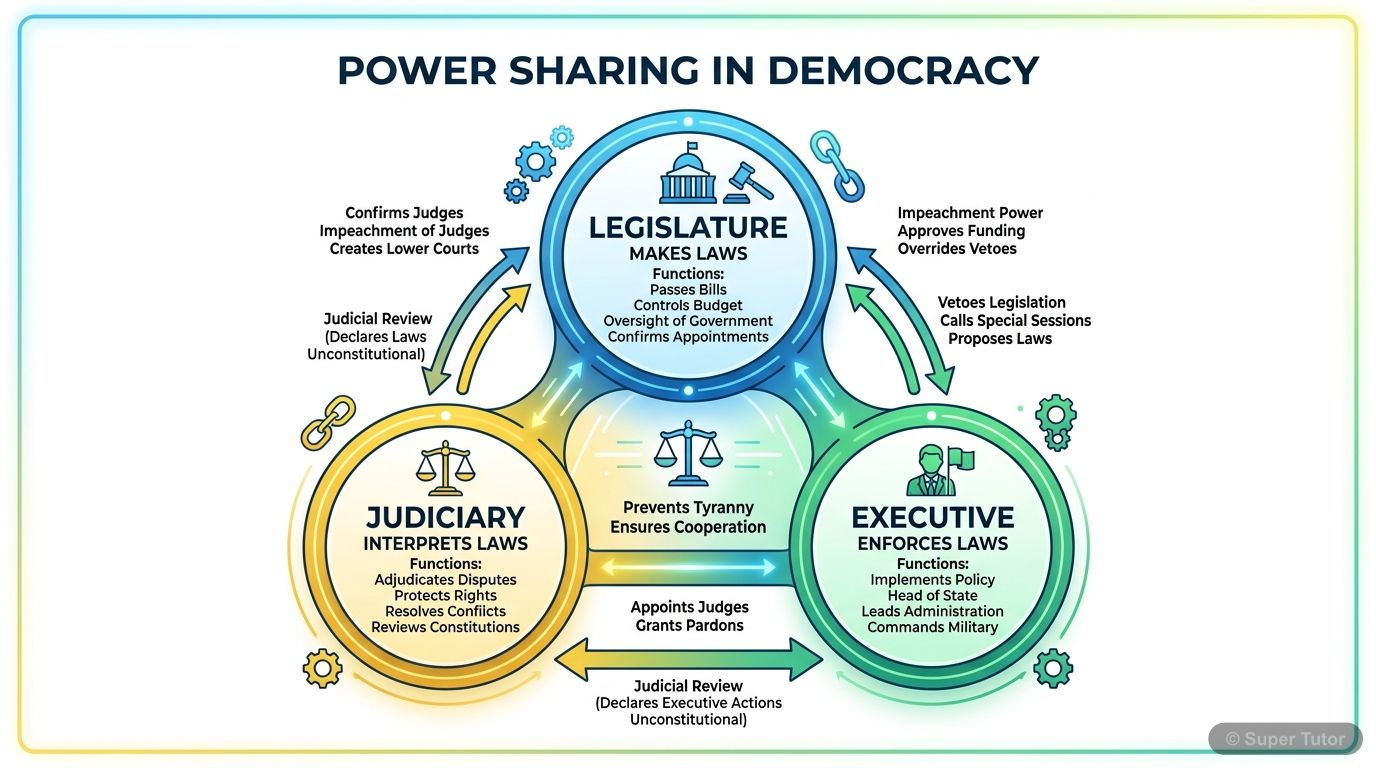
Learn better with visuals Super Tutor pairs illustrations like this with notes and quizzes for Power-sharing.
Overview
Power-sharing is a central idea in democracy. It means that political power is not kept in one hand, but is shared among different organs of government, different levels of government, different social groups, and different political parties or movements. The chapter explains why sharing power is im
Key Concepts
Majoritarianism is the belief that
Majoritarianism is the belief that the majority community should rule in any way it wants, without considering the wishes and needs of the minority. I
Accommodation means respecting different communities
Accommodation means respecting different communities and making political arrangements that allow them to live together with equal dignity. Belgium fo
Power is shared among the legislature
Power is shared among the legislature, executive, and judiciary, which function at the same level. Each organ checks the others so that no single orga
Power is shared among different levels
Power is shared among different levels of government, such as the Central Government and State Governments. In countries with such arrangements, the c
Power may be shared among religious
Power may be shared among religious, linguistic, or other social groups. Belgium’s community government is an example, where language communities get
Learning Objectives
- Understand why power-sharing is important in democracy.
- Compare the political choices made in Belgium and Sri Lanka.
- Identify the four broad forms of power-sharing.
- Distinguish between prudential reasons and moral reasons for power-sharing.
- Recognise how power-sharing helps maintain unity, peace, and stability.
Frequently Asked Questions
What are the important topics in Power-sharing for Madhya Pradesh Board Class 10 Social Science?
How should I revise Power-sharing for the Madhya Pradesh Board Class 10 board exam?
Sources & Official References
Content is aligned to the official syllabus. Refer to the board website for the latest curriculum.
More resources for Power-sharing
Practice Quiz
Test yourself with a quick quiz
Important Questions
Exam-style questions with answers
Revision Notes
Key points for last-minute revision
Concept Maps
See how topics connect
Study Plan
Step-by-step plan for this chapter
Flashcards
Quick-fire cards for active recall
Syllabus
What topics to cover
NCERT Solutions
Every textbook question solved step by step
For serious students
Get the full Power-sharing chapter — start free.
Quizzes, flashcards, an AI doubt solver and a study plan for Madhya Pradesh Board Class 10 Social Science. Free to start, no card needed.