Minerals and Energy Resources — Chapter Summary
Madhya Pradesh Board · Class 10 · Social Science
Summary of Minerals and Energy Resources for Madhya Pradesh Board Class 10 Social Science. Minerals are natural substances with a definite internal.
Interactive on Super Tutor
Studying Minerals and Energy Resources? Get the full interactive chapter.
Quizzes, flashcards, AI doubt-solver and a step-by-step study plan — built for chapter summary and more.
Free trial, no card needed.
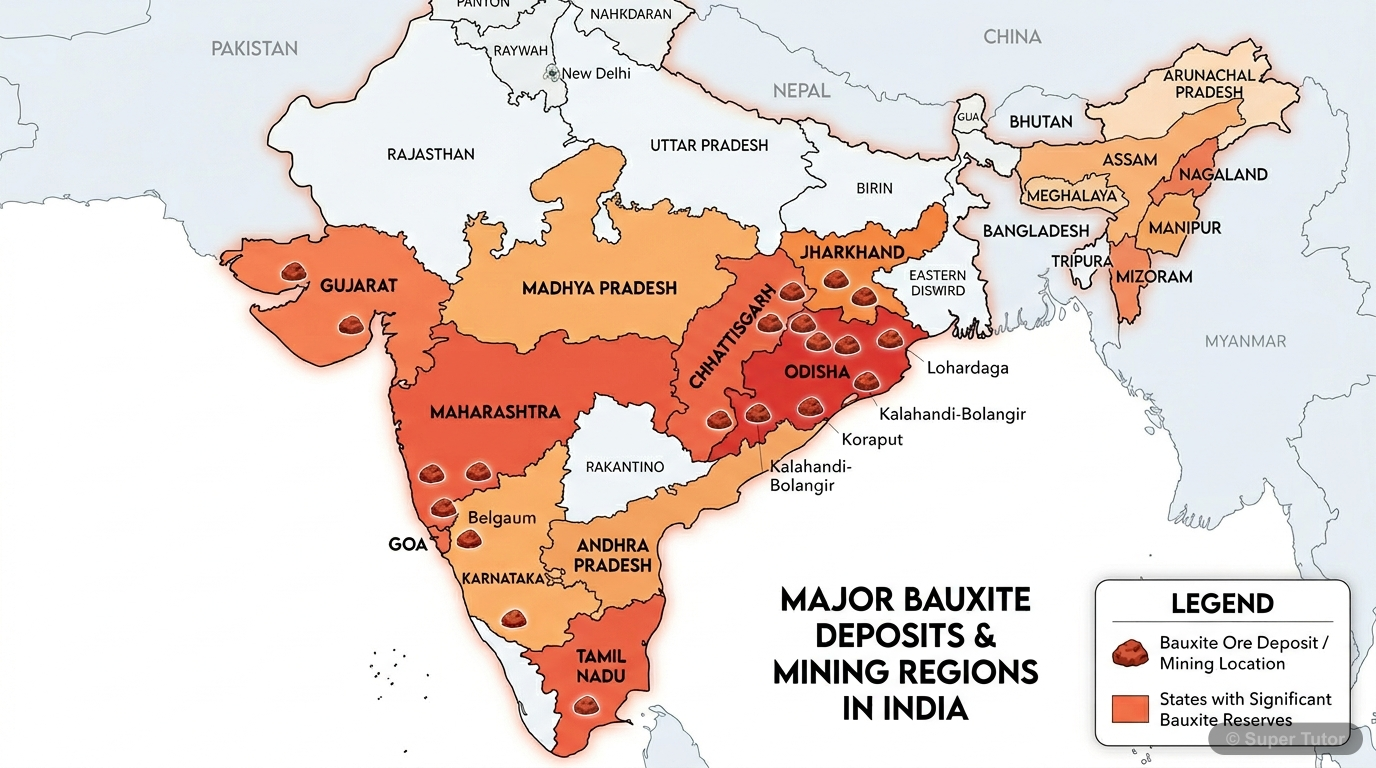
One of 33 illustrations for Minerals and Energy Resources in Super Tutor — alongside flashcards, concept maps and practice questions.
Overview
Minerals are natural substances with a definite internal structure, and they are essential for daily life, industry, transport, and agriculture. Earth’s crust contains more than 2000 identified minerals, but only a few are found abundantly in most rocks. Mineral resources are finite and non-renewabl
Key Concepts
A mineral is a homogenous
A mineral is a homogenous, naturally occurring substance with a definable internal structure. Minerals occur in different forms and properties because
Minerals occur in veins and lodes
Minerals occur in veins and lodes in igneous and metamorphic rocks, in beds or layers in sedimentary rocks, as residual deposits such as bauxite, as p
Ferrous minerals contain iron
Ferrous minerals contain iron. Magnetite is the finest iron ore with iron content up to 70 per cent, while hematite has 50–60 per cent iron content an
Major iron ore production comes mainly
Major iron ore production comes mainly from Odisha, Chhattisgarh, Karnataka, and Jharkhand. Important belts include Odisha-Jharkhand, Durg-Bastar-Chan
Copper
Copper, bauxite, lead, zinc, and gold are important non-ferrous minerals. Copper is used in electrical cables, electronics, and chemical industries. B
Learning Objectives
- Understand what minerals are and how they occur in nature.
- Identify the main ways minerals are formed and classified.
- Learn the major mineral regions of India and their important uses.
- Distinguish between ferrous and non-ferrous minerals.
- Recognise the major types of coal, petroleum, natural gas, electricity, and renewable energy sources.
Frequently Asked Questions
What are the important topics in Minerals and Energy Resources for Madhya Pradesh Board Class 10 Social Science?
How should I revise Minerals and Energy Resources for the Madhya Pradesh Board Class 10 board exam?
Sources & Official References
Content is aligned to the official syllabus. Refer to the board website for the latest curriculum.
More resources for Minerals and Energy Resources
Practice Quiz
Test yourself with a quick quiz
Important Questions
Exam-style questions with answers
Revision Notes
Key points for last-minute revision
Concept Maps
See how topics connect
Study Plan
Step-by-step plan for this chapter
Flashcards
Quick-fire cards for active recall
Syllabus
What topics to cover
NCERT Solutions
Every textbook question solved step by step
For serious students
Get the full Minerals and Energy Resources chapter — start free.
Quizzes, flashcards, an AI doubt solver and a study plan for Madhya Pradesh Board Class 10 Social Science. Free to start, no card needed.