Money and Credit — NCERT Solutions
Madhya Pradesh Board · Class 10 · Social Science
NCERT Solutions for Money and Credit, Madhya Pradesh Board Class 10 Social Science: 31 textbook questions solved step by step.
Interactive on Super Tutor
Studying Money and Credit? Get the full interactive chapter.
Quizzes, flashcards, AI doubt-solver and a step-by-step study plan — built for NCERT solutions and more.
Free trial, no card needed.
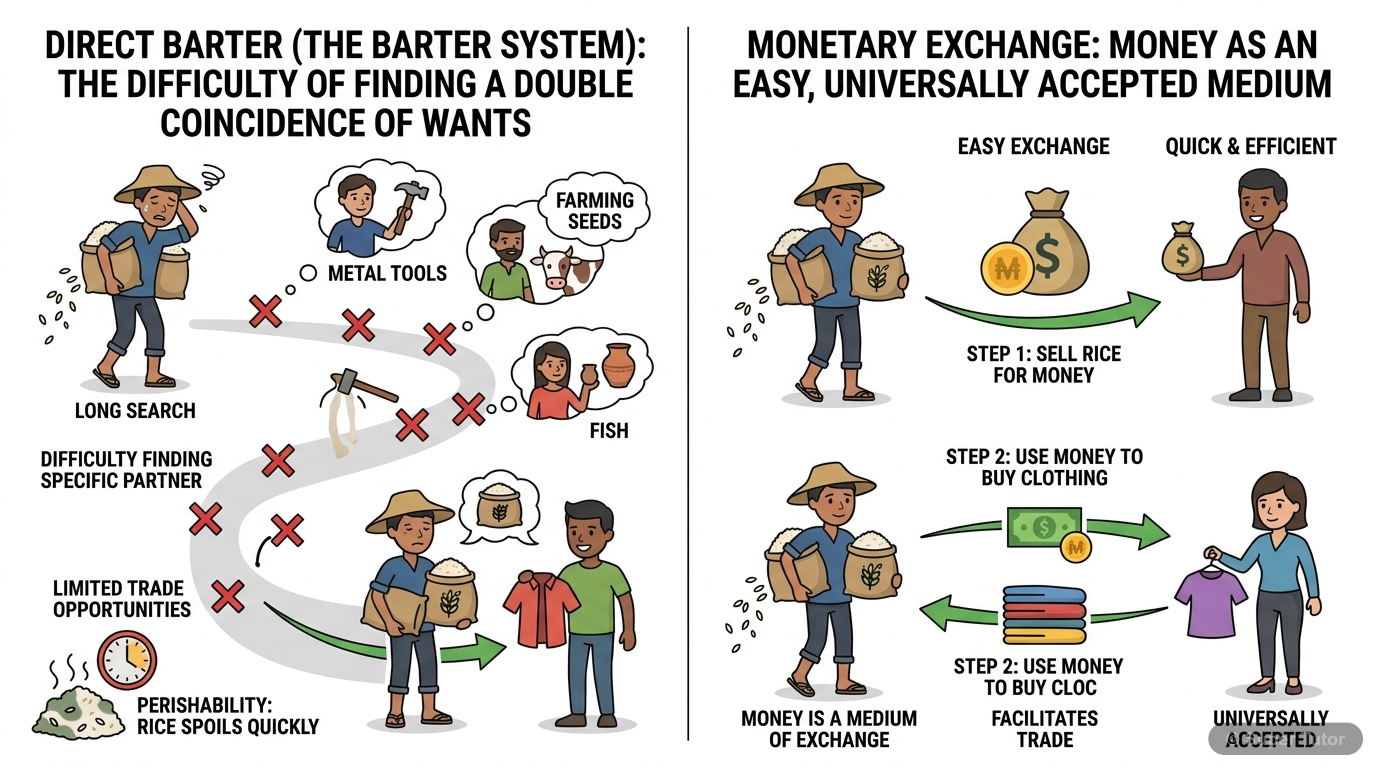
Learn better with visuals Super Tutor pairs illustrations like this with notes and quizzes for Money and Credit.
The first 16 solutions are open to read. The other 15 are free with a Super Tutor account.
Let's Work These Out
1How does the use of money make it easier to exchange things?Show solution
Money acts as a medium of exchange. So a person can sell goods for money first and then use that money to buy whatever they need, without needing to find someone who wants exactly what they offer in return.
2Can you think of some examples of goods / services being exchanged or wages being paid through barter?Show solution
Examples of barter from everyday life can include exchanging one good for another directly, such as grain for cattle, shoes for wheat, or working in return for food or services.
Let's Work These Out
1M. Salim wants to withdraw Rs 20,000 in cash for making payments. How would he write a cheque to withdraw money?Show solution
To withdraw cash, he would write a cheque in his own name or to self for Rs 20,000 and present it to the bank. The bank would then pay him that amount in cash from his account.
2Tick the correct answer.
After the transaction between Salim and Prem,Show solution
When Salim pays Prem by cheque, money is transferred from Salim's account to Prem's account. So Salim's balance decreases and Prem's balance increases.
3Why are demand deposits considered as money?Show solution
Demand deposits are considered money because they can be withdrawn on demand and can also be used for payment through cheques. Since they are accepted widely as a means of payment, they share the essential features of money.
Let's Work These Out
2Supposing Salim continues to get orders from traders. What would be his position after 6 years?Show solution
If Salim keeps getting orders, he will keep borrowing for production, complete his orders, earn profits, and be in a stronger position. Over time, he would likely become better off, with higher income and possibly an expanding business.
3What are the reasons that make Swapna's situation so risky? Discuss factors – pesticides; role of moneylenders; climate.Show solution
Swapna's situation is risky because:
- Pesticides may not work if the crop is badly affected, so the crop can still fail.
- The moneylender charges high interest, so the debt grows quickly.
- Climate and other natural factors can cause crop failure, and farming income depends on the harvest.
Because repayment depends on the crop, any failure can push her into a debt trap.
Let's Work These Out
1Why do lenders ask for collateral while lending?Show solution
Lenders ask for collateral as a guarantee that the loan will be repaid. If the borrower fails to repay, the lender can sell the collateral and recover the money.
2Given that a large number of people in our country are poor, does it in any way affect their capacity to borrow?Show solution
Yes. Since many poor people do not have collateral or proper documents, they find it difficult to get bank loans. So poverty reduces their capacity to borrow from formal sources, and they often depend on informal lenders.
3Fill in the blanks choosing the correct option from the brackets.
While taking a loan, borrowers look for easy terms of credit. This means _________ (low/high) interest rate, _________ (easy/tough) conditions for repayment, _________ (less/more) collateral and documentation requirements.Show solution
Easy terms of credit mean a low interest rate, easy conditions for repayment, and less collateral and documentation requirements.
Let's Work These Out
2Underline the various uses of credit in Sonpur in the above passages.Show solution
The uses of credit in Sonpur include:
- Cultivation / crop production
- Buying farm inputs such as seeds, fertilisers, pesticides, water, electricity, and repair of equipment
- Meeting daily expenses
- Paying for sudden illnesses
- Meeting family functions
- Buying agricultural implements
- Construction of houses
- Some loans are used for trade and other needs
3Compare the terms of credit for the small farmer, the medium farmer and the landless agricultural worker in Sonpur.Show solution
- Small farmer (Shyamal): borrowed from moneylender/trader at high interest; had to repay after harvest; terms were costly.
- Medium farmer (Arun): got a bank loan at a lower interest rate; repayment could be made anytime in the next three years; terms were easier.
- Landless agricultural worker (Rama): depended on the employer/landowner at 5% per month; repaid by working for him; terms were very harsh and she often had to take new loans.
So, the bank loan was cheapest, the trader/moneylender loan was costlier, and the employer's loan was also expensive and exploitative.
4Why will Arun have a higher income from cultivation compared to Shyamal?Show solution
Arun will have a higher income because he gets a bank loan at a lower interest rate and has enough land and resources to produce more. Shyamal borrows at a higher rate, so a larger part of his earnings goes into repayment.
5Can everyone in Sonpur get credit at a cheap rate? Who are the people who can?Show solution
No, everyone in Sonpur cannot get credit at a cheap rate. The people who can are mainly those who can access bank loans or cooperative loans, such as Arun and members of cooperatives. Poorer people like Rama depend on costly informal credit.
Let's Work These Out
2Why should credit at reasonable rates be available for all?Show solution
Credit at reasonable rates should be available for all because people need loans for farming, business, education, housing and emergencies. If credit is too costly or unavailable, poor people are pushed deeper into debt and development becomes unequal. Cheap credit helps increase income and supports development.
3Should there be a supervisor, such as the Reserve Bank of India, that looks into the loan activities of informal lenders? Why would its task be quite difficult?Show solution
In principle, there should be supervision because informal lenders can charge unfair interest and harass borrowers. But the task would be difficult because informal lending is spread out, often unrecorded, and involves personal, varied arrangements that are hard to monitor.
Free with a Super Tutor account
Exercises
Free with a Super Tutor account
Free with a Super Tutor account
Free with a Super Tutor account
Free with a Super Tutor account
Free with a Super Tutor account
Free with a Super Tutor account
Free with a Super Tutor account
Free with a Super Tutor account
Free with a Super Tutor account
Free with a Super Tutor account
(a) Why might banks be unwilling to lend to small farmers?
(b) What are the other sources from which the small farmers can borrow?
(c) Explain with an example how the terms of credit can be unfavourable for the small farmer.
(d) Suggest some ways by which small farmers can get cheap credit.
Free with a Super Tutor account
(i) Majority of the credit needs of the ____________ households are met from informal sources.
(ii) ____________ costs of borrowing increase the debt-burden.
(iii) ____________ issues currency notes on behalf of the Central Government.
(iv) Banks charge a higher interest rate on loans than what they offer on ____________.
(v) ____________ is an asset that the borrower owns and uses as a guarantee until the loan is repaid to the lender.
Free with a Super Tutor account
(i) In a SHG most of the decisions regarding savings and loan activities are taken by
(a) Bank.
(b) Members.
(c) Non-government organisation.
(ii) Formal sources of credit does not include
(a) Banks.
(b) Cooperatives.
(c) Employers.
Free with a Super Tutor account
Additional Project / Activity
Free with a Super Tutor account
15 more solved questions in Money and Credit
They are free with a Super Tutor account, along with practice quizzes and flashcards for this chapter. Free to start, no card needed.
Frequently Asked Questions
What are the important topics in Money and Credit for Madhya Pradesh Board Class 10 Social Science?
Are these NCERT Solutions for Money and Credit free?
How should I revise Money and Credit for the Madhya Pradesh Board Class 10 board exam?
Sources & Official References
Content is aligned to the official syllabus. Refer to the board website for the latest curriculum.
More resources for Money and Credit
Practice Quiz
Test yourself with a quick quiz
Important Questions
Exam-style questions with answers
Revision Notes
Key points for last-minute revision
Chapter Summary
Understand the chapter at a glance
Concept Maps
See how topics connect
Study Plan
Step-by-step plan for this chapter
Flashcards
Quick-fire cards for active recall
Syllabus
What topics to cover
For serious students
Get the full Money and Credit chapter — start free.
Quizzes, flashcards, an AI doubt solver and a study plan for Madhya Pradesh Board Class 10 Social Science. Free to start, no card needed.