Accounting Ratios — NCERT Solutions
Madhya Pradesh Board · Class 12 · Accountancy
NCERT Solutions for Accounting Ratios, Madhya Pradesh Board Class 12 Accountancy: 49 textbook questions solved step by step.
Interactive on Super Tutor
Studying Accounting Ratios? Get the full interactive chapter.
Quizzes, flashcards, AI doubt-solver and a step-by-step study plan — built for NCERT solutions and more.
Free trial, no card needed.
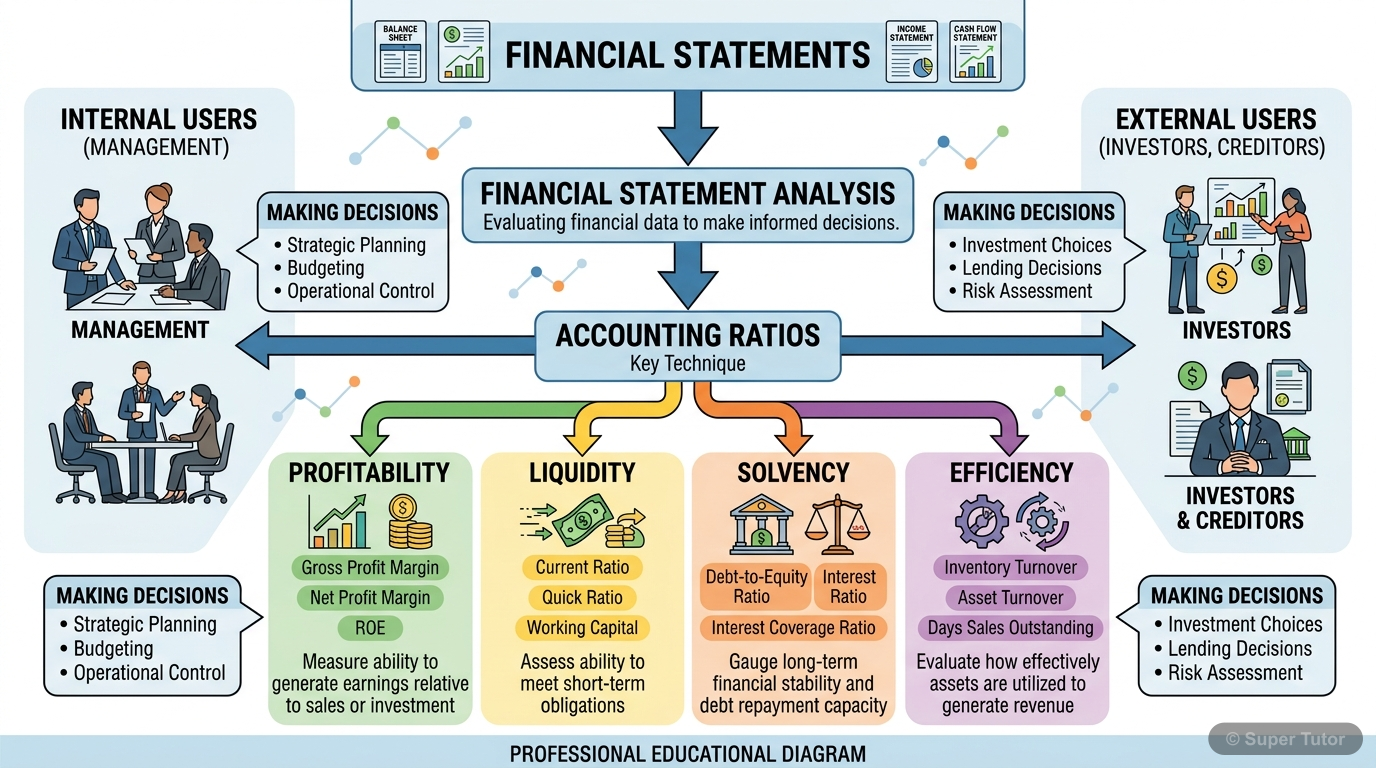
One of 15 illustrations for Accounting Ratios in Super Tutor — alongside flashcards, concept maps and practice questions.
The first 25 solutions are open to read. The other 24 are free with a Super Tutor account.
Test your Understanding – I
1State which of the following statements are True or False.
(a) The only purpose of financial reporting is to keep the managers informed about the progress of operations.
(b) Analysis of data provided in the financial statements is termed as financial analysis.
(c) Long-term borrowings are concerned about the ability of a firm to discharge its obligations to pay interest and repay the principal amount.
(d) A ratio is always expressed as a quotient of one number divided by another.
(e) Ratios help in comparisons of a firm's results over a number of accounting periods as well as with other business enterprises.
(f) A ratio reflects quantitative and qualitative aspects of results.Show solution
(a) False – Financial reporting serves multiple purposes: it informs managers, investors, creditors, government, and other stakeholders about the financial position and performance of the firm, not just managers.
(b) True – The process of examining and interpreting the data contained in financial statements is called financial analysis.
(c) True – Long-term lenders (providers of long-term borrowings) are primarily concerned with the firm's ability to meet interest obligations periodically and repay the principal at maturity.
(d) False – A ratio can be expressed as a quotient, a percentage, a rate (e.g., times), or a proportion. It is not always expressed only as a quotient.
(e) True – Ratio analysis facilitates both time-series comparison (over different periods for the same firm) and cross-sectional comparison (with other firms in the same industry).
(f) False – Ratios are computed from accounting figures and therefore reflect only quantitative aspects. They do not capture qualitative aspects such as management quality, employee morale, or brand value.
Test your Understanding – II
(i)The following groups of ratios are primarily measure risk:
A. liquidity, activity, and profitability
B. liquidity, activity, and inventory
C. liquidity, activity, and debt
D. liquidity, debt and profitabilityShow solution
Correct Answer: D – liquidity, debt and profitability
Liquidity ratios measure short-term risk (inability to meet current obligations), debt (solvency) ratios measure long-term financial risk, and profitability ratios measure the risk of inadequate returns. Together, these three groups primarily measure the various dimensions of risk faced by a firm.
(ii)The ______ ratios are primarily measures of return:
A. liquidity
B. activity
C. debt
D. profitabilityShow solution
Correct Answer: D – profitability
Profitability ratios such as Gross Profit Ratio, Net Profit Ratio, Return on Investment, and Return on Equity are specifically designed to measure the returns generated by the firm from its operations and resources.
(iii)The ______ of business firm is measured by its ability to satisfy its short-term obligations as they become due:
A. activity
B. liquidity
C. debt
D. profitabilityShow solution
Correct Answer: B – liquidity
Liquidity refers to the ability of a firm to meet its short-term obligations as and when they fall due. Liquidity ratios (Current Ratio and Quick/Liquid Ratio) are used to assess this ability.
(iv)______ ratios are a measure of the speed with which various accounts are converted into revenue from operations or cash:
A. activity
B. liquidity
C. debt
D. profitabilityShow solution
Correct Answer: A – activity
Activity ratios (also called turnover ratios) measure how efficiently a firm uses its assets. They indicate the speed at which assets like inventory, trade receivables, etc., are converted into revenue from operations or cash.
(v)The two basic measures of liquidity are:
A. inventory turnover and current ratio
B. current ratio and liquid ratio
C. gross profit margin and operating ratio
D. current ratio and average collection periodShow solution
Correct Answer: B – current ratio and liquid ratio
The two fundamental measures of a firm's short-term liquidity are:
- Current Ratio = Current Assets / Current Liabilities (measures overall short-term liquidity)
- Liquid (Quick) Ratio = Liquid Assets / Current Liabilities (measures immediate liquidity by excluding inventory)
(vi)The ______ is a measure of liquidity which excludes ______, generally the least liquid asset:
A. current ratio, trade receivable
B. liquid ratio, trade receivable
C. current ratio, inventory
D. liquid ratio, inventoryShow solution
Correct Answer: D – liquid ratio, inventory
The Liquid Ratio (also called Quick Ratio or Acid-Test Ratio) excludes inventory from current assets because inventory is generally the least liquid current asset — it must first be sold and then collected before it becomes cash.
Test your Understanding – III
(i)The ______ is useful in evaluating credit and collection policies.
A. average payment period
B. current ratio
C. average collection period
D. current asset turnoverShow solution
Correct Answer: C – average collection period
The average collection period measures the average number of days a firm takes to collect its trade receivables. It directly reflects the effectiveness of the firm's credit granting and collection policies.
(ii)The ______ measures the activity of a firm's inventory.
A. average collection period
B. inventory turnover
C. liquid ratio
D. current ratioShow solution
Correct Answer: B – inventory turnover
Inventory Turnover Ratio measures how many times a firm's inventory is sold and replaced over a period. It indicates the efficiency with which inventory is managed.
(iii)The ______ may indicate that the firm is experiencing stockouts and lost sales.
A. average payment period
B. inventory turnover ratio
C. average collection period
D. quick ratioShow solution
Correct Answer: B – inventory turnover ratio
A very high inventory turnover ratio may indicate that the firm is not maintaining adequate inventory levels, leading to stockouts (running out of stock) and consequently lost sales opportunities.
(iv)ABC Co. extends credit terms of 45 days to its customers. Its credit collection would be considered poor if its average collection period was:
A. 30 days
B. 36 days
C. 47 days
D. 37 daysShow solution
Correct Answer: C – 47 days
If the credit terms extended are 45 days, then an average collection period greater than 45 days indicates poor collection performance. Among the options, only 47 days exceeds the 45-day credit period, indicating that customers are taking longer than allowed to pay.
(v)______ are especially interested in the average payment period, since it provides them with a sense of the bill-paying patterns of the firm.
A. Customers
B. Stockholders
C. Lenders and suppliers
D. Borrowers and buyersShow solution
Correct Answer: C – Lenders and suppliers
The average payment period shows how long a firm takes to pay its creditors. Lenders and suppliers are most interested in this ratio because it tells them whether the firm pays its bills on time, which affects their decision to extend credit or loans to the firm.
(vi)The ______ ratios provide the information critical to the long run operation of the firm.
A. liquidity
B. activity
C. solvency
D. profitabilityShow solution
Correct Answer: C – solvency
Solvency ratios (Debt-Equity Ratio, Total Assets to Debt Ratio, Proprietary Ratio, Interest Coverage Ratio) assess the firm's ability to meet its long-term obligations. They provide information critical to the long-run survival and operation of the firm.
Do it Yourself – Liquidity Ratios
1Current liabilities of a company are Rs. 5,60,000, current ratio is 2.5:1 and quick ratio is 2:1. Find the value of the Inventories.Show solution
Given:
- Current Liabilities = Rs. 5,60,000
- Current Ratio = 2.5 : 1
- Quick Ratio = 2 : 1
Step 1: Find Current Assets
Step 2: Find Liquid (Quick) Assets
Step 3: Find Inventories
2Current ratio = 4.5:1, quick ratio = 3:1. Inventory is Rs. 36,000. Calculate the current assets and current liabilities.Show solution
Given:
- Current Ratio = 4.5 : 1
- Quick Ratio = 3 : 1
- Inventory = Rs. 36,000
Concept: Inventory = Current Assets − Liquid Assets
Step 1: Let Current Liabilities =
Then: Current Assets = and Liquid Assets =
Step 2:
Step 3:
3Current assets of a company are Rs. 5,00,000. Current ratio is 2.5:1 and Liquid ratio is 1:1. Calculate the value of current liabilities, liquid assets and inventories.Show solution
Given:
- Current Assets = Rs. 5,00,000
- Current Ratio = 2.5 : 1
- Liquid Ratio = 1 : 1
Step 1: Find Current Liabilities
Step 2: Find Liquid Assets
Step 3: Find Inventories
Do it Yourself – Inventory Turnover Ratio
1Calculate the amount of gross profit:
- Average inventory = Rs. 80,000
- Inventory turnover ratio = 6 times
- Selling price = 25% above costShow solution
Given:
- Average Inventory = Rs. 80,000
- Inventory Turnover Ratio = 6 times
- Selling Price = Cost + 25% of Cost = 125% of Cost
Step 1: Find Cost of Revenue from Operations
Step 2: Find Revenue from Operations
Since selling price is 25% above cost:
Step 3: Find Gross Profit
2Calculate Inventory Turnover Ratio:
- Annual Revenue from operations = Rs. 2,00,000
- Gross Profit = 20% on cost of Revenue from operations
- Inventory in the beginning = Rs. 38,500
- Inventory at the end = Rs. 41,500Show solution
Given:
- Revenue from Operations = Rs. 2,00,000
- Gross Profit = 20% on Cost
- Opening Inventory = Rs. 38,500
- Closing Inventory = Rs. 41,500
Step 1: Find Cost of Revenue from Operations
Let Cost = . Then Gross Profit = 20% of
Step 2: Find Average Inventory
Step 3: Calculate Inventory Turnover Ratio
Questions for Practice – Short Answer Questions
1What do you mean by Ratio Analysis?Show solution
Ratio Analysis is a technique of financial statement analysis that involves computing, determining, and presenting the relationship between items or groups of items of financial statements.
Key Points:
- A ratio expresses the mathematical relationship between two accounting figures.
- It can be expressed as a pure ratio (2:1), a rate (e.g., 4 times), or a percentage (e.g., 25%).
- Ratio analysis helps in assessing the profitability, liquidity, solvency, and operational efficiency of a business.
- It enables comparison over time (trend analysis) and across firms (inter-firm comparison).
- It acts as a tool for decision-making by management, investors, creditors, and other stakeholders.
2What are various types of ratios?Show solution
Ratios are broadly classified into four types based on their functional purpose:
1. Liquidity Ratios – Measure the ability of a firm to meet its short-term obligations.
- Current Ratio
- Liquid (Quick/Acid-Test) Ratio
2. Solvency Ratios – Measure the ability of a firm to meet its long-term obligations.
- Debt-Equity Ratio
- Total Assets to Debt Ratio
- Proprietary Ratio
- Interest Coverage Ratio
3. Activity (Turnover) Ratios – Measure the efficiency with which assets are used.
- Inventory Turnover Ratio
- Trade Receivables Turnover Ratio
- Trade Payables Turnover Ratio
- Working Capital Turnover Ratio
- Fixed Assets Turnover Ratio
- Current Assets Turnover Ratio
4. Profitability Ratios – Measure the earning capacity of the firm.
- Gross Profit Ratio
- Operating Ratio
- Net Profit Ratio
- Return on Investment
- Earnings Per Share
- Book Value Per Share
3What relationships will be established to study:
a. Inventory turnover
b. Trade receivables turnover
c. Trade payables turnover
d. Working capital turnoverShow solution
(a) Inventory Turnover Ratio:
Relationship: Between Cost of Goods Sold and Average Inventory. It shows how many times inventory is sold and replaced during a period.
(b) Trade Receivables Turnover Ratio:
Relationship: Between Net Credit Sales and Average Trade Receivables. It indicates how efficiently credit is collected.
(c) Trade Payables Turnover Ratio:
Relationship: Between Net Credit Purchases and Average Trade Payables. It shows how quickly a firm pays its creditors.
(d) Working Capital Turnover Ratio:
where Net Working Capital = Current Assets − Current Liabilities.
Relationship: Between Revenue from Operations and Working Capital. It measures how efficiently working capital is used to generate sales.
4The liquidity of a business firm is measured by its ability to satisfy its long-term obligations as they become due. What are the ratios used for this purpose?Show solution
Note: The question contains an error in its premise. Liquidity actually refers to the ability to meet short-term obligations. The ability to meet long-term obligations is measured by solvency ratios.
Ratios used to measure Solvency (long-term obligations):
(i) Debt-Equity Ratio:
Measures the proportion of debt relative to equity in financing the firm's assets.
(ii) Total Assets to Debt Ratio:
Indicates the extent to which total assets cover long-term debt.
(iii) Proprietary Ratio:
Shows the proportion of total assets financed by shareholders.
(iv) Interest Coverage Ratio:
Measures the firm's ability to pay interest on its long-term borrowings.
5The average age of inventory is viewed as the average length of time inventory is held by the firm. Explain with reasons.Show solution
Average Age of Inventory (also called Days' Inventory Outstanding) represents the average number of days for which inventory is held before it is sold.
Explanation with Reasons:
- Holding Period: Inventory is purchased, stored, and then sold. The time between purchase and sale is the holding period. The average age of inventory measures this average holding period.
- Efficiency Indicator: A lower average age means inventory moves quickly (high turnover), indicating efficient inventory management and strong demand for the firm's products.
- Liquidity Implication: Inventory that is held for a long time ties up working capital and increases storage costs, insurance, and risk of obsolescence. Hence, a shorter average age is generally preferred.
- Industry Comparison: The average age varies by industry. For perishable goods (e.g., food), it should be very low. For heavy machinery, it may be higher. Comparison with industry norms helps assess performance.
- Stockout Risk: An extremely low average age may indicate insufficient inventory levels, risking stockouts and lost sales.
Conclusion: The average age of inventory is a meaningful measure because it translates the abstract turnover ratio into a concrete number of days, making it easier to evaluate inventory management efficiency.
Questions for Practice – Long Answer Questions
1What are liquidity ratios? Discuss the importance of current and liquid ratio.Show solution
Liquidity Ratios are financial ratios that measure a firm's ability to meet its short-term obligations as they fall due, using its short-term assets. They assess the short-term financial health of the firm.
A. Current Ratio:
Current Assets include: Inventories, Trade Receivables, Cash and Cash Equivalents, Short-term Loans and Advances, Other Current Assets.
Current Liabilities include: Short-term Borrowings, Trade Payables, Short-term Provisions, Other Current Liabilities.
Ideal Standard: 2 : 1 (i.e., for every Re. 1 of current liability, there should be Rs. 2 of current assets).
Importance of Current Ratio:
- Measures the overall short-term liquidity of the firm.
- Indicates the margin of safety available to short-term creditors.
- A ratio of 2:1 means even if current assets lose 50% of their value, current liabilities can still be paid.
- Helps management in planning short-term financial requirements.
- Used by banks and creditors to assess creditworthiness.
B. Liquid (Quick/Acid-Test) Ratio:
where Liquid Assets = Current Assets − Inventory − Prepaid Expenses
Ideal Standard: 1 : 1
Importance of Liquid Ratio:
- Provides a more rigorous test of liquidity than the current ratio by excluding inventory (least liquid asset).
- Indicates whether the firm can meet its immediate obligations without selling inventory.
- A ratio of 1:1 is considered satisfactory — liquid assets exactly cover current liabilities.
- Useful when inventory is slow-moving or difficult to convert to cash quickly.
- Complements the current ratio to give a complete picture of short-term liquidity.
Conclusion: Both ratios together provide a comprehensive assessment of a firm's short-term liquidity position.
2How would you study the Solvency position of the firm?Show solution
Solvency refers to the ability of a firm to meet its long-term obligations — both interest payments and repayment of principal. The following ratios are used to study the solvency position:
1. Debt-Equity Ratio:
- Measures the relative proportion of debt and equity in financing assets.
- A lower ratio indicates lower financial risk.
- Ideal ratio: 2:1 (as per Indian norms).
2. Total Assets to Debt Ratio:
- Shows the extent to which total assets cover long-term debt.
- A higher ratio indicates better solvency and greater security for long-term lenders.
3. Proprietary Ratio:
- Indicates the proportion of total assets financed by shareholders.
- A higher ratio indicates a stronger financial position and lower dependence on external debt.
4. Interest Coverage Ratio:
- Measures how many times the firm can pay its interest obligations from operating profits.
- A higher ratio indicates greater ability to service debt.
- A ratio below 1 means the firm cannot cover its interest from earnings.
Conclusion: By analysing these four ratios together, one can comprehensively assess whether a firm is financially sound in the long run and whether it can honour its debt obligations without undue financial stress.
Free with a Super Tutor account
Free with a Super Tutor account
Questions for Practice – Numerical Questions
Particulars: Share capital Rs. 7,90,000; Reserves and surplus Rs. 35,000; Trade Payables Rs. 72,000; Total Rs. 8,97,000.
Fixed assets (Tangible) Rs. 7,53,000; Inventories Rs. 55,800; Trade Receivables Rs. 28,800; Cash and cash equivalents Rs. 59,400; Total Rs. 8,97,000.
Free with a Super Tutor account
Share capital Rs. 24,00,000; Reserves and surplus Rs. 6,00,000; Long-term borrowings Rs. 9,00,000; Short-term borrowings Rs. 6,00,000; Trade payables Rs. 23,40,000; Short-term provisions Rs. 60,000; Total Rs. 69,00,000.
Tangible assets Rs. 45,00,000; Inventories Rs. 12,00,000; Trade receivables Rs. 9,00,000; Cash and cash equivalents Rs. 2,28,000; Short-term loans and advances Rs. 72,000; Total Rs. 69,00,000.
Calculate Current Ratio and Liquid Ratio.
Free with a Super Tutor account
Free with a Super Tutor account
Free with a Super Tutor account
Free with a Super Tutor account
Free with a Super Tutor account
Total Assets Rs. 15,00,000
Current Liabilities Rs. 6,00,000
Total Debts Rs. 12,00,000
Free with a Super Tutor account
Inventory is Rs. 6,00,000; Liquid Assets Rs. 24,00,000; Quick Ratio 2 : 1.
Free with a Super Tutor account
Revenue from Operations Rs. 2,00,000
Gross Profit Rs. 50,000
Inventory at the end Rs. 60,000
Excess of inventory at the end over inventory in the beginning Rs. 20,000
Free with a Super Tutor account
(i) Current ratio (ii) Liquid ratio (iii) Operating Ratio (iv) Gross profit ratio
Current Assets Rs. 35,000; Current Liabilities Rs. 17,500; Inventory Rs. 15,000; Operating Expenses Rs. 20,000; Revenue from Operations Rs. 60,000; Cost of Revenue from operation Rs. 30,000
Free with a Super Tutor account
(i) Gross Profit Ratio (ii) Inventory Turnover Ratio (iii) Current Ratio (iv) Liquid Ratio (v) Net Profit Ratio (vi) Working Capital Ratio
Revenue from Operations Rs. 25,20,000; Net Profit Rs. 3,60,000; Cost of Revenue from Operations Rs. 19,20,000; Long-term Debts Rs. 9,00,000; Trade Payables Rs. 2,00,000; Average Inventory Rs. 8,00,000; Liquid Assets Rs. 7,60,000; Fixed Assets Rs. 14,40,000; Current Liabilities Rs. 6,00,000; Net Profit before Interest and Tax Rs. 8,00,000
Free with a Super Tutor account
Paid-up Share Capital Rs. 5,00,000; Current Assets Rs. 4,00,000; Revenue from Operations Rs. 10,00,000; 13% Debentures Rs. 2,00,000; Current Liabilities Rs. 2,80,000
Free with a Super Tutor account
Inventory in the beginning is Rs. 76,250, Inventory at the end is Rs. 98,500, Sales is Rs. 5,20,000, Sales Return is Rs. 20,000, Purchases is Rs. 3,22,250.
Free with a Super Tutor account
Inventory in the beginning of the year Rs. 10,000; Inventory at the end of the year Rs. 5,000; Carriage Rs. 2,500; Revenue from Operations Rs. 50,000; Purchases Rs. 25,000
Free with a Super Tutor account
Free with a Super Tutor account
Trade receivables on Apr. 01 (2015-16): Rs. 4,00,000; Trade receivables on Mar. 31 (2016-17): Rs. 5,60,000; Stock in trade on Mar. 31 (2015-16): Rs. 6,00,000; Stock in trade on Mar. 31 (2016-17): Rs. 9,00,000; Revenue from operations (2015-16): Rs. 3,00,000; Revenue from operations (2016-17): Rs. 24,00,000. Gross profit is 25% on cost of Revenue from operations.
Calculate Inventory Turnover Ratio and Trade Receivables Turnover Ratio.
Free with a Super Tutor account
(i) Debt-Equity Ratio (ii) Working Capital Turnover Ratio (iii) Trade Receivables Turnover Ratio
Balance Sheet as at March 31, 2017:
Share capital Rs. 10,00,000; Reserves and surplus Rs. 7,00,000; Money received against share warrants Rs. 2,00,000; Long-term borrowings Rs. 12,00,000; Trade payables Rs. 5,00,000; Total Rs. 36,00,000.
Tangible assets Rs. 18,00,000; Inventories Rs. 4,00,000; Trade Receivables Rs. 9,00,000; Cash and cash equivalents Rs. 5,00,000; Total Rs. 36,00,000.
Additional Information: Revenue from Operations Rs. 18,00,000
Free with a Super Tutor account
i) Liquid Ratio
ii) Inventory turnover ratio
iii) Return on investment
Inventory in the beginning Rs. 50,000; Inventory at the end Rs. 60,000; Net Profit Rs. 2,17,900; 10% Debentures Rs. 2,50,000; Revenue from operations Rs. 4,00,000; Gross Profit Rs. 1,94,000; Cash and Cash Equivalents Rs. 40,000; Money received against share warrants Rs. 20,000; Trade Receivables Rs. 1,00,000; Trade Payables Rs. 1,90,000; Other Current Liabilities Rs. 70,000; Share Capital Rs. 2,00,000; Reserves and Surplus Rs. 1,20,000
Free with a Super Tutor account
Equity Share Capital Rs. 75,000; Share application money pending allotment Rs. 25,000; General Reserve Rs. 45,000; Balance in the Statement of Profit & Loss Rs. 30,000; Debentures Rs. 75,000; Trade Payables Rs. 40,000; Outstanding Expenses Rs. 10,000
Free with a Super Tutor account
Free with a Super Tutor account
(i) Gross Profit Ratio (ii) Current Ratio (iii) Acid Test Ratio (iv) Inventory Turnover Ratio (v) Fixed Assets Turnover Ratio
Gross Profit Rs. 50,000; Revenue from Operations Rs. 1,00,000; Inventory Rs. 15,000; Trade Receivables Rs. 27,500; Cash and Cash Equivalents Rs. 17,500; Current Liabilities Rs. 40,000; Land & Building Rs. 50,000; Plant & Machinery Rs. 30,000; Furniture Rs. 20,000
Free with a Super Tutor account
Revenue from Operations Rs. 3,00,000; Cost of Revenue from Operations Rs. 2,40,000; Inventory at the end Rs. 62,000; Gross Profit Rs. 60,000; Inventory in the beginning Rs. 58,000; Trade Receivables Rs. 32,000
Free with a Super Tutor account
24 more solved questions in Accounting Ratios
They are free with a Super Tutor account, along with practice quizzes and flashcards for this chapter. Free to start, no card needed.
Frequently Asked Questions
What are the important topics in Accounting Ratios for Madhya Pradesh Board Class 12 Accountancy?
Are these NCERT Solutions for Accounting Ratios free?
How should I revise Accounting Ratios for the Madhya Pradesh Board Class 12 board exam?
Sources & Official References
Content is aligned to the official syllabus. Refer to the board website for the latest curriculum.
More resources for Accounting Ratios
Practice Quiz
Test yourself with a quick quiz
Important Questions
Exam-style questions with answers
Revision Notes
Key points for last-minute revision
Formula Sheet
The chapter's formulas in one place
Chapter Summary
Understand the chapter at a glance
Concept Maps
See how topics connect
Study Plan
Step-by-step plan for this chapter
Flashcards
Quick-fire cards for active recall
Syllabus
What topics to cover
For serious students
Get the full Accounting Ratios chapter — start free.
Quizzes, flashcards, an AI doubt solver and a study plan for Madhya Pradesh Board Class 12 Accountancy. Free to start, no card needed.