Financial Statements of a Company — NCERT Solutions
Madhya Pradesh Board · Class 12 · Accountancy
NCERT Solutions for Financial Statements of a Company, Madhya Pradesh Board Class 12 Accountancy: 21 textbook questions solved step by step.
Interactive on Super Tutor
Studying Financial Statements of a Company? Get the full interactive chapter.
Quizzes, flashcards, AI doubt-solver and a step-by-step study plan — built for NCERT solutions and more.
Free trial, no card needed.
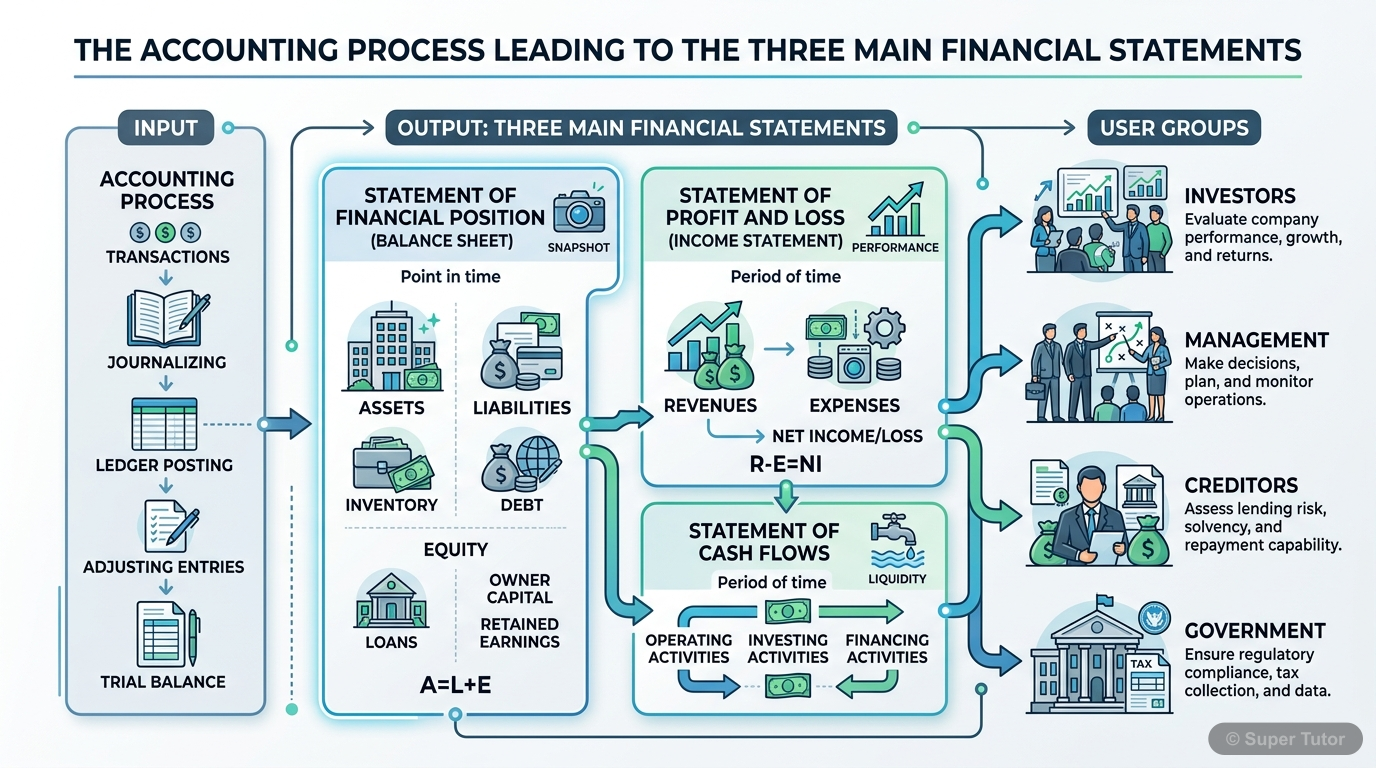
One of 7 illustrations for Financial Statements of a Company in Super Tutor — alongside flashcards, concept maps and practice questions.
The first 11 solutions are open to read. The other 10 are free with a Super Tutor account.
Do It Yourself — Classify the following items in the Balance Sheet of a Company under Major Heads and Sub-heads
1Classify the following items in the balance sheet of a company under Major heads and Sub-heads (Items 1–47).Show solution
Given: 47 items to be classified under Major Heads and Sub-heads as per Schedule III of the Companies Act, 2013.
Classification Table:
| S. No. | Item | Major Head | Sub-head (if any) |
|---|---|---|---|
| 1 | Goodwill | Non-Current Assets | Fixed Assets – Intangible Assets |
| 2 | Forfeited shares | Shareholders' Funds | Share Capital (shown as addition) |
| 3 | Acceptances | Current Liabilities | Trade Payables |
| 4 | Preliminary expenses | Non-Current Assets | Other Non-Current Assets (to be written off) |
| 5 | Capital reserve | Shareholders' Funds | Reserves and Surplus |
| 6 | Loans from banks | Non-Current Liabilities (if long-term) / Current Liabilities (if short-term) | Long-Term Borrowings / Short-Term Borrowings |
| 7 | Investment in shares and debentures | Non-Current Assets | Non-Current Investments |
| 8 | Interest accrued and due on debentures | Current Liabilities | Other Current Liabilities |
| 9 | Interest accrued but not due on Secured Loans | Current Liabilities | Other Current Liabilities |
| 10 | Interest accrued but not due on Unsecured Loans | Current Liabilities | Other Current Liabilities |
| 11 | Interest accrued on Investments | Current Assets | Other Current Assets |
| 12 | Surplus | Shareholders' Funds | Reserves and Surplus |
| 13 | Securities Premium Reserve | Shareholders' Funds | Reserves and Surplus |
| 14 | Loose Tools | Current Assets | Inventories |
| 15 | Provision for Taxation | Current Liabilities | Short-Term Provisions |
| 16 | Underwriting Commission | Non-Current Assets | Other Non-Current Assets (fictitious asset, to be written off) |
| 17 | Bills of Exchange | Current Assets | Trade Receivables |
| 18 | Unclaimed dividend | Current Liabilities | Other Current Liabilities |
| 19 | Short-term loans & advances | Current Assets | Short-Term Loans and Advances |
| 20 | Live stock | Non-Current Assets | Fixed Assets – Tangible Assets |
| 21 | Calls unpaid / Calls in arrears | Shareholders' Funds | Share Capital (shown as deduction from subscribed capital) |
| 22 | Uncalled liability on shares partly paid | Contingent Liabilities | Notes to Accounts (Contingent Liabilities) |
| 23 | Pre-paid Insurance | Current Assets | Other Current Assets |
| 24 | Stores and spare parts | Current Assets | Inventories |
| 25 | Advances from customers | Current Liabilities | Other Current Liabilities |
| 26 | Debentures Redemption Reserve | Shareholders' Funds | Reserves and Surplus |
| 27 | Premium on redemption of debentures | Non-Current Liabilities | Other Long-Term Liabilities |
| 28 | Loss on issue of debentures | Non-Current Assets | Other Non-Current Assets (to be written off) |
| 29 | Debentures Redemption Fund | Shareholders' Funds | Reserves and Surplus |
| 30 | Debentures Redemption Fund Investment | Non-Current Assets | Non-Current Investments |
| 31 | Vehicles | Non-Current Assets | Fixed Assets – Tangible Assets |
| 32 | Advances to suppliers | Current Assets | Short-Term Loans and Advances |
| 33 | Patents, trademarks, design | Non-Current Assets | Fixed Assets – Intangible Assets |
| 34 | Calls in advance | Current Liabilities | Other Current Liabilities |
| 35 | Deposits with custom authorities | Non-Current Assets | Long-Term Loans and Advances |
| 36 | Arrears of fixed cumulative dividend | Contingent Liabilities | Notes to Accounts (Contingent Liabilities) |
| 37 | Furniture and fittings | Non-Current Assets | Fixed Assets – Tangible Assets |
| 38 | Brokerage on issue of shares | Non-Current Assets | Other Non-Current Assets (to be written off) |
| 39 | Statement of Profit & Loss (Dr.) | Shareholders' Funds | Reserves and Surplus (shown as negative/debit balance) |
| 40 | Capital work-in-progress | Non-Current Assets | Fixed Assets – Capital Work-in-Progress |
| 41 | Provision for doubtful debts | Current Assets | Trade Receivables (shown as deduction) |
| 42 | Statement of Profit & Loss (Cr.) | Shareholders' Funds | Reserves and Surplus |
| 43 | Uncalled liability on partly paid shares held as investments | Contingent Liabilities | Notes to Accounts (Contingent Liabilities) |
| 44 | Claims against the company not acknowledged as debt | Contingent Liabilities | Notes to Accounts (Contingent Liabilities) |
| 45 | Capital Redemption Reserve | Shareholders' Funds | Reserves and Surplus |
| 46 | Public deposits | Non-Current Liabilities | Long-Term Borrowings |
| 47 | Authorised Capital | Shareholders' Funds | Share Capital (disclosed in Notes to Accounts) |
Questions for Practice — Short Answer Questions
1State the meaning of financial statements.Show solution
Meaning of Financial Statements:
Financial statements are the end products of the accounting process. They are formal records that summarise the financial activities and position of a business, person, or other entity.
For a company, financial statements consist of:
- Statement of Profit and Loss – shows revenues earned and expenses incurred during a specific accounting period, thereby revealing the net profit or net loss.
- Balance Sheet – shows the financial position of the company on a particular date by listing all assets, liabilities, and shareholders' funds.
These statements are prepared at the end of each accounting period and are published for the benefit of various stakeholders such as shareholders, creditors, investors, government, etc.
In short: Financial statements are structured financial reports that present the financial performance and financial position of an enterprise.
2What are limitations of financial statements?Show solution
Limitations of Financial Statements:
- Historical Information: Financial statements are based on historical cost and past data. They do not reflect the current market value of assets and liabilities, making them less useful for future decision-making.
- Ignores Price Level Changes: Financial statements are prepared on the basis of historical cost and do not account for changes in the price level (inflation/deflation). Hence, comparison over different periods may be misleading.
- Bias: These statements are the outcome of recorded facts, accounting concepts, conventions, and personal judgements. Hence, bias may be observed, and the financial position depicted may not be fully realistic.
- Aggregate Information: Financial statements show aggregate (summarised) information and not detailed information, which may not help users in specific decision-making.
- Vital Information Missing: The balance sheet does not disclose information relating to loss of markets, cessation of agreements, etc., which have a vital bearing on the enterprise.
- No Qualitative Information: Financial statements contain only monetary information but not qualitative information like industrial relations, labour relations, quality of work, employee satisfaction, etc.
- Only Interim Reports: The Statement of Profit and Loss discloses profit/loss for a specified period but does not give an idea about earning capacity over time. Similarly, the balance sheet reflects the financial position only at a specific point of time.
3List any three objectives of financial statements.Show solution
Three Objectives of Financial Statements:
- To provide information about financial performance: Financial statements provide information about the revenues earned and expenses incurred during an accounting period, thereby showing the net profit or loss of the enterprise.
- To provide information about financial position: The balance sheet shows the assets owned, liabilities owed, and the owners' equity on a particular date, helping stakeholders assess the financial strength of the company.
- To assist in decision-making: Financial statements provide relevant and reliable financial data to various users — management, investors, creditors, government — to help them make informed economic decisions.
4State the importance of financial statements to: (i) shareholders (ii) creditors (iii) government (iv) investorsShow solution
Importance of Financial Statements:
(i) Shareholders:
Shareholders are the owners of the company. Financial statements help them to:
- Assess the profitability and financial health of the company.
- Evaluate the return on their investment (dividend declared).
- Make decisions about buying, holding, or selling shares.
(ii) Creditors:
Creditors (suppliers, banks, debenture holders) use financial statements to:
- Assess the liquidity and solvency of the company.
- Determine whether the company can repay its debts on time.
- Decide whether to extend further credit or loans.
(iii) Government:
The government uses financial statements to:
- Assess the taxable income of the company and levy taxes.
- Regulate business activities and ensure compliance with laws.
- Formulate economic policies based on the financial data of industries.
(iv) Investors:
Prospective investors use financial statements to:
- Evaluate the profitability and growth prospects of the company.
- Compare the performance of different companies before investing.
- Assess the risk involved in investing in the company.
5How will you disclose the following items in the Balance Sheet of a company: (i) Current assets, inventory (ii) Contingent liabilities in notes to accounts (iii) Shareholders Funds, Reserve and Surplus (iv) Fixed Assets, Intangible Assets (v) Proposed Dividend for the current year (vi) Non Current Liabilities (vii) Arrears of Dividend on Cumulative Preference Shares.Show solution
Disclosure of items in the Balance Sheet as per Schedule III:
(i) Current Assets – Inventory:
Shown under Current Assets on the Assets side of the Balance Sheet under the sub-head Inventories.
It includes: Raw materials, Work-in-progress, Finished goods, Stock-in-trade, Stores and spare parts, Loose tools, etc.
(ii) Contingent Liabilities in Notes to Accounts:
Contingent liabilities are not shown in the Balance Sheet itself. They are disclosed in the Notes to Accounts as a footnote. Examples: Claims against the company not acknowledged as debts, arrears of cumulative dividend, uncalled liability on partly paid shares.
(iii) Shareholders' Funds – Reserves and Surplus:
Shown under Shareholders' Funds on the Equity and Liabilities side. It includes:
- Capital Reserve
- Securities Premium Reserve
- General Reserve
- Debenture Redemption Reserve
- Capital Redemption Reserve
- Surplus (Credit balance of Statement of Profit & Loss)
- A debit balance of Statement of Profit & Loss is shown as a negative figure.
(iv) Fixed Assets – Intangible Assets:
Shown under Non-Current Assets → Fixed Assets → Intangible Assets.
Examples: Goodwill, Patents, Trademarks, Copyrights, Franchises, Computer software.
(v) Proposed Dividend for the current year:
As per the revised Schedule III and AS-4, proposed dividend (declared after the balance sheet date) is not recognised as a liability in the balance sheet. It is disclosed in the Notes to Accounts as a contingent liability or as a subsequent event.
(vi) Non-Current Liabilities:
Shown on the Equity and Liabilities side of the Balance Sheet under the head Non-Current Liabilities. Sub-heads include:
- Long-Term Borrowings (Debentures, Bank Loans repayable after 12 months)
- Deferred Tax Liabilities (Net)
- Other Long-Term Liabilities
- Long-Term Provisions
(vii) Arrears of Dividend on Cumulative Preference Shares:
This is a contingent liability and is not shown in the Balance Sheet. It is disclosed in the Notes to Accounts under Contingent Liabilities.
Questions for Practice — Long Answer Questions
1Explain the nature of the financial statements.Show solution
Nature of Financial Statements:
Financial statements are the end products of the accounting process. Their nature can be understood from the following points:
- Recorded Facts: Financial statements are based on facts recorded in the books of accounts. Only transactions that have been recorded are reflected in these statements. They are based on actual historical cost.
- Accounting Concepts and Conventions: Financial statements are prepared following generally accepted accounting principles (GAAP), concepts (going concern, accrual, consistency) and conventions (conservatism, materiality, full disclosure). These concepts and conventions influence the figures shown.
- Personal Judgements: In many situations, accountants have to use personal judgement — for example, in estimating the useful life of an asset for depreciation, provision for doubtful debts, valuation of inventory, etc. Hence, personal bias can affect the statements.
- Historical in Nature: Financial statements reflect past transactions and events. They are prepared at the end of an accounting period and show what has already happened.
- Monetary Measurement: Only those transactions and events that can be expressed in monetary terms are recorded. Non-monetary aspects like employee morale, brand reputation, etc., are not reflected.
- Interim Reports: Financial statements are prepared for a specific period (usually one year). They are interim reports and do not give a complete picture of the long-term earning capacity of the enterprise.
- Combination of Art and Science: Preparation of financial statements involves both the application of accounting rules (science) and the exercise of judgement (art).
2Explain in detail about the significance of the financial statements.Show solution
Significance of Financial Statements:
Financial statements are significant to various users for the following reasons:
- To Management: Financial statements help management in planning, controlling, and decision-making. They provide data about profitability, liquidity, and solvency, which are essential for efficient management of the business.
- To Shareholders/Owners: Shareholders use financial statements to assess the return on their investment, evaluate the performance of management, and decide whether to continue holding or sell their shares.
- To Investors (Prospective): Potential investors use financial statements to evaluate the financial health, profitability, and growth prospects of the company before making investment decisions.
- To Creditors and Lenders: Banks, financial institutions, and trade creditors use financial statements to assess the creditworthiness and repayment capacity of the company before granting loans or credit.
- To Government and Tax Authorities: The government uses financial statements to assess taxable income, levy taxes, and regulate business activities. They also help in formulating economic policies.
- To Employees: Employees use financial statements to assess the financial stability and profitability of the company, which affects their job security, wages, and bonus.
- To Customers: Customers, especially those with long-term contracts, are interested in the financial stability of the company to ensure continuity of supply.
- To Researchers and Analysts: Financial analysts and researchers use financial statements to study trends, compare companies, and provide recommendations.
- Basis for Comparison: Financial statements of different years or different companies can be compared to assess relative performance and progress.
Conclusion: Financial statements serve as a mirror of the financial health of a company and are indispensable tools for all stakeholders.
3Explain the limitations of financial statements.Show solution
Limitations of Financial Statements:
- Based on Historical Cost: Financial statements are prepared on the basis of historical cost (original cost). They do not reflect the current market value or replacement cost of assets, making them less relevant for current decision-making.
- Ignores Price Level Changes: Financial statements do not account for changes in the purchasing power of money due to inflation or deflation. As a result, comparison of financial statements over different periods may be misleading.
- Bias: Financial statements are the outcome of recorded facts, accounting concepts, conventions, and personal judgements. Different accountants may use different methods (e.g., FIFO vs. LIFO for inventory, different depreciation methods), leading to bias and lack of comparability.
- Aggregate Information: Financial statements present summarised/aggregate information. They do not provide detailed information about individual transactions, products, or departments, which limits their usefulness for specific decisions.
- Vital Information Missing: The balance sheet does not disclose information about loss of markets, cessation of agreements, or other qualitative factors that have a vital bearing on the enterprise's future.
- No Qualitative Information: Financial statements contain only monetary information. They do not reflect qualitative aspects like employee morale, industrial relations, quality of management, customer satisfaction, brand value, etc.
- Only Interim Reports: The Statement of Profit and Loss shows profit/loss for a specific period but does not indicate the long-term earning capacity. The balance sheet reflects the financial position only at a specific point in time.
- Window Dressing: Management may manipulate financial statements to present a more favourable picture than the actual situation (window dressing), misleading users.
- Not Free from Errors: Financial statements may contain errors due to wrong recording, omissions, or incorrect application of accounting principles.
Conclusion: Despite these limitations, financial statements remain the most important source of financial information and should be carefully analysed before use in decision-making.
4Prepare the format of statement of profit and loss and explain its items up to the ascertainment of profit before tax.Show solution
Format of Statement of Profit and Loss (as per Schedule III, Companies Act 2013):
| Particulars | Note No. | Current Year (Rs.) | Previous Year (Rs.) |
|---|---|---|---|
| I. Revenue from Operations | |||
| II. Other Income | |||
| III. Total Revenue (I + II) | |||
| IV. Expenses: | |||
| Cost of Materials Consumed | |||
| Purchases of Stock-in-Trade | |||
| Changes in Inventories of Finished Goods, WIP and Stock-in-Trade | |||
| Employee Benefits Expense | |||
| Finance Costs | |||
| Depreciation and Amortisation Expense | |||
| Other Expenses | |||
| Total Expenses | |||
| V. Profit Before Tax (III – IV) |
Explanation of Items up to Profit Before Tax:
- Revenue from Operations: This is the primary revenue earned from the main business activities of the company. For a manufacturing/trading company, it includes:
- Net Sales (Sales – Sales Returns)
- Revenue from services rendered
- Other operating revenues (scrap sales, commission, etc.)
- Other Income: Income earned from activities other than the main business operations:
- Interest income, Dividend income, Profit on sale of assets, Rent received, etc.
- Total Revenue = Revenue from Operations + Other Income
- Cost of Materials Consumed:
This represents the cost of raw materials actually used in production.
- Purchases of Stock-in-Trade: Cost of goods purchased for resale (in case of trading companies).
- Changes in Inventories:
A positive figure means stock has decreased (added to cost); a negative figure means stock has increased (deducted from cost).
- Employee Benefits Expense: Salaries and wages, provident fund contributions, gratuity, staff welfare expenses, etc.
- Finance Costs: Interest on borrowings (debentures, bank loans), bank charges, etc.
- Depreciation and Amortisation Expense: Depreciation on tangible fixed assets and amortisation of intangible assets.
- Other Expenses: All other expenses not covered above — rent, repairs, advertising, selling expenses, administrative expenses, etc.
- Profit Before Tax = Total Revenue – Total Expenses
5Prepare the format of balance sheet and explain the various elements of balance sheet.Show solution
Format of Balance Sheet (as per Schedule III, Companies Act 2013):
| Particulars | Note No. | Current Year (Rs.) | Previous Year (Rs.) |
|---|---|---|---|
| I. EQUITY AND LIABILITIES | |||
| 1. Shareholders' Funds | |||
| (a) Share Capital | |||
| (b) Reserves and Surplus | |||
| (c) Money received against Share Warrants | |||
| 2. Share Application Money Pending Allotment | |||
| 3. Non-Current Liabilities | |||
| (a) Long-Term Borrowings | |||
| (b) Deferred Tax Liabilities (Net) | |||
| (c) Other Long-Term Liabilities | |||
| (d) Long-Term Provisions | |||
| 4. Current Liabilities | |||
| (a) Short-Term Borrowings | |||
| (b) Trade Payables | |||
| (c) Other Current Liabilities | |||
| (d) Short-Term Provisions | |||
| TOTAL | |||
| II. ASSETS | |||
| 1. Non-Current Assets | |||
| (a) Fixed Assets | |||
| (i) Tangible Assets | |||
| (ii) Intangible Assets | |||
| (iii) Capital Work-in-Progress | |||
| (iv) Intangible Assets under Development | |||
| (b) Non-Current Investments | |||
| (c) Deferred Tax Assets (Net) | |||
| (d) Long-Term Loans and Advances | |||
| (e) Other Non-Current Assets | |||
| 2. Current Assets | |||
| (a) Current Investments | |||
| (b) Inventories | |||
| (c) Trade Receivables | |||
| (d) Cash and Cash Equivalents | |||
| (e) Short-Term Loans and Advances | |||
| (f) Other Current Assets | |||
| TOTAL |
Explanation of Elements:
EQUITY AND LIABILITIES SIDE:
- Share Capital: The amount of capital raised by issuing shares — Equity Share Capital and Preference Share Capital. Details of authorised, issued, subscribed, called-up, and paid-up capital are given in Notes to Accounts.
- Reserves and Surplus: Accumulated profits and reserves — Capital Reserve, Securities Premium, General Reserve, Debenture Redemption Reserve, Surplus (Profit & Loss balance). A debit balance is shown as a negative figure.
- Long-Term Borrowings: Loans and borrowings repayable after 12 months — Debentures, Term Loans from banks, Public Deposits.
- Other Long-Term Liabilities: Liabilities not classified elsewhere — Premium on Redemption of Debentures, etc.
- Long-Term Provisions: Provisions for liabilities payable after 12 months — Provision for employee benefits (gratuity, leave encashment).
- Short-Term Borrowings: Loans repayable within 12 months — Cash credit, overdraft, short-term loans.
- Trade Payables: Amounts owed to suppliers for goods/services — Creditors, Bills Payable.
- Other Current Liabilities: Current liabilities not covered above — Outstanding expenses, Advance from customers, Unclaimed dividend, Interest accrued and due.
- Short-Term Provisions: Provisions for liabilities payable within 12 months — Provision for tax, Proposed dividend.
ASSETS SIDE:
- Tangible Fixed Assets: Physical assets with long life — Land, Building, Plant & Machinery, Furniture, Vehicles. Shown at cost less accumulated depreciation.
- Intangible Fixed Assets: Non-physical assets — Goodwill, Patents, Trademarks, Computer Software.
- Non-Current Investments: Long-term investments in shares, debentures, government securities.
- Long-Term Loans and Advances: Loans given and advances recoverable after 12 months — Security deposits, Capital advances.
- Inventories: Stock of Raw Materials, WIP, Finished Goods, Stores & Spares, Loose Tools.
- Trade Receivables: Amounts due from customers — Debtors and Bills Receivable (net of provision for doubtful debts).
- Cash and Cash Equivalents: Cash in hand, Cash at bank, Short-term highly liquid investments.
Free with a Super Tutor account
Free with a Super Tutor account
Free with a Super Tutor account
Numerical Questions
Free with a Super Tutor account
Free with a Super Tutor account
Free with a Super Tutor account
Free with a Super Tutor account
Free with a Super Tutor account
Free with a Super Tutor account
Free with a Super Tutor account
10 more solved questions in Financial Statements of a Company
They are free with a Super Tutor account, along with practice quizzes and flashcards for this chapter. Free to start, no card needed.
Frequently Asked Questions
What are the important topics in Financial Statements of a Company for Madhya Pradesh Board Class 12 Accountancy?
Are these NCERT Solutions for Financial Statements of a Company free?
How should I revise Financial Statements of a Company for the Madhya Pradesh Board Class 12 board exam?
Sources & Official References
Content is aligned to the official syllabus. Refer to the board website for the latest curriculum.
More resources for Financial Statements of a Company
Practice Quiz
Test yourself with a quick quiz
Important Questions
Exam-style questions with answers
Revision Notes
Key points for last-minute revision
Chapter Summary
Understand the chapter at a glance
Concept Maps
See how topics connect
Study Plan
Step-by-step plan for this chapter
Flashcards
Quick-fire cards for active recall
Syllabus
What topics to cover
For serious students
Get the full Financial Statements of a Company chapter — start free.
Quizzes, flashcards, an AI doubt solver and a study plan for Madhya Pradesh Board Class 12 Accountancy. Free to start, no card needed.