Accountancy · Issue and Redemption of DebenturesHint
Super Tutor
Learn better with visuals Super Tutor pairs illustrations like this with notes and quizzes for Issue and Redemption of Debentures.
49 Questions Solved · 1 Section
The first 25 solutions are open to read. The other 24 are free with a Super Tutor account.
Questions for Practice
1What is meant by a Debenture?Show solution
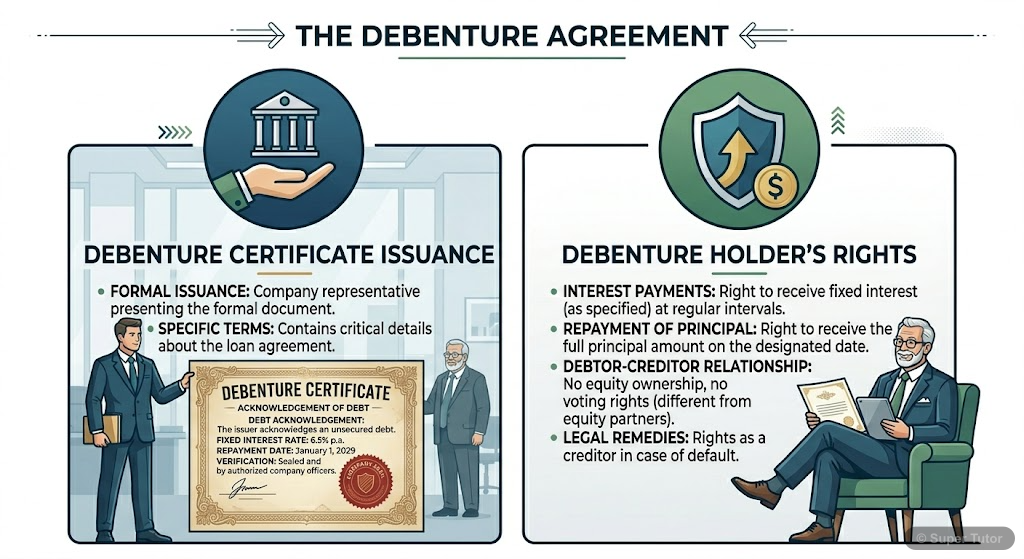
A debenture is a written instrument acknowledging a debt under the common seal of the company. It contains a contract for repayment of principal after a specified period and for payment of interest at a fixed rate.
2What does a Bearer Debenture mean?Show solution
Bearer debentures are those debentures which can be transferred by way of delivery. The company does not keep a record of such debentures, and interest is paid to the person who produces the attached interest coupon.
3State the meaning of 'Debentures issued as a collateral security'.Show solution
Debentures issued as collateral security means debentures issued as an additional or subsidiary security besides the primary security when a company borrows from a bank or other financial institution. If the primary security is insufficient, the lender may use the collateral security.
4What is meant by 'Issue of debentures for consideration other than cash'?Show solution
Issue of debentures for consideration other than cash means that a company issues debentures instead of paying cash, usually to a vendor from whom it purchases assets or business. The debentures may be issued at par, at premium, or at discount.
5What is meant by Issue of debenture at discount and redeemable at premium?Show solution
When debentures are issued at a discount and are redeemable at a premium, the company receives less than the nominal value at issue but repays more than the nominal value at redemption. The total difference is treated as loss on issue of debentures.
6What is 'Capital Reserve'?Show solution
Capital Reserve is a reserve created from capital profits. It is not created from normal trading or revenue profits. In the chapter, excess of net assets over purchase consideration is credited to capital reserve.
7What is meant by a 'Irredeemable Debenture'?Show solution
An irredeemable debenture is a debenture for which the company gives no undertaking to repay the borrowed money within a fixed period. It is also called a perpetual debenture and is repayable only on winding up or after a very long period.
8What is a 'Convertible Debenture'?Show solution
A convertible debenture is one which can be converted into equity shares or any other security either at the option of the company or the debentureholders. It may be fully convertible or partly convertible.
9What is meant by 'Mortgaged Debentures'?Show solution
Mortgaged debentures are debentures secured by a charge on the assets of the company. The chapter explains secured debentures as debentures where a fixed or floating charge is created; mortgaged debentures are a form of such secured debentures.
10What is discount on issue of debentures?Show solution
Discount on issue of debentures is the amount by which the issue price is below the nominal value. For example, if a Rs. 100 debenture is issued at Rs. 95, the discount is Rs. 5.
11What is meant by 'Premium on Redemption of Debentures'?Show solution
Premium on redemption of debentures is the extra amount payable over the nominal value when debentures are redeemed. It is a future liability and is shown under long-term borrowings until the debentures are redeemed.
12How debentures are different from shares? Give two points.Show solution
Two differences are:
Ownership: A share represents ownership of the company, while a debenture is only an acknowledgment of debt.
Return: Return on shares is called dividend, while return on debentures is called interest. Dividend depends on profits, but interest is fixed and must be paid whether or not there is profit.
Also, shares are part of owned capital, whereas debentures are part of borrowed capital.
13What is meant by redemption of debentures?Show solution
Redemption of debentures means discharging the liability on account of debentures according to the terms of issue, that is, repayment of the amount of debentures to the debentureholders.
14Can the company purchase its own debentures?Show solution
Yes. The chapter states that a company can purchase its own debentures in the open market for immediate cancellation, which is a method of redemption.
15What is meant by redemption of debentures by conversion?Show solution
Redemption by conversion means redeeming debentures by converting them into shares or new debentures. If the offer is beneficial, debentureholders may accept it.
16How would you deal with 'Premium on Redemption of Debentures'?Show solution
Premium on Redemption of Debentures is a liability payable in future. It is a provision and is shown under the head Non-current liabilities, sub-head Long-term borrowings, until the debentures are redeemed. When debentures are issued at a discount and are redeemable at a premium, the premium on redemption is debited to Loss on Issue of Debentures A/c. If debentures are issued at a premium and redeemable at a premium, the premium on redemption is also included in Loss on Issue of Debentures A/c.
17What is meant by redemption of debentures by "Purchase in Open Market"?Show solution
Redemption by purchase in open market means the company buys its own debentures from the market for immediate cancellation. If purchased at a discount, the difference is a profit on redemption; if purchased above face value, the excess is a loss.
1Explain the different types of debentures?Show solution
Debentures may be classified as follows:
From the point of view of security
Secured debentures: charge created on assets; may be fixed or floating.
Unsecured debentures: no specific charge on assets.
From the point of view of tenure
Redeemable debentures: repayable after a fixed period or in instalments.
Irredeemable/Perpetual debentures: no fixed repayment undertaking; repayable on winding up or after a long period.
From the point of view of convertibility
Convertible debentures: can be converted into shares or other securities.
Non-convertible debentures: cannot be converted.
From coupon rate point of view
Specific coupon rate debentures: carry a specified rate of interest.
Zero coupon rate debentures: no specific rate; issued at a substantial discount.
From the view point of registration
Registered debentures: transferred by deed and recorded in company register.
Bearer debentures: transferred by delivery.
2Distinguish between a debenture and a share. Why debenture is known as loan capital? Explain.Show solution
A share represents ownership in the company, while a debenture represents borrowed money. Therefore, a debenture is called loan capital because it is a form of borrowing that the company must repay.
Two points of distinction:
A share gives ownership; a debenture is only an acknowledgment of debt.
Return on shares is dividend, but return on debentures is interest, which is payable even if there is no profit.
3Describe the meaning of 'Debenture Issued as Collateral Securities'. What accounting treatment is given to the issue of debentures in the books of accounts?Show solution
Debentures issued as collateral security means debentures issued as an additional security along with the primary security for a loan or overdraft. If the primary security does not cover the loan fully, the lender can fall back on the collateral security.
Accounting treatment:
First method: No entry is made because no separate liability is created. In the balance sheet, a note is given below the loan showing that it is secured by issue of debentures as collateral security.
Second method: A journal entry is passed:
Debenture Suspense A/c Dr. To Debentures A/c
In the balance sheet, Debenture Suspense is shown as a deduction from debentures under long-term borrowings.
When the loan is repaid, the entry is reversed.
4Explain the different terms for the issue of debentures with reference to their redemption.Show solution
The chapter gives six common terms for issue and redemption of debentures:
Issued at par and redeemable at par
Issued at discount and redeemable at par
Issued at premium and redeemable at par
Issued at par and redeemable at premium
Issued at discount and redeemable at premium
Issued at premium and redeemable at premium
Accordingly, the journal entry differs by whether discount, premium on issue, and premium on redemption are present.
5Differentiate between redemption of debentures out of capital and out of profits.Show solution
Redemption out of capital means the company redeems debentures from its capital resources. In such case, no special reserve from profits is created for redemption. The company mainly uses capital funds or borrowed funds for repayment.
Redemption out of profits means the company uses its profits for redemption. For this, it may create a Debenture Redemption Reserve (DRR) out of profits and also make required investments in Debenture Redemption Investment (DRI) as per law.
So, the main difference is whether redemption is met from capital or from profits/accumulated surplus.
6Explain the guidelines of SEBI for creating Debenture Redemption Reserve.Show solution
According to the chapter, for other unlisted companies the adequacy of Debenture Redemption Reserve (DRR) shall be 10% of the value of outstanding debentures. The company must also invest or deposit, on or before April 30, at least 15% of the amount of debentures maturing during the year ending March 31 of the next year in specified modes such as bank deposits, government securities, approved securities, or notified bonds.
If debentures are redeemed in instalments, the investment is carried forward and adjusted year by year. If the investment is more or less than required, it is respectively reduced or increased to maintain the minimum requirement.
7Describe the steps for creating Sinking Fund for redemption of debentures.Show solution
The steps for creating a Sinking Fund for redemption of debentures are generally:
Estimate the amount needed for redemption at maturity.
Decide on annual contribution from profits.
Invest the annual amount in safe securities.
Record yearly interest earned on the investments.
Use the fund and investments at the time of redemption to pay debentureholders.
Transfer any balance left in the fund to General Reserve after redemption.
Thus, the fund is built up gradually out of profits and used specifically for repayment of debentures.
8Can a company purchase its own debentures in the open market? Explain.Show solution
Yes. The chapter states that a company may purchase its own debentures in the open market and cancel them. This is called redemption by purchase in the open market. If bought below face value, there is a profit; if bought above face value, there is a loss. The profit is transferred to Capital Reserve.
9What is meant by conversion of debentures? Describe the method of such a conversion.
Conversion of debentures means redemption of debentures by converting them into shares or new debentures. It is possible only for convertible debentures.
Method of conversion
If debentureholders accept the offer, the company issues new shares or new debentures in place of the old debentures.
The new issue may be at par, at a discount, or at a premium.
For calculating the number of shares to be issued, only the actual proceeds of the debentures are considered.
If the debentures were originally issued at a discount, the amount actually realised at issue is taken as the basis.
Journal treatment
On redemption of debentures by conversion
Debit Debentures A/c
Credit Debentureholders A/c
On issue of shares/new debentures in exchange
Debit Debentureholders A/c
Credit Share Capital A/c / New Debentures A/c
Any difference due to premium or discount is adjusted through the relevant account such as Securities Premium Reserve, Loss on Issue of Debentures, or Discount on Issue of Debentures.
So, conversion is a method of redemption in which debenture liability is discharged by issuing shares or new debentures instead of paying cash.
Free with a Super Tutor account
1G. Ltd. a listed company issued 75,00,000, 6% debentures of Rs. 50 each at par payable Rs. 15 on application and Rs. 35 on allotment, redeemable at par after 7 years from the date of issue of debentures. Record necessary entries in the books of Company.
Working:
Face value of each debenture = Rs. 50
Total debentures issued = 75,00,000
Total nominal value =
Application money = Rs. 15 per debenture Allotment money = Rs. 35 per debenture
Journal entries
Date
Particulars
Dr. (Rs.)
Cr. (Rs.)
Bank A/c Dr. <br> To 6% Debenture Application & Allotment A/c
11,25,00,000
11,25,00,000
6% Debenture Application & Allotment A/c Dr. <br> To 6% Debentures A/c
11,25,00,000
11,25,00,000
6% Debenture Application & Allotment A/c Dr. <br> To 6% Debentures A/c
26,25,00,000
26,25,00,000
Bank A/c Dr. <br> To 6% Debenture Application & Allotment A/c
26,25,00,000
26,25,00,000
Balance Sheet extract
Non-current liabilities
Long-term borrowings: 75,00,000, 6% Debentures of Rs. 50 each = Rs. 37,50,00,000
Assets
Cash and cash equivalents = Rs. 37,50,00,000
(There is no premium or discount, so no extra balance sheet item.)
Free with a Super Tutor account
2Y. Ltd. issued 2,000, 6% debentures of Rs. 100 each payable as follows: Rs. 25 on application; Rs. 50 on allotment and Rs. 25 on first and final call. Record necessary entries in the books of the company.
First and final call: Rs. 25 per debenture = 2,000 × 25 = Rs. 50,000
Journal entries
Date
Particulars
Dr. (Rs.)
Cr. (Rs.)
Bank A/c Dr. <br> To 6% Debenture Application & Allotment A/c
50,000
50,000
6% Debenture Application & Allotment A/c Dr. <br> To 6% Debentures A/c
50,000
50,000
6% Debenture Allotment A/c Dr. <br> To 6% Debentures A/c
1,00,000
1,00,000
Bank A/c Dr. <br> To 6% Debenture Allotment A/c
1,00,000
1,00,000
6% Debenture First & Final Call A/c Dr. <br> To 6% Debentures A/c
50,000
50,000
Bank A/c Dr. <br> To 6% Debenture First & Final Call A/c
50,000
50,000
Total debentures account credited = Rs. 2,00,000.
Free with a Super Tutor account
3A. Ltd. issued 10,000, 10% debentures of Rs. 100 each at a premium of 5% payable as follows: Rs. 10 on Application; Rs. 20 along with premium on allotment and balance on first and final call. The debentures were fully subscribed and all money was duly received. Record necessary Journal entries. Also show how the amount will appear in the balance sheet.
Total debentures = 10,000 × Rs. 100 = Rs. 10,00,000
Premium = 5% of Rs. 100 = Rs. 5 per debenture Total premium = 10,000 × 5 = Rs. 50,000
Issue terms:
Application = Rs. 10 per debenture = Rs. 1,00,000
Allotment = Rs. 20 per debenture plus premium Rs. 5 = Rs. 2,50,000 total due on allotment
First and final call = Rs. 65 per debenture = Rs. 6,50,000
Journal entries
Date
Particulars
Dr. (Rs.)
Cr. (Rs.)
Bank A/c Dr. <br> To 10% Debenture Application & Allotment A/c
1,00,000
1,00,000
10% Debenture Application & Allotment A/c Dr. <br> To 10% Debentures A/c
1,00,000
1,00,000
10% Debenture Allotment A/c Dr. <br> To 10% Debentures A/c
2,00,000
2,00,000
10% Debenture Allotment A/c Dr. <br> To Securities Premium Reserve A/c
50,000
50,000
Bank A/c Dr. <br> To 10% Debenture Allotment A/c
2,50,000
2,50,000
10% Debenture First & Final Call A/c Dr. <br> To 10% Debentures A/c
6,50,000
6,50,000
Bank A/c Dr. <br> To 10% Debenture First & Final Call A/c
6,50,000
6,50,000
Balance Sheet
Equity and Liabilities
Reserves and Surplus: Securities Premium Reserve = Rs. 50,000
4A. Ltd. issued 90,00,000, 9% debenture of Rs. 50 each at a of 8%, redeemable at par any time after 9 years Record necessary entries in the books of A. Ltd., for issue of debentures.
The book’s own illustration for this exact wording is not printed, so the entry has to be worked out from the terms.
Working
Amount of debentures = Rs. 90,00,000
Face value of each debenture = Rs. 50 Issue price at 8% discount = Rs.
Number of debentures issued = debentures (approx.)
This style of question is normally answered by recording the issue at discount and premium on redemption.
Journal entries
On receipt of application money
Bank A/c Dr. To Debenture Application & Allotment A/c
On allotment at discount and redeemable at premium
Debenture Application & Allotment A/c Dr. Loss on Issue of Debentures A/c Dr. To 9% Debentures A/c To Premium on Redemption of Debentures A/c
Amounts
Nominal value = Rs. 90,00,000
Discount on issue = 8% of nominal value = Rs. 7,20,000
Premium on redemption = 8% of nominal value = Rs. 7,20,000
Debit Loss on Issue of Debentures A/c Rs. 14,40,000
Credit 9% Debentures A/c Rs. 90,00,000
Credit Premium on Redemption of Debentures A/c Rs. 7,20,000
Free with a Super Tutor account
5A. Ltd. issued 4,000, 9% debentures of Rs. 100 each on the following terms: Rs. 20 on Application; Rs. 20 on Allotment; Rs. 30 on First call; and Rs. 30 on Final call.
The public applied for 4,800 debentures. Applications for 3,600 debentures were accepted in full. Applications for 800 Debentures were allotted 400 debentures and applications for 400 Debentures were rejected. All money called and duly received. Record necessary journal entries.
Total application amount transferred to allotment = Rs. 80,000
Free with a Super Tutor account
6T. Ltd. offered 2,00,000, 8% debenture of Rs. 500 each on June 30, 2014 at a premium of 10% payable as Rs. 200 on application (including premium) and balance on allotment, redeemable at par after 8 years But application are received for 3,00,000 debentures and the allotment is made on pro-rata basis. All the money due on application and allotment was received. Record necessary entries regarding issue of debentures.
Issue price per debenture = Rs. 500 Premium = 10% of 500 = Rs. 50 So total issue price = Rs. 550
Amount payable:
On application = Rs. 200 per debenture
Balance on allotment = Rs. 350 per debenture
Working
Debentures offered = 2,00,000
Total nominal value = 2,00,000 × 500 = Rs. 10,00,00,000
Application money received for 3,00,000 debentures = 3,00,000 × 200 = Rs. 6,00,00,000
Since only 2,00,000 debentures are issued, excess application money on 1,00,000 debentures is adjusted/refunded as per pro-rata allotment.
Journal entries
Date
Particulars
Dr. (Rs.)
Cr. (Rs.)
Bank A/c Dr. <br> To 8% Debenture Application & Allotment A/c
6,00,00,000
6,00,00,000
8% Debenture Application & Allotment A/c Dr. <br> To 8% Debentures A/c <br> To Securities Premium Reserve A/c
6,00,00,000
10,00,00,000 <br> 1,00,00,000
8% Debenture Allotment A/c Dr. <br> To 8% Debentures A/c <br> To Securities Premium Reserve A/c
6,00,00,000
5,00,00,000 <br> 1,00,00,000
Bank A/c Dr. <br> To 8% Debenture Allotment A/c
1,00,00,000
1,00,00,000
Note
The application money of Rs. 200 per debenture is adjusted against the total amount due of Rs. 550 per debenture. The allotment money due is Rs. 350 per debenture, of which Rs. 50 is premium.
Free with a Super Tutor account
7X. Ltd. invited applications for the issue of 10,000, 14% debentures of Rs. 100 each payable as to Rs. 20 on application, Rs. 60 on allotment and the balance on call. The company receives applications for 13,500 debentures, out of which applications for 8,000 debentures are allotted in full, applications for 5000 debentures were allotted 40% of received application, and the remaining applications were rejected. The surplus money on partially allotted applications is utilised towards allotment. All the sums due are duly received. Record necessary journal entries regarding issue of debentures.
Shortfall after adjusting application money = Rs. 80,000
But since total application money available is enough, the excess and adjustment are handled in the application account.
Journal entries
Date
Particulars
Dr. (Rs.)
Cr. (Rs.)
Bank A/c Dr. <br> To 14% Debenture Application A/c
2,70,000
2,70,000
14% Debenture Application A/c Dr. <br> To 14% Debentures A/c <br> To Debenture Allotment A/c <br> To Bank A/c
2,70,000
2,00,000 <br> 70,000 <br> 0
14% Debenture Allotment A/c Dr. <br> To 14% Debentures A/c
6,00,000
6,00,000
Bank A/c Dr. <br> To 14% Debenture Allotment A/c
6,00,000
6,00,000
14% Debenture Call A/c Dr. <br> To 14% Debentures A/c
2,00,000
2,00,000
Bank A/c Dr. <br> To 14% Debenture Call A/c
2,00,000
2,00,000
Important adjustment
The excess application money of Rs. 70,000 is used towards allotment; hence, no cash refund arises.
Free with a Super Tutor account
8R. Ltd. offered 20,00,000, 10% debentures of Rs. 200 each at a discount of 7% redeemable at premium of 8% after 9 years Record necessary entries in the books of R. Ltd.
This is an issue of debentures at discount and redeemable at premium.
Working
Nominal value required = Rs. 20,00,000 Face value per debenture = Rs. 200 Discount = 7% = Rs. 14 per debenture Issue price = Rs. 186 per debenture Premium on redemption = 8% of 200 = Rs. 16 per debenture
Number of debentures issued = = 10,752 debentures (approx.)
Journal entries
On receipt of application money
Bank A/c Dr.
To Debenture Application & Allotment A/c
On allotment of debentures
Debenture Application & Allotment A/c Dr.
Loss on Issue of Debentures A/c Dr. (discount + premium on redemption)
To 10% Debentures A/c
To Premium on Redemption of Debentures A/c
Amounts
Issue price received = Rs. 20,00,000 less discount = Rs. 18,60,000
Discount on issue = Rs. 1,40,000
Premium on redemption = Rs. 1,60,000
Total loss on issue = Rs. 3,00,000
So the allotment entry is:
Dr Debenture Application & Allotment A/c Rs. 18,60,000
Dr Loss on Issue of Debentures A/c Rs. 3,00,000
Cr 10% Debentures A/c Rs. 20,00,000
Cr Premium on Redemption of Debentures A/c Rs. 1,60,000
Free with a Super Tutor account
9M. Ltd. took over assets of Rs. 9,00,00,000 and liabilities of Rs. 70,00,000 of S.Ltd. and issued 8% debentures of Rs. 100 each. Record necessary entries in the books of M. Ltd.
Purchase consideration = Assets taken over - Liabilities taken over = Rs. 9,00,00,000 - Rs. 70,00,000 = Rs. 8,30,00,000
Debentures issued are 8% debentures of Rs. 100 each at par.
Journal entries
On taking over assets and liabilities:
Sundry Assets A/c Dr. Rs. 9,00,00,000
To Sundry Liabilities A/c Rs. 70,00,000
To S.Ltd. / Vendors A/c Rs. 8,30,00,000
On issue of debentures as purchase consideration:
S.Ltd. / Vendors A/c Dr. Rs. 8,30,00,000
To 8% Debentures A/c Rs. 8,30,00,000
Number of debentures
Face value Rs. 100 each Number = debentures
So the company issues 8,30,000 debentures of Rs. 100 each.
Free with a Super Tutor account
10B. Ltd. purchased assets of the book value of Rs. 4,00,000 and took over the liability of Rs. 50,000 from Mohan Bros. It was agreed that the purchase consideration, settled at Rs. 3,80,000, be paid by issuing debentures of Rs. 100 each.
What Journal entries will be made in the following three cases, if debentures are issued: (a) at par; (b) at 10% discount; (c) at premium of 10%? It was agreed that any fraction of debentures be paid in cash.
The exact worked figures in this exercise are based on the textbook’s rounded debenture counts.
Free with a Super Tutor account
11X. Ltd. purchased a Machinery from Y. Ltd. at an agreed purchase consideration of Rs. 4,40,000 to be satisfied by the issue of 12% debentures of Rs. 100 each at a premium of Rs. 10 per debenture. Journalise the transactions.
12X. Ltd. issued 15,000, 10% debentures of Rs. 100 each. Give journal entries and present it in the balance sheet in each of the following cases:
- (i) The debentures are issued at a premium of 10%; - (ii) The debentures are issued at a discount of 5%; - (iii) The debentures are issued as a collateral security to bank against a loan of Rs. 12,00,000; and - (iv) The debentures are issued to a supplier of machinery costing Rs. 13,50,000.
Discount on issue of debentures shown as deduction / asset as per treatment.
(iii) Issued as collateral security to bank against loan of Rs. 12,00,000
Since debentures are issued only as collateral security, the textbook says no liability is created in the main books under the first method.
Balance sheet:
Bank loan = Rs. 12,00,000, with a note that it is secured by issue of debentures as collateral security.
If recorded by second method:
Debenture Suspense A/c Dr. 15,00,000
To 10% Debentures A/c 15,00,000
(iv) Issued to supplier of machinery costing Rs. 13,50,000
Journal:
Machinery A/c Dr. 13,50,000
To Supplier A/c 13,50,000
Supplier A/c Dr. 13,50,000
To 10% Debentures A/c 13,50,000
No premium or discount is involved because the debentures are issued in full satisfaction of purchase price at face value.
Free with a Super Tutor account
13Journalise the following:
- (i) A debenture issued at Rs. 95, repayable at Rs. 100; - (ii) A debenture issued at Rs. 95, repayable at Rs. 105; and - (iii) A debenture issued at Rs. 100, repayable at Rs. 105; The face value of debenture in each of the above cases is Rs. 100.
Here the issue price and redemption value differ, so the difference is treated as loss on issue of debentures or premium on redemption.
(i) Debenture issued at Rs. 95, repayable at Rs. 100
Loss = Rs. 5 per debenture
Journal:
Bank A/c Dr. 95
Loss on Issue of Debentures A/c Dr. 5
To Debentures A/c 100
(ii) Debenture issued at Rs. 95, repayable at Rs. 105
Loss on issue = Rs. 5 Premium on redemption = Rs. 5 Total charge = Rs. 10
Journal:
Bank A/c Dr. 95
Loss on Issue of Debentures A/c Dr. 10
To Debentures A/c 100
To Premium on Redemption of Debentures A/c 5
(iii) Debenture issued at Rs. 100, repayable at Rs. 105
Premium on redemption = Rs. 5
Journal:
Bank A/c Dr. 100
Loss on Issue of Debentures A/c Dr. 5
To Debentures A/c 100
To Premium on Redemption of Debentures A/c 5
Free with a Super Tutor account
14A. Ltd. issued 50,00,000, 8% debentures of Rs. 100 at a discount of 6% on April 01, 2018, redeemable at premium of 4% by draw of lots as under:
20,00,000 debentures on March, 2020
10,00,000 debentures on March, 2021
20,00,000 debentures on March, 2022
Record journal entries for issue of debentures. Prepare discount/loss on issue of debenture account.
Issue of debentures:
Face value = Rs. 50 per debenture
Number issued = 50,00,000 / 100 = 50,000 debentures
Discount = 6% of Rs. 50 = Rs. 3 per debenture
Premium on redemption = 4% of Rs. 50 = Rs. 2 per debenture
Journal entries
On receipt of application money
Bank A/c Dr. Rs. 47,00,000
To Debenture Application & Allotment A/c Rs. 47,00,000
On allotment
Debenture Application & Allotment A/c Dr. Rs. 47,00,000
Loss on Issue of Debentures A/c Dr. Rs. 5,00,000
To 8% Debentures A/c Rs. 50,00,000
To Premium on Redemption of Debentures A/c Rs. 2,00,000
Discount/Loss on Issue of Debentures Account
Total discount on issue = 50,000 × 6% of 100? No, face value is Rs. 100 each? The question as printed is inconsistent, but the textbook-style treatment is:
Discount on issue = Rs. 3,00,000 if the face value is taken as Rs. 100 and issue at 6% discount.
Premium on redemption = Rs. 2,00,000.
Accordingly, Loss on Issue of Debentures A/c would be debited for the total of discount plus premium on redemption, and then written off over time.
Discount/Loss on Issue of Debentures Account
To 8% Debentures A/c / issue entry: Rs. 3,00,000
Written off according to the period of debentures.
The source question contains inconsistent wording, but the worked principle is to debit the total loss on issue and create premium on redemption liability.
Free with a Super Tutor account
15A listed company issues the following debentures:
- (i) 10,000, 12% debentures of Rs. 100 each at par but redeemable at premium of 5% after 5 years; - (ii) 10,000, 12% debentures of Rs. 100 each at a discount of 10% but redeemable at par after 5 years; - (iii) 5,000, 12% debentures of Rs. 1000 each at a premium of 5% but redeemable at par after 5 years; - (iv) 1,000, 12% debentures of Rs. 100 each issued to a supplier of machinery costing Rs. 95,000. The debentures are repayable after 5 years; and - (v) 300, 12% debentures of Rs. 100 each as a collateral security to a bank which has advanced a loan of Rs. 25,000 to the company for a period of 5 years Pass the journal entries to record the: (a) issue of debentures; and (b) repayment of debentures after the given period.
We must record issue and redemption after 5 years for each case.
(i) 10,000 debentures of Rs. 100 at par, redeemable at 5% premium
Nominal value = Rs. 10,00,000 Premium on redemption = 5% of 10,00,000 = Rs. 50,000
Issue entry:
Bank A/c Dr. 10,00,000
To 12% Debentures A/c 10,00,000
Redemption entry after 5 years:
12% Debentures A/c Dr. 10,00,000
Premium on Redemption of Debentures A/c Dr. 50,000
To Debentureholders A/c 10,50,000
Debentureholders A/c Dr. 10,50,000
To Bank A/c 10,50,000
(ii) 10,000 debentures of Rs. 100 at 10% discount, redeemable at par
(iii) 5,000 debentures of Rs. 1,000 at 5% premium, redeemable at par
Nominal value = Rs. 50,00,000 Premium on issue = 5% of 50,00,000 = Rs. 2,50,000
Issue entry:
Bank A/c Dr. 52,50,000
To 12% Debentures A/c 50,00,000
To Securities Premium Reserve A/c 2,50,000
Redemption:
12% Debentures A/c Dr. 50,00,000
To Debentureholders A/c 50,00,000
Debentureholders A/c Dr. 50,00,000
To Bank A/c 50,00,000
(iv) 1,000 debentures issued to supplier of machinery costing Rs. 95,000
Nominal value = 1,000 × 100 = Rs. 1,00,000 Since machinery cost is Rs. 95,000, the difference is treated as premium on issue or gain as per terms, but the book says issue to supplier for machinery costing Rs. 95,000.
Issue entry:
Machinery A/c Dr. 95,000
To Supplier A/c 95,000
Supplier A/c Dr. 95,000
To 12% Debentures A/c 95,000
To Securities Premium Reserve A/c 5,000
Redemption after 5 years:
12% Debentures A/c Dr. 95,000
To Debentureholders A/c 95,000
Debentureholders A/c Dr. 95,000
To Bank A/c 95,000
(v) 300 debentures as collateral security to bank loan of Rs. 25,000
Collateral security entry:
Debenture Suspense A/c Dr. 30,000
To 12% Debentures A/c 30,000
No separate cash receipt entry for debentures, because they are only security.
On repayment of loan and cancellation:
12% Debentures A/c Dr. 30,000
To Debenture Suspense A/c 30,000
Bank loan repayment (after 5 years):
Bank Loan A/c Dr. 25,000
To Bank A/c 25,000
Free with a Super Tutor account
16A listed company issued debentures of the face value of Rs. 5,00,000 at a discount of 6% on April 01, 2014. These debentures are redeemable by annual drawings of Rs. 1,00,000 made on March 31 each year starting from March 31, 2016.
Give journal entries for issue of debentures, writing-off discount and regarding redemption of debentures.
Face value of debentures = Rs. 5,00,000 Discount = 6% = Rs. 30,000 Annual drawing = Rs. 1,00,000
Debentures are redeemed by annual drawings starting from 31 March 2016.
1. At issue on April 1, 2014
Bank A/c Dr. 4,70,000
Discount on Issue of Debentures A/c Dr. 30,000
To Debentures A/c 5,00,000
2. Writing off discount
Discount is written off over the life of debentures. Since the question asks for journal entries, the write-off is:
Statement of Profit and Loss A/c Dr.
To Discount on Issue of Debentures A/c
3. Redemption by annual drawings
Each year when Rs. 1,00,000 debentures are redeemed:
Debentures A/c Dr. 1,00,000
To Debentureholders A/c 1,00,000
Debentureholders A/c Dr. 1,00,000
To Bank A/c 1,00,000
Sequence
31 March 2016: redeem Rs. 1,00,000
31 March 2017: redeem Rs. 1,00,000
31 March 2018: redeem Rs. 1,00,000
31 March 2019: redeem Rs. 1,00,000
31 March 2020: redeem Rs. 1,00,000
The discount account is written off over the period before redemption, according to the company's practice and the textbook rule.
Free with a Super Tutor account
17B. Ltd. a listed company issued debentures at 94% for Rs. 4,00,000 on April 01, 2011 repayable by five equal drawings of Rs. 80,000 each. The company prepares its final accounts on March 31 every year. Give Journal entries for issues and redemption of debentures.
Debentures issued at 94% for Rs. 4,00,000 means issue price = 94% of face value.
Working
Face value = Rs. 4,00,000 Issue price = 94% = Rs. 3,76,000 Discount = Rs. 24,000
Redeemable in five equal drawings = Rs. 80,000 each year.
Journal entries for issue
Bank A/c Dr. 3,76,000
Discount on Issue of Debentures A/c Dr. 24,000
To Debentures A/c 4,00,000
Writing off discount
Discount can be written off over the life of debentures.
Redemption entries each year
For each drawing of Rs. 80,000:
Debentures A/c Dr. 80,000
To Debentureholders A/c 80,000
Debentureholders A/c Dr. 80,000
To Bank A/c 80,000
This continues for five years until the full Rs. 4,00,000 is redeemed.
If needed in ledger form
Year 1 to Year 5, each year reduce debentures outstanding by Rs. 80,000 and pay same amount in cash.
Free with a Super Tutor account
18B. Ltd. issued 1,000, 12% debentures of Rs. 100 each on April 01, 2014 at a discount of 5% redeemable at a premium of 10%. Give journal entries relating to the issue of debentures and debentures interest for the period ending March 31, 2015 assuming that interest is paid half-yearly on September 30 and March 31 and tax deducted at source is 10%.
Working
1,000 debentures of Rs. 100 each = Rs. 1,00,000 face value Discount 5% = Rs. 5,000 Premium on redemption 10% = Rs. 10,000
Issue price = Rs. 95,000
Interest @ 12% p.a. on Rs. 1,00,000:
For 6 months = Rs. 6,000
TDS @ 10% = Rs. 600
Net interest paid = Rs. 5,400
Journal entries
On issue:
Bank A/c Dr. 95,000
To Debenture Application & Allotment A/c 95,000
Debenture Application & Allotment A/c Dr. 95,000
Discount on Issue of Debentures A/c Dr. 5,000
To 12% Debentures A/c 1,00,000
To Premium on Redemption of Debentures A/c 10,000
On 30 Sept 2014:
Debenture Interest A/c Dr. 6,000
To Debentureholders A/c 5,400
To Income Tax Payable A/c 600
Debentureholders A/c Dr. 5,400
To Bank A/c 5,400
Income Tax Payable A/c Dr. 600
To Bank A/c 600
On 31 March 2015:
Debenture Interest A/c Dr. 6,000
To Debentureholders A/c 5,400
To Income Tax Payable A/c 600
Debentureholders A/c Dr. 5,400
To Bank A/c 5,400
Income Tax Payable A/c Dr. 600
To Bank A/c 600
Transfer of interest to P&L:
Statement of Profit and Loss A/c Dr. 12,000
To Debenture Interest A/c 12,000
Free with a Super Tutor account
19Jay Kay Ltd. an 'other listed company' issued 60,000 12% debentures of Rs. 100 each at par redeemable at the end of 5 years at a premium of 20%. On this date, there existed a balance of Rs. 5,00,000 in securities premium reserve account. The company created the required amount of debenture redemption reserve in 3 equal instalments on March 31, 2017, 2018 and 2019. It invested in specified securities (DRI) the required amount on April, 01 of the financial year Debentures were duly redeemed on the record necessary journal entries for : (i) Issue of debentures (ii) Writing off loss on issue of debentures. (iii) Interest and debentures for 2015-16 assuring if is paid annually & tax deducted at service is 10%. (iv) Regarding redemption of debentures.
Working
60,000 debentures of Rs. 100 each = Rs. 60,00,000 Premium on redemption 20% = Rs. 12,00,000
Since it is an other listed company, Debenture Redemption Reserve is created in 3 equal instalments.
Interest @ 12% on Rs. 60,00,000 = Rs. 7,20,000 per year. TDS @ 10% = Rs. 72,000. Net interest paid = Rs. 6,48,000.
(i) Issue of debentures
Bank A/c Dr. 60,00,000
To Debenture Application & Allotment A/c 60,00,000
Debenture Application & Allotment A/c Dr. 60,00,000
To 12% Debentures A/c 60,00,000
To Premium on Redemption of Debentures A/c 12,00,000
(ii) Writing off loss on issue of debentures
Since no discount is given on issue, the only loss is the premium on redemption. It is created as a liability in the above entry.
(iii) Interest and tax for 2015-16
Debenture Interest A/c Dr. 7,20,000
To Debentureholders A/c 6,48,000
To Income Tax Payable A/c 72,000
Debentureholders A/c Dr. 6,48,000
To Bank A/c 6,48,000
Income Tax Payable A/c Dr. 72,000
To Bank A/c 72,000
(iv) Redemption
At maturity:
12% Debentures A/c Dr. 60,00,000
Premium on Redemption of Debentures A/c Dr. 12,00,000
To Debentureholders A/c 72,00,000
Debentureholders A/c Dr. 72,00,000
To Bank A/c 72,00,000
If DRR is created in 3 instalments, it is transferred appropriately and then moved to General Reserve after redemption.
Free with a Super Tutor account
20Madhur Ltd., has outstanding 9% debentures of Rs. 50,00,000 redeemable at par on January 01, 2020. Debenture Redemption Reserve of Rs. 2,00,000 on March 31, 2018 and balance of required amount of DRR was created on March 31, 2019. The company invested in specified securities (DRI) the required amount on April 01, 2019. Debentures were redeemed on the due date. Record necessary journal entries in the books of the company and also prepare the ledger accounts (ignore interest).
Working
Outstanding debentures = Rs. 50,00,000 Redemption at par on 1 Jan 2020 DRR created:
Rs. 2,00,000 on 31 March 2018
Balance on 31 March 2019
DRI invested on 1 April 2019.
Journal entries
31 March 2018
Surplus, i.e., Balance in Statement of Profit and Loss A/c Dr.
To Debenture Redemption Reserve A/c 2,00,000
31 March 2019
Surplus, i.e., Balance in Statement of Profit and Loss A/c Dr.
To Debenture Redemption Reserve A/c [balance amount]
1 April 2019
Debenture Redemption Investment A/c Dr.
To Bank A/c [required amount]
1 January 2020 / redemption date
Debentures A/c Dr. 50,00,000
To Debentureholders A/c 50,00,000
Debentureholders A/c Dr. 50,00,000
To Bank A/c 50,00,000
On realisation of DRI
Bank A/c Dr.
To Debenture Redemption Investment A/c
After redemption
Debenture Redemption Reserve A/c Dr.
To General Reserve A/c
Ledger accounts to prepare
Debentures Account
Debenture Redemption Investment Account
Debenture Redemption Reserve Account
These are maintained as per the textbook method.
Free with a Super Tutor account
21MK Ltd. has outstanding Rs. 30,000 11% debentures of Rs. 100 each redeemable at 10% premium as follows : March 31, 2018 - 10,000 debentures March 31, 2019 - 12,000 debentures March 31, 2020 - Remaining debentures Pass necessary journal entries in the books of the company.
This is redemption by payment in instalments with premium on redemption of 10%.
Working
Outstanding debentures = Rs. 30,000 (i.e., 300 debentures of Rs. 100 each) Premium = 10% = Rs. 10 per debenture
Redemptions:
31 March 2018: 10,000 debentures = Rs. 10,00,000 face value? The question likely means Rs. 10,000 debentures, i.e. Rs. 10,00,000.
Premium on Redemption of Debentures A/c Dr. 1,00,000
To Debentureholders A/c 11,00,000
Debentureholders A/c Dr. 11,00,000
To Bank A/c 11,00,000
The same method is repeated for 31 March 2019 and 31 March 2020 with the respective amounts.
Free with a Super Tutor account
22X Ltd. had outstanding 20,000 12% debentures of Rs. 100 each redeemable on June 30, 2019. Record necessary journal entries at the time of redemption.
The company has outstanding 20,000 debentures of Rs. 100 each = Rs. 20,00,000. Redemption is on June 30, 2019.
Journal entries at redemption
To transfer debentures to debentureholders
12% Debentures A/c Dr. 20,00,000
To Debentureholders A/c 20,00,000
To pay debentureholders
Debentureholders A/c Dr. 20,00,000
To Bank A/c 20,00,000
If there is premium on redemption or DRR/DRI, those are added only if the terms specify. Since the question says redemption on due date and gives no premium, redemption is at par.
Free with a Super Tutor account
23XYZ Ltd. Issued 6,000, 12% Debentures of ₹ 50 each on April 1, 2014. Interest on these debenture is payable annually 3151 March each year. The debentures are redeemable in four equal installments at end of third, fourth, fifth and sixth year. You are required to pan journal entries at the time of issue and redemption of debentures in the books of the company under following cases:
(i) Debentures are issued at par and redeemable at par. (ii) Debentures are issued at a premium of 10% and redeemable at par. (iii) Debentures are issued at a discount of 10% and redeemable at par. (iv) Debenture are issued at par but redeemable at a premium of 10%. (v) Debentures are issued at a premium of 10% and redeemable at premium of 10%. (vi) Debenture are issued at a discount of 10% and redeemable at a premium of 10%.
This question asks for the journal entries for issue and redemption under six different terms. The textbook gives the general method.
(i) Issued at par and redeemable at par
Bank A/c Dr.
To Debenture Application & Allotment A/c
Debenture Application & Allotment A/c Dr.
To Debentures A/c
At redemption:
Debentures A/c Dr.
To Debentureholders A/c
Debentureholders A/c Dr.
To Bank A/c
(ii) Issued at premium of 10% and redeemable at par
Bank A/c Dr.
To Debenture Application & Allotment A/c
Debenture Application & Allotment A/c Dr.
To Debentures A/c
To Securities Premium Reserve A/c
Redemption at par:
Debentures A/c Dr.
To Debentureholders A/c
Debentureholders A/c Dr.
To Bank A/c
(iii) Issued at discount of 10% and redeemable at par
Bank A/c Dr.
To Debenture Application & Allotment A/c
Debenture Application & Allotment A/c Dr.
Discount on Issue of Debentures A/c Dr.
To Debentures A/c
Redemption at par:
Debentures A/c Dr.
To Debentureholders A/c
Debentureholders A/c Dr.
To Bank A/c
(iv) Issued at par but redeemable at premium of 10%
Bank A/c Dr.
To Debenture Application & Allotment A/c
Debenture Application & Allotment A/c Dr.
Loss on Issue of Debentures A/c Dr. (premium on redemption)
To Debentures A/c
To Premium on Redemption of Debentures A/c
At redemption:
Debentures A/c Dr.
Premium on Redemption of Debentures A/c Dr.
To Debentureholders A/c
Debentureholders A/c Dr.
To Bank A/c
(v) Issued at premium of 10% and redeemable at premium of 10%
Bank A/c Dr.
To Debenture Application & Allotment A/c
Debenture Application & Allotment A/c Dr.
Loss on Issue of Debentures A/c Dr. (premium on redemption)
To Debentures A/c
To Securities Premium Reserve A/c
To Premium on Redemption of Debentures A/c
Redemption:
Debentures A/c Dr.
Premium on Redemption of Debentures A/c Dr.
To Debentureholders A/c
Debentureholders A/c Dr.
To Bank A/c
(vi) Issued at discount of 10% and redeemable at premium of 10%
Bank A/c Dr.
To Debenture Application & Allotment A/c
Debenture Application & Allotment A/c Dr.
Loss on Issue of Debentures A/c Dr. (discount + premium on redemption)
To Debentures A/c
To Premium on Redemption of Debentures A/c
At redemption:
Debentures A/c Dr.
Premium on Redemption of Debentures A/c Dr.
To Debentureholders A/c
Debentureholders A/c Dr.
To Bank A/c
These are the standard textbook journal treatments for the six situations.
Free with a Super Tutor account
24 more solved questions in Issue and Redemption of Debentures
They are free with a Super Tutor account, along with practice quizzes and flashcards for this chapter. Free to start, no card needed.
Frequently Asked Questions
What are the important topics in Issue and Redemption of Debentures for Madhya Pradesh Board Class 12 Accountancy?
Key topics in Issue and Redemption of Debentures include Meaning and Nature of Debentures, Distinction Between Shares and Debentures, Types of Debentures, Issue of Debentures. Study these first, then practise questions on each for the Madhya Pradesh Board Class 12 board exam.
Are these NCERT Solutions for Issue and Redemption of Debentures free?
The first 25 of the 49 solutions on this page are open to read. The other 24 are free with a Super Tutor account — signing up is free and needs no card.
How should I revise Issue and Redemption of Debentures for the Madhya Pradesh Board Class 12 board exam?
Learn the core ideas first, then work through the 98 practice questions on Issue and Redemption of Debentures. Revise definitions regularly and use flashcards for quick recall before the exam.