Amines — NCERT Solutions
Madhya Pradesh Board · Class 12 · Chemistry
NCERT Solutions for Amines, Madhya Pradesh Board Class 12 Chemistry: 23 textbook questions solved step by step. Covers Intext Questions and Exercises.
Interactive on Super Tutor
Studying Amines? Get the full interactive chapter.
Quizzes, flashcards, AI doubt-solver and a step-by-step study plan — built for NCERT solutions and more.
Free trial, no card needed.
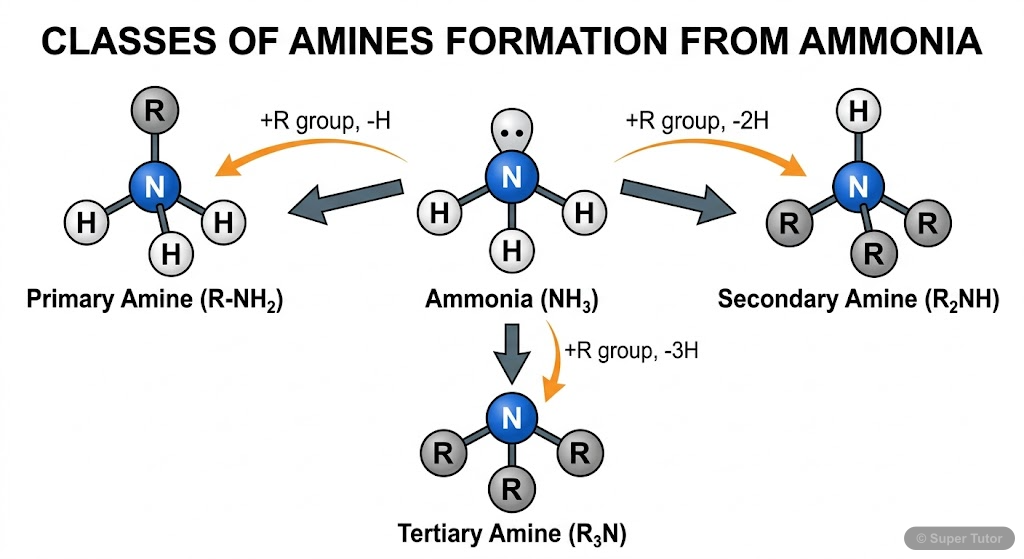
One of 21 illustrations for Amines in Super Tutor — alongside flashcards, concept maps and practice questions.
The first 12 solutions are open to read. The other 11 are free with a Super Tutor account.
Intext Questions
9.1Classify the following amines as primary, secondary or tertiary:
(i) (CH₃)₂CHNH₂ [structure from image]
(ii) Structure from image
(iii) (C₂H₅)₂CHNH₂
(iv) (C₂H₅)₂NHShow solution
Concept: An amine is classified based on the number of hydrogen atoms of NH₃ replaced by alkyl/aryl groups.
- Primary (1°): one H replaced → R–NH₂
- Secondary (2°): two H replaced → R₂NH
- Tertiary (3°): three H replaced → R₃N
(i) The structure shown in the image is that of a cyclic secondary amine (cyclohexylamine type) or an N-substituted compound. Based on standard NCERT context, image (i) represents a compound where nitrogen bears two carbon substituents and one H → Secondary amine.
(ii) The structure shown in image (ii) represents a compound where nitrogen bears three carbon substituents and no H → Tertiary amine.
(iii)
The nitrogen atom is bonded to two H atoms and one carbon group (the group). Since only one H of NH₃ is replaced by an alkyl group, this is a Primary amine (1°).
(iv)
The nitrogen atom is bonded to two ethyl groups and one H atom. Two H atoms of NH₃ are replaced → Secondary amine (2°).
9.2(i) Write structures of different isomeric amines corresponding to the molecular formula C₄H₁₁N.
(ii) Write IUPAC names of all the isomers.
(iii) What type of isomerism is exhibited by different pairs of amines?
(Note: The molecular formula given in the OCR appears as C₂H₁₁N but the correct formula for amines with multiple isomers is C₄H₁₁N, which is the standard NCERT question.)Show solution
Given: Molecular formula
Degree of unsaturation , so all isomers are saturated amines.
(i) Structures of all isomeric amines:
Primary amines (R–NH₂):
- — Butan-1-amine
- — Butan-2-amine
- — 2-Methylpropan-1-amine
- — 2-Methylpropan-2-amine
Secondary amines (R₂NH):
- — N-Methylpropan-1-amine
- — N-Methylpropan-2-amine
- — N-Ethylethanamine (Diethylamine)
Tertiary amines (R₃N):
- — N,N-Dimethylethanamine
- — Wait, has formula , not .
Correct: — N,N-Dimethylethanamine ✓
(ii) IUPAC names:
| S.No. | Structure | IUPAC Name |
|---|---|---|
| 1 | Butan-1-amine | |
| 2 | Butan-2-amine | |
| 3 | 2-Methylpropan-1-amine | |
| 4 | 2-Methylpropan-2-amine | |
| 5 | N-Methylpropan-1-amine | |
| 6 | N-Methylpropan-2-amine | |
| 7 | N-Ethylethanamine | |
| 8 | N,N-Dimethylethanamine |
(iii) Types of isomerism:
- Chain isomerism: Isomers 1 and 3 (different carbon skeletons, both primary amines). E.g., butan-1-amine and 2-methylpropan-1-amine.
- Position isomerism: Isomers 1 and 2 (same chain, at different positions). E.g., butan-1-amine and butan-2-amine.
- Metamerism: Isomers among secondary amines having different alkyl groups on either side of nitrogen. E.g., N-methylpropan-1-amine and N-ethylethanamine.
- Functional isomerism: Primary, secondary and tertiary amines with the same molecular formula are functional isomers of each other.
9.3How will you convert:
(i) Benzene into aniline
(ii) Benzene into N,N-dimethylaniline
(iii) Cl–(CH₂)₄–Cl into hexan-1,6-diamine?Show solution
(i) Benzene → Aniline:
Step 1: Nitration of benzene to give nitrobenzene.
Step 2: Reduction of nitrobenzene to aniline.
(ii) Benzene → N,N-Dimethylaniline:
Step 1: Benzene → Nitrobenzene (as above)
Step 2: Nitrobenzene → Aniline (reduction as above)
Step 3: Aniline is treated with excess methyl iodide (CH₃I) in the presence of :
(N,N-Dimethylaniline)
(iii) Cl–(CH₂)₄–Cl → Hexan-1,6-diamine:
1,4-Dichlorobutane is treated with excess ethanolic ammonia in a sealed tube:
However, to get hexan-1,6-diamine (6 carbons) from 1,4-dichlorobutane (4 carbons), the correct route is via nitrile:
Step 1: React with NaCN:
(Hexanedinitrile)
Step 2: Reduce with /Ni or :
(Hexan-1,6-diamine)
Final Answer: (Hexan-1,6-diamine)
9.4Arrange the following in increasing order of their basic strength:
(i) C₂H₅NH₂, C₆H₅NH₂, NH₃, C₆H₅CH₂NH₂ and (C₂H₅)₂NH
(ii) C₂H₅NH₂, (C₂H₅)₂NH, (C₂H₅)₃N, C₆H₅NH₂
(iii) CH₃NH₂, (CH₃)₂NH, (CH₃)₃N, C₆H₅NH₂, C₆H₅CH₂NH₂Show solution
Concept: Basic strength depends on the availability of the lone pair on nitrogen.
- Alkyl groups (electron-donating) increase basic strength.
- Aryl groups (electron-withdrawing by resonance) decrease basic strength.
- In aqueous solution, secondary alkylamines are stronger bases than primary, which are stronger than tertiary (due to solvation effects).
(i)
- : lone pair delocalised into ring → weakest base.
- : no alkyl group.
- : benzyl group is electron-withdrawing by induction but not directly on ring, so stronger than .
- : alkyl group donates electrons → stronger than .
- : two alkyl groups → strongest.
(ii)
In aqueous solution:
- : weakest (resonance withdrawal).
- : tertiary, less solvated → weaker than secondary.
- : primary.
- : secondary, best combination of induction and solvation → strongest.
(iii)
- : weakest (lone pair in resonance with ring).
- : not on ring, slightly stronger than aniline but weaker than alkylamines.
- : tertiary, less solvated.
- : primary.
- : secondary → strongest.
9.5Complete the following acid-base reactions and name the products:
(i) CH₃CH₂CH₂NH₂ + HCl →
(ii) (C₂H₅)₂NH + HCl →Show solution
Concept: Amines are Lewis bases. They react with acids to form salts (ammonium salts).
(i)
Product: Propan-1-aminium chloride (or propylammonium chloride)
(ii)
Product: N-Ethylethanaminium chloride (or diethylammonium chloride)
9.6Write reactions of the final alkylation product of aniline with excess of methyl iodide in the presence of sodium carbonate solution.Show solution
Step 1: Aniline reacts with excess in the presence of :
The final alkylation product is trimethylphenylammonium iodide:
Reaction of the final product:
Trimethylphenylammonium iodide is a quaternary ammonium salt. It does not react further with alkyl halides. However, it can react with to give trimethylphenylammonium hydroxide:
The quaternary ammonium hydroxide is a strong base and can undergo Hofmann elimination on heating:
Note: The key point is that the final product (trimethylphenylammonium iodide) is a quaternary ammonium salt with no further N-alkylation possible.
9.7Write chemical reaction of aniline with benzoyl chloride and write the name of the product obtained.Show solution
Concept: Aniline (a primary amine) undergoes acylation with benzoyl chloride (an acid chloride) to form an amide. This is the Schotten-Baumann reaction.
Product: -Phenylbenzamide (benzanilide)
The HCl produced is neutralised if the reaction is carried out in the presence of a base like pyridine or NaOH.
9.8Write structures of different isomers corresponding to the molecular formula C₃H₉N. Write IUPAC names of the isomers which will liberate nitrogen gas on treatment with nitrous acid.Show solution
Molecular formula:
Degree of unsaturation , so all are saturated amines.
All isomers:
Primary amines:
- — Propan-1-amine
- — Propan-2-amine
Secondary amine:
- — N-Methylethanamine
Tertiary amine:
- — N,N-Dimethylmethanamine (Trimethylamine)
Reaction with nitrous acid ():
- Primary aliphatic amines react with to liberate gas:
- Secondary amines form N-nitrosamines (yellow oily liquid, no gas).
- Tertiary amines form ammonium salts (no gas).
Isomers that liberate gas (primary amines):
- Propan-1-amine —
- Propan-2-amine —
9.9Convert:
(i) 3-Methylaniline into 3-nitrotoluene.
(ii) Aniline into 1,3,5-tribromobenzene.Show solution
(i) 3-Methylaniline → 3-Nitrotoluene:
3-Methylaniline is -toluidine:
Step 1: Protect the group by acetylation (to prevent oxidation during nitration):
Step 2: Diazotisation — convert to diazonium salt:
Step 3: Replace with using Sandmeyer-type reaction (treat with / , catalyst) — but the standard route is:
Actually, the correct approach:
Step 1: Diazotise 3-methylaniline:
Step 2: Treat with then heat (Balz-Schiemann) — not for nitro.
Correct standard method:
Step 1: Acetylate :
Step 2: Nitrate (the acetamido group directs ortho/para; since position 3 has , nitration occurs at position 4 relative to , i.e., position 4 of the ring).
Simpler NCERT approach:
Step 1: Diazotise:
Step 2: Replace with using (Sandmeyer reaction with ):
Product: 3-Nitrotoluene ✓
(ii) Aniline → 1,3,5-Tribromobenzene:
Direct bromination of aniline gives 2,4,6-tribromoaniline. To get 1,3,5-tribromobenzene, the group must be removed after bromination.
Step 1: Bromination of aniline with excess :
(2,4,6-Tribromoaniline)
Step 2: Diazotisation of 2,4,6-tribromoaniline:
Step 3: Reductive removal of diazonium group using :
Product: 1,3,5-Tribromobenzene ✓
Exercises
9.1Write IUPAC names of the following compounds and classify them into primary, secondary and tertiary amines.
(i) (CH₃)₂CHNH₂
(ii) CH₃(CH₂)₂NH₂
(iii) CH₃NHCH(CH₃)₂
(iv) (CH₃)₃CNH₂
(v) C₆H₅NHCH₃
(vi) (CH₃CH₂)₂NCH₃
(vii) m-BrC₆H₄NH₂Show solution
Concept: IUPAC name of amine = name of parent alkane + suffix '-amine'. For secondary/tertiary amines, use N- prefix for substituents on nitrogen.
(i)
- Parent chain: propane (3 carbons including the CH)
- on C-2
- IUPAC Name: Propan-2-amine
- Classification: Primary amine (1°) — attached to one carbon
(ii)
- Parent chain: propane, on C-1
- IUPAC Name: Propan-1-amine
- Classification: Primary amine (1°)
(iii)
- Nitrogen has two different groups: methyl and isopropyl
- Larger group: propan-2-yl (isopropyl) → parent: propan-2-amine
- Smaller group on N: methyl → N-methyl
- IUPAC Name: N-Methylpropan-2-amine
- Classification: Secondary amine (2°)
(iv)
- Parent chain: 2-methylpropane; on C-2
- IUPAC Name: 2-Methylpropan-2-amine
- Classification: Primary amine (1°)
(v)
- Parent: benzenamine (aniline); N-methyl substituent
- IUPAC Name: N-Methylaniline (or N-Methylbenzenamine)
- Classification: Secondary amine (2°)
(vi)
- Nitrogen has two ethyl groups and one methyl group
- Largest group: ethanamine as parent
- IUPAC Name: N-Ethyl-N-methylethanamine
- Classification: Tertiary amine (3°)
(vii)
- Bromine at meta position of aniline
- IUPAC Name: 3-Bromoaniline (or 3-Bromobenzenamine)
- Classification: Primary amine (1°)
9.2Give one chemical test to distinguish between the following pairs of compounds.
(i) Methylamine and dimethylamine
(ii) Secondary and tertiary amines
(iii) Ethylamine and aniline
(iv) Aniline and benzylamine
(v) Aniline and N-methylanilineShow solution
(i) Methylamine () and Dimethylamine ():
Test — Hinsberg's test (using benzenesulphonyl chloride, ):
- (primary amine) reacts with to give a sulphonamide soluble in alkali (NaOH).
- (secondary amine) reacts to give a sulphonamide insoluble in alkali.
Alternatively — Carbylamine test:
- (primary amine) gives isocyanide (foul smell) with /alc. KOH.
- (secondary amine) does not give carbylamine test.
(Foul-smelling isocyanide)
(ii) Secondary and Tertiary amines:
Test — Hinsberg's test:
- Secondary amine reacts with to give a sulphonamide insoluble in NaOH.
- Tertiary amine does not react with (no reaction or forms a soluble salt).
Alternatively — Nitrous acid test:
- Secondary amine + → N-nitrosamine (yellow oily liquid).
- Tertiary amine + → forms a salt (no yellow precipitate).
(iii) Ethylamine () and Aniline ():
Test — Azo dye test (diazonium coupling):
- Aniline (aromatic primary amine) undergoes diazotisation with at 273–278 K to form a diazonium salt, which couples with -naphthol to give an orange-red azo dye.
- Ethylamine (aliphatic primary amine) forms an unstable diazonium salt that immediately decomposes to give gas and alcohol; no azo dye is formed.
Alternatively: Aniline does not give carbylamine test (wait — aniline does give carbylamine test as it is a primary amine). Better test: Aniline gives orange precipitate with water (2,4,6-tribromoaniline), while ethylamine does not give a precipitate.
(iv) Aniline () and Benzylamine ():
Test — Azo dye test:
- Aniline (aromatic primary amine) forms a stable diazonium salt at 273–278 K, which couples with -naphthol to give an orange-red azo dye.
- Benzylamine (aliphatic primary amine) forms an unstable diazonium salt that decomposes immediately; no azo dye formed.
Alternatively — Reaction with :
- Aniline gives a characteristic colour with .
- Benzylamine does not.
(v) Aniline () and N-Methylaniline ():
Test — Carbylamine test:
- Aniline (primary amine) reacts with and alc. KOH to give phenyl isocyanide (foul smell).
- N-Methylaniline (secondary amine) does not give carbylamine test.
Alternatively — Hinsberg's test:
- Aniline gives sulphonamide soluble in NaOH.
- N-Methylaniline gives sulphonamide insoluble in NaOH.
9.3Account for the following:
(i) pKb of aniline is more than that of methylamine.
(ii) Ethylamine is soluble in water whereas aniline is not.
(iii) Methylamine in water reacts with ferric chloride to precipitate hydrated ferric oxide.
(iv) Although amino group is o- and p-directing in aromatic electrophilic substitution reactions, aniline on nitration gives a substantial amount of m-nitroaniline.
(v) Aniline does not undergo Friedel-Crafts reaction.
(vi) Diazonium salts of aromatic amines are more stable than those of aliphatic amines.
(vii) Gabriel phthalimide synthesis is preferred for synthesising primary amines.Show solution
(i) pKb of aniline > pKb of methylamine (aniline is a weaker base):
In aniline, the lone pair of electrons on the nitrogen atom is in conjugation with the -electron system of the benzene ring. This delocalisation reduces the availability of the lone pair for protonation, making aniline a weaker base.
In methylamine, the methyl group is electron-donating (+I effect), which increases the electron density on nitrogen, making the lone pair more available for protonation. Hence methylamine is a stronger base.
Higher means weaker base, so (aniline) (methylamine).
(ii) Ethylamine is soluble in water but aniline is not:
Ethylamine can form hydrogen bonds with water molecules due to the presence of group. The ethyl group is small, so the hydrophobic part does not significantly hinder dissolution.
Aniline also has group but the large hydrophobic benzene ring makes it predominantly non-polar. The hydrophobic interaction of the benzene ring with water outweighs the hydrogen bonding of with water, making aniline sparingly soluble in water.
(iii) Methylamine precipitates hydrated ferric oxide from FeCl₃ solution:
Methylamine is a stronger base than water. In aqueous solution, it produces ions:
The ions react with to precipitate hydrated ferric oxide (reddish-brown precipitate):
(or , hydrated ferric oxide)
(iv) Aniline gives substantial m-nitroaniline on nitration:
Nitration is carried out with conc. /conc. (a strongly acidic medium). In this medium, aniline gets protonated to form anilinium ion ().
The anilinium ion has group which is an electron-withdrawing group (−I and −M effect) and is a meta-director. Hence, nitration of the protonated aniline gives a substantial amount of m-nitroaniline.
(Some unprotonated aniline also undergoes nitration at o/p positions, giving o- and p-nitroaniline.)
(v) Aniline does not undergo Friedel-Crafts reaction:
Friedel-Crafts reaction requires a Lewis acid catalyst like . Aniline is a Lewis base; it donates its lone pair to to form a complex:
This complex formation deactivates the catalyst. Also, the group becomes , which is an electron-withdrawing group and deactivates the ring. Hence, Friedel-Crafts reaction does not occur with aniline.
(vi) Diazonium salts of aromatic amines are more stable than those of aliphatic amines:
In arenediazonium salts (), the positive charge on nitrogen is stabilised by resonance with the -electron system of the benzene ring. The group is in conjugation with the ring, distributing the positive charge.
In alkyldiazonium salts (), no such resonance stabilisation is possible. Hence, they are highly unstable and decompose immediately to give gas and carbocation.
(vii) Gabriel phthalimide synthesis is preferred for synthesising primary amines:
Gabriel phthalimide synthesis involves the reaction of phthalimide (potassium salt) with an alkyl halide, followed by hydrolysis. This method gives exclusively primary amines because:
- The nitrogen in phthalimide has only one replaceable H (actually none — it is the K salt).
- Only one alkyl group can be introduced on nitrogen.
- Hydrolysis of the N-alkyl phthalimide gives the primary amine.
This avoids the formation of secondary and tertiary amines and quaternary ammonium salts, which are common side products in ammonolysis of alkyl halides. Hence, Gabriel synthesis gives pure primary amines.
(i) In decreasing order of pKb values: C₂H₅NH₂, C₆H₅NHCH₃, (C₂H₅)₂NH and C₆H₅NH₂
(ii) In increasing order of basic strength: C₆H₅NH₂, C₆H₅N(CH₃)₂, (C₂H₅)₂NH and CH₃NH₂
(iii) In increasing order of basic strength:
(a) Aniline, p-nitroaniline and p-toluidine
(b) C₆H₅NH₂, C₆H₅NHCH₃, C₆H₅CH₂NH₂
(iv) In decreasing order of basic strength in gas phase: C₂H₅NH₂, (C₂H₅)₂NH, (C₂H₅)₃N and NH₃
(v) In increasing order of boiling point: C₂H₅OH, (CH₃)₂NH, C₂H₅NH₂
(vi) In increasing order of solubility in water: C₆H₅NH₂, (C₂H₅)₂NH, C₂H₅NH₂
Free with a Super Tutor account
(i) Ethanoic acid into methanamine
(ii) Hexanenitrile into 1-aminopentane
(iii) Methanol to ethanoic acid
(iv) Ethanamine into methanamine
(v) Ethanoic acid into propanoic acid
(vi) Methanamine into ethanamine
(vii) Nitromethane into dimethylamine
(viii) Propanoic acid into ethanoic acid
Free with a Super Tutor account
Free with a Super Tutor account
(i) Carbylamine reaction
(ii) Diazotisation
(iii) Hofmann's bromamide reaction
(iv) Coupling reaction
(v) Ammonolysis
(vi) Acetylation
(vii) Gabriel phthalimide synthesis
Free with a Super Tutor account
(i) Nitrobenzene to benzoic acid
(ii) Benzene to m-bromophenol
(iii) Benzoic acid to aniline
(iv) Aniline to 2,4,6-tribromofluorobenzene
(v) Benzyl chloride to 2-phenylethanamine
(vi) Chlorobenzene to p-chloroaniline
(vii) Aniline to p-bromoaniline
(viii) Benzamide to toluene
(ix) Aniline to benzyl alcohol
Free with a Super Tutor account
(i) CH₃CH₂I → (NaCN) → A → (OH⁻, partial hydrolysis) → B → (Ph₂) → C
(ii) C₆H₅N₂Cl → (CuCN) → A → (H₂O/H⁺) → B → (NH₃) → C
(iii) CH₃CH₂Br → (KCN) → A → (LiAlH₄) → B → (HNO₂) → C
(iv) C₆H₅NO₂ → (Fe/HCl) → A → (NaNO₂+HCl) → B → (H₂O/H⁺) → C
(v) CH₃COOH → (NH₃) → A → (NaOBr) → B → (NaNO₂/HCl) → C
(vi) C₆H₅NO₂ → (Fe/HCl) → A → (HNO₂) → B → (C₆H₅OH) → C
Free with a Super Tutor account
Free with a Super Tutor account
(i) C₆H₅NH₂ + CHCl₃ + alc. KOH →
(ii) C₆H₅N₂Cl + H₃PO₂ + H₂O →
(iii) C₆H₅NH₂ + H₂SO₄ (conc.) →
(iv) C₆H₅N₂Cl + C₂H₅OH →
(v) C₆H₅NH₂ + Br₂(aq) →
(vi) C₆H₅NH₂ + (CH₃CO)₂O →
(vii) C₆H₅N₂Cl → (i) HBF₄, (ii) NaNO₂/Cu, Δ
Free with a Super Tutor account
Free with a Super Tutor account
Free with a Super Tutor account
(i) Why are amines less acidic than alcohols of comparable molecular masses?
(ii) Why do primary amines have higher boiling point than tertiary amines?
(iii) Why are aliphatic amines stronger bases than aromatic amines?
Free with a Super Tutor account
11 more solved questions in Amines
They are free with a Super Tutor account, along with practice quizzes and flashcards for this chapter. Free to start, no card needed.
Frequently Asked Questions
What are the important topics in Amines for Madhya Pradesh Board Class 12 Chemistry?
Are these NCERT Solutions for Amines free?
How should I revise Amines for the Madhya Pradesh Board Class 12 board exam?
Sources & Official References
Content is aligned to the official syllabus. Refer to the board website for the latest curriculum.
More resources for Amines
Practice Quiz
Test yourself with a quick quiz
Important Questions
Exam-style questions with answers
Revision Notes
Key points for last-minute revision
Formula Sheet
The chapter's formulas in one place
Chapter Summary
Understand the chapter at a glance
Concept Maps
See how topics connect
Study Plan
Step-by-step plan for this chapter
Flashcards
Quick-fire cards for active recall
Syllabus
What topics to cover
For serious students
Get the full Amines chapter — start free.
Quizzes, flashcards, an AI doubt solver and a study plan for Madhya Pradesh Board Class 12 Chemistry. Free to start, no card needed.