Coordination Compounds — NCERT Solutions
Madhya Pradesh Board · Class 12 · Chemistry
NCERT Solutions for Coordination Compounds, Madhya Pradesh Board Class 12 Chemistry: 41 textbook questions solved step by step.
Interactive on Super Tutor
Studying Coordination Compounds? Get the full interactive chapter.
Quizzes, flashcards, AI doubt-solver and a step-by-step study plan — built for NCERT solutions and more.
Free trial, no card needed.
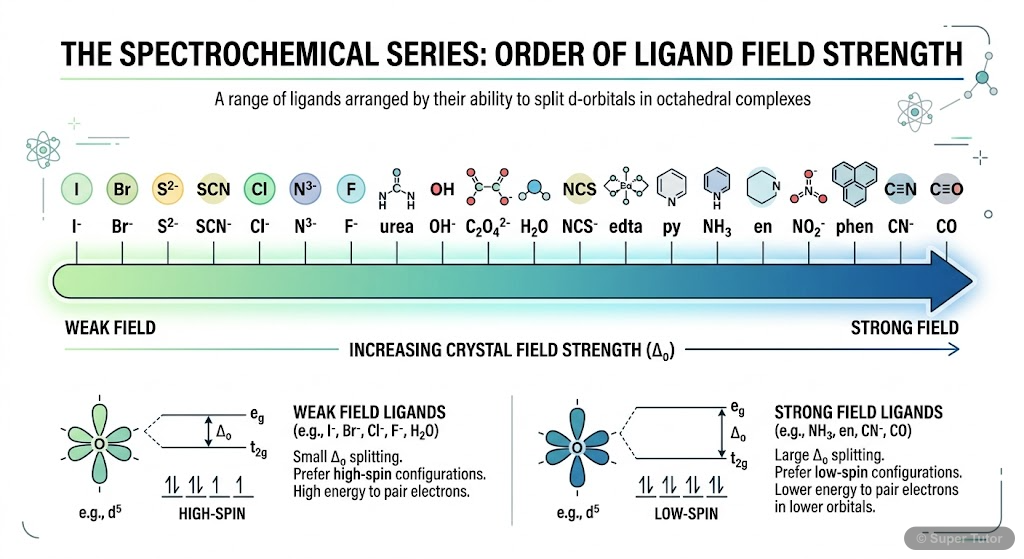
Learn better with visuals Super Tutor pairs illustrations like this with notes and quizzes for Coordination Compounds.
The first 21 solutions are open to read. The other 20 are free with a Super Tutor account.
Intext Questions
5.1Write the formulas for the following coordination compounds:
(i) tetraamminediaquacobalt(III) chloride
(ii) potassium tetracyanidonickelate(II)
(iii) tris(ethane-1,2-diamine) chromium(III) chloride
(iv) amminebromidochloridonitrito-N-platinate(II)
(v) dichloridobis(ethane-1,2-diamine)platinum(IV) nitrate
(vi) iron(III) hexacyanidoferrate(II)Show solution
Given: Names of coordination compounds. We apply IUPAC rules: write the coordination entity in square brackets with metal last, then counter-ions outside.
(i) tetraamminediaquacobalt(III) chloride
- Central metal: Co(III), i.e., Co³⁺
- Ligands: 4 NH₃ (tetraammine) + 2 H₂O (diaqua)
- Charge on complex ion: +3, so 3 Cl⁻ outside
(ii) potassium tetracyanidonickelate(II)
- Central metal: Ni(II), i.e., Ni²⁺ (anionic complex → potassium outside)
- Ligands: 4 CN⁻ (tetracyanido)
- Charge on complex ion: 2−4 = −2, so K₂ outside
(iii) tris(ethane-1,2-diamine)chromium(III) chloride
- Central metal: Cr(III), i.e., Cr³⁺
- Ligands: 3 en (tris(ethane-1,2-diamine))
- Charge on complex ion: +3, so 3 Cl⁻ outside
(iv) amminebromidochloridonitrito-N-platinate(II)
- Central metal: Pt(II), anionic complex
- Ligands: NH₃ (ammine), Br⁻ (bromido), Cl⁻ (chlorido), NO₂⁻ bonded through N (nitrito-N)
- Charge: 2 − 1 − 1 − 1 = −1, so no outer cation shown (the name implies it is an anion; written as the anion)
(v) dichloridobis(ethane-1,2-diamine)platinum(IV) nitrate
- Central metal: Pt(IV), i.e., Pt⁴⁺
- Ligands: 2 Cl⁻ (dichloro) + 2 en (bis(ethane-1,2-diamine))
- Charge on complex ion: 4 − 2 = +2, so 2 NO₃⁻ outside
(vi) iron(III) hexacyanidoferrate(II)
- Two metal centres: Fe³⁺ (cation) and Fe²⁺ (in anionic complex)
- Complex anion: [Fe(CN)₆]⁴⁻
- Charge balance: 3 Fe³⁺ balanced by 4 [Fe(CN)₆]⁴⁻ → Fe₄[Fe(CN)₆]₃
5.2Write the IUPAC names of the following coordination compounds:
(i) [Co(NH₃)₆]Cl₃
(ii) [Co(NH₃)₅Cl]Cl₂
(iii) K₃[Fe(CN)₆]
(iv) K₃[Fe(C₂O₄)₃]
(v) K₂[PdCl₄]
(vi) [Pt(NH₃)₂Cl(NH₂CH₃)]ClShow solution
Rules used: Name ligands alphabetically before the metal; use prefixes di-, tri-, etc. for simple ligands and bis-, tris- for complex ones; state oxidation state of metal in Roman numerals; for anionic complexes add suffix '-ate'.
(i) [Co(NH₃)₆]Cl₃
- Ligands: 6 NH₃ → hexaammine
- Metal: Co; charge = +3 → cobalt(III)
- Anion: Cl⁻ → chloride
Name: Hexaamminecobalt(III) chloride
(ii) [Co(NH₃)₅Cl]Cl₂
- Ligands: 5 NH₃ (pentaammine) + 1 Cl⁻ (chlorido)
- Metal: Co; charge: let x + 0×5 − 1 = +2 (overall cation charge) → x = +3 → cobalt(III)
- Anion: 2 Cl⁻ → chloride
Name: Pentaamminechloridocobalt(III) chloride
(iii) K₃[Fe(CN)₆]
- Cation: K⁺ (potassium)
- Ligands: 6 CN⁻ → hexacyanido
- Metal: Fe; charge: 3K⁺ balances −3 on complex; x − 6 = −3 → x = +3 → ferrate(III) (anionic complex)
Name: Potassium hexacyanidoferrate(III)
(iv) K₃[Fe(C₂O₄)₃]
- Cation: K⁺ (potassium)
- Ligands: 3 C₂O₄²⁻ (oxalato) → trioxalato (or tris(oxalato))
- Metal: Fe; x − 6 = −3 → x = +3 → ferrate(III)
Name: Potassium trioxalatoferrate(III)
(v) K₂[PdCl₄]
- Cation: K⁺ (potassium)
- Ligands: 4 Cl⁻ → tetrachloro
- Metal: Pd; x − 4 = −2 → x = +2 → palladate(II)
Name: Potassium tetrachloridopalladate(II)
(vi) [Pt(NH₃)₂Cl(NH₂CH₃)]Cl
- Ligands (alphabetical): Cl⁻ (chlorido), NH₂CH₃ (methanamine), 2 NH₃ (diammine)
- Metal: Pt; charge: x − 1 = +1 → x = +2 → platinum(II)
- Anion: Cl⁻ → chloride
Name: Diamminechloridomethanamiineplatinum(II) chloride
(More precisely: Diamminechlorido(methanamine)platinum(II) chloride)
5.3Indicate the types of isomerism exhibited by the following complexes and draw the structures for these isomers:
(i) K[Cr(H₂O)₂(C₂O₄)₂]
(ii) [Co(en)₃]Cl₃
(iii) [Co(NH₃)₅(NO₂)](NO₃)₂
(iv) [Pt(NH₃)(H₂O)Cl₂]Show solution
(i) K[Cr(H₂O)₂(C₂O₄)₂]
Types of isomerism: Geometrical isomerism (cis and trans) and Optical isomerism (for the cis form).
- The complex ion [Cr(H₂O)₂(C₂O₄)₂]⁻ is octahedral with two water molecules and two bidentate oxalate ligands.
- Cis isomer: The two H₂O ligands are adjacent (90° apart). This cis form is non-superimposable on its mirror image → optical isomers (Δ and Λ).
- Trans isomer: The two H₂O ligands are opposite (180° apart). This form has a plane of symmetry → optically inactive.
Structures (described):
- trans: H₂O–Cr–OH₂ along one axis; two oxalates in the equatorial plane.
- cis: H₂O and H₂O adjacent; two oxalates spanning adjacent positions → gives d and l (Δ and Λ) optical isomers.
Summary: Geometrical isomers (cis and trans) + optical isomers of the cis form.
(ii) [Co(en)₃]Cl₃
Type of isomerism: Optical isomerism only.
- The complex [Co(en)₃]³⁺ is octahedral with three bidentate en ligands. It has no plane of symmetry.
- Two non-superimposable mirror images exist: Δ (d) and Λ (l) forms.
- No geometrical isomerism is possible since all three ligands are identical bidentate ligands.
Summary: Two optical isomers (enantiomers).
(iii) [Co(NH₃)₅(NO₂)](NO₃)₂
Types of isomerism:
- Linkage isomerism: NO₂⁻ can coordinate through N (nitrito-N, –NO₂) or through O (nitrito-O, –ONO).
- Isomer 1: [Co(NH₃)₅(NO₂)]²⁺ — N-bonded (nitro)
- Isomer 2: [Co(NH₃)₅(ONO)]²⁺ — O-bonded (nitrito)
- Ionisation isomerism: The NO₃⁻ outside can exchange with NO₂⁻ inside:
- [Co(NH₃)₅(NO₂)](NO₃)₂ ↔ [Co(NH₃)₅(NO₃)](NO₃)(NO₂) ↔ [Co(NH₃)₅(NO₃)₂]NO₂
- Geometrical isomerism: Not applicable here (all NH₃ are equivalent in a MA₅B type complex — only one geometric form possible).
Summary: Linkage isomerism and ionisation isomerism (total ~10 possible isomers when all types are considered).
(iv) [Pt(NH₃)(H₂O)Cl₂]
Type of isomerism: Geometrical isomerism (cis and trans).
- Square planar complex of type MA₂BC (two different unidentate ligands Cl₂, plus NH₃ and H₂O).
- Cis isomer: Two Cl ligands are adjacent to each other.
- Trans isomer: Two Cl ligands are opposite to each other.
Structures:
- *cis*-[Pt(NH₃)(H₂O)Cl₂]: Cl–Pt–Cl at 90°; NH₃ and H₂O adjacent.
- *trans*-[Pt(NH₃)(H₂O)Cl₂]: Cl–Pt–Cl at 180°; NH₃ and H₂O opposite each other.
Summary: Two geometrical isomers (cis and trans).
5.4Give evidence that [Co(NH₃)₅Cl]SO₄ and [Co(NH₃)₅(SO₄)]Cl are ionisation isomers.Show solution
Concept: Ionisation isomers give different ions in solution and therefore react differently with specific reagents.
Evidence from chemical reactions:
Test with BaCl₂/Ba²⁺ solution (test for SO₄²⁻):
Adding Ba²⁺: (white precipitate formed ✓)
Adding Ba²⁺: No free SO₄²⁻ in solution → No precipitate ✗
Test with AgNO₃/Ag⁺ solution (test for Cl⁻):
(Cl⁻ is inside the coordination sphere, not free)
(white precipitate formed ✓)
Conclusion: The two compounds produce different ions in solution and respond differently to the same reagents, confirming they are ionisation isomers.
5.5Explain on the basis of valence bond theory that [Ni(CN)₄]²⁻ ion with square planar structure is diamagnetic and the [NiCl₄]²⁻ ion with tetrahedral geometry is paramagnetic.Show solution
Given: [Ni(CN)₄]²⁻ (square planar, diamagnetic) and [NiCl₄]²⁻ (tetrahedral, paramagnetic).
Electronic configuration of Ni²⁺:
Ni: [Ar] 3d⁸ 4s²; Ni²⁺: [Ar] 3d⁸ (8 electrons in 3d)
[Ni(CN)₄]²⁻ — Square Planar, Diamagnetic:
CN⁻ is a strong field ligand. It forces the two unpaired 3d electrons to pair up:
One 3d orbital becomes empty. Hybridisation: dsp² (one 3d + one 4s + two 4p orbitals).
All electrons are paired → Diamagnetic ✓
[NiCl₄]²⁻ — Tetrahedral, Paramagnetic:
Cl⁻ is a weak field ligand. It does not cause pairing of 3d electrons.
Hybridisation uses 4s and three 4p orbitals: sp³ (tetrahedral).
Two unpaired electrons remain in 3d orbitals → Paramagnetic ✓
Magnetic moment: BM
5.6[NiCl₄]²⁻ is paramagnetic while [Ni(CO)₄] is diamagnetic though both are tetrahedral. Why?Show solution
Given: Both [NiCl₄]²⁻ and [Ni(CO)₄] are tetrahedral, yet one is paramagnetic and the other diamagnetic.
Key difference: Oxidation state of Ni and nature of ligand.
In [NiCl₄]²⁻:
- Ni is in +2 oxidation state → Ni²⁺: [Ar] 3d⁸
- Cl⁻ is a weak field ligand → does not cause pairing of electrons
- 3d⁸ configuration retains 2 unpaired electrons
- Hybridisation: sp³ (tetrahedral)
- Result: Paramagnetic ( BM)
In [Ni(CO)₄]:
- Ni is in zero oxidation state → Ni⁰: [Ar] 3d¹⁰ 4s⁰ (in the complex, 4s electrons shift to 3d)
- Actually Ni⁰: [Ar] 3d¹⁰ — all 3d orbitals are completely filled
- CO is a strong field ligand and also causes back-bonding; in Ni(0), the configuration is 3d¹⁰
- Hybridisation: sp³ (tetrahedral)
- All electrons are paired → Diamagnetic
Conclusion: The difference arises because in [NiCl₄]²⁻, Ni is Ni²⁺ (3d⁸, 2 unpaired electrons) with weak-field Cl⁻, while in [Ni(CO)₄], Ni is Ni⁰ (3d¹⁰, no unpaired electrons) with strong-field CO.
5.7[Fe(H₂O)₆]³⁺ is strongly paramagnetic whereas [Fe(CN)₆]³⁻ is weakly paramagnetic. Explain.Show solution
Given: Fe³⁺ is the central metal in both complexes. Fe³⁺: [Ar] 3d⁵ (5 unpaired electrons in free ion).
[Fe(H₂O)₆]³⁺ — Strongly Paramagnetic:
- H₂O is a weak field ligand → small crystal field splitting (Δ₀ < P, pairing energy)
- 3d electrons do not pair up → high spin complex
- Electronic configuration: → 5 unpaired electrons
- Hybridisation: sp³d² (outer orbital complex)
- Magnetic moment: BM → strongly paramagnetic
[Fe(CN)₆]³⁻ — Weakly Paramagnetic:
- CN⁻ is a strong field ligand → large crystal field splitting (Δ₀ > P)
- 3d electrons pair up as much as possible → low spin complex
- Electronic configuration: → 1 unpaired electron
- Hybridisation: d²sp³ (inner orbital complex)
- Magnetic moment: BM → weakly paramagnetic
Conclusion: The difference is due to the field strength of the ligands. H₂O (weak field) gives high-spin Fe³⁺ with 5 unpaired electrons; CN⁻ (strong field) gives low-spin Fe³⁺ with only 1 unpaired electron.
5.8Explain [Co(NH₃)₆]³⁺ is an inner orbital complex whereas [Ni(NH₃)₆]²⁺ is an outer orbital complex.Show solution
[Co(NH₃)₆]³⁺ — Inner Orbital Complex:
- Co³⁺: [Ar] 3d⁶ → 6 electrons in 3d
- Free Co³⁺: (4 unpaired)
- NH₃ is a strong field ligand → forces pairing of 3d electrons:
- Two empty 3d orbitals + one 4s + two 4p → d²sp³ hybridisation
- Uses inner (n−1)d = 3d orbitals → inner orbital complex
- All electrons paired → diamagnetic
[Ni(NH₃)₆]²⁺ — Outer Orbital Complex:
- Ni²⁺: [Ar] 3d⁸ → 8 electrons in 3d
- NH₃, though a moderately strong ligand, cannot pair up the 3d electrons in Ni²⁺ (3d⁸ — no room to pair further without using 4d)
- Hybridisation uses 4s, three 4p, and two 4d orbitals → sp³d² hybridisation
- Uses outer nd = 4d orbitals → outer orbital complex
- 2 unpaired electrons → paramagnetic
Conclusion: Co³⁺ (3d⁶) with strong-field NH₃ undergoes d²sp³ hybridisation (inner orbital), while Ni²⁺ (3d⁸) cannot free inner 3d orbitals, so sp³d² hybridisation (outer orbital) occurs.
5.9Predict the number of unpaired electrons in the square planar [Pt(CN)₄]²⁻ ion.Show solution
Given: [Pt(CN)₄]²⁻ is square planar.
Step 1: Find oxidation state of Pt.
Let oxidation state of Pt = x.
So Pt is in +2 oxidation state.
Step 2: Electronic configuration of Pt²⁺.
Pt: [Xe] 4f¹⁴ 5d⁹ 6s¹; Pt²⁺: [Xe] 4f¹⁴ 5d⁸
Step 3: Effect of CN⁻ (strong field ligand).
For square planar geometry, hybridisation is dsp². One 5d orbital must be emptied.
CN⁻ forces pairing:
Step 4: Hybridisation.
One empty 5d + 6s + two 6p → dsp² (square planar)
Result: All electrons are paired.
The complex is diamagnetic.
5.10The hexaquo manganese(II) ion contains five unpaired electrons, while the hexacyano ion contains only one unpaired electron. Explain using Crystal Field Theory.Show solution
Given: Mn²⁺ is the central metal ion in both complexes.
Electronic configuration of Mn²⁺: [Ar] 3d⁵ (5 electrons)
[Mn(H₂O)₆]²⁺ — 5 unpaired electrons (High Spin):
- H₂O is a weak field ligand → small crystal field splitting energy
- Since (pairing energy), electrons occupy all five 3d orbitals singly before pairing
- Crystal field configuration:
- 5 unpaired electrons → strongly paramagnetic
- BM
[Mn(CN)₆]⁴⁻ — 1 unpaired electron (Low Spin):
- CN⁻ is a strong field ligand → large crystal field splitting energy
- Since , electrons pair up in the lower energy orbitals
- Crystal field configuration:
Actually for 3d⁵ in strong field:
- 1 unpaired electron → weakly paramagnetic
- BM
Conclusion: The difference is due to the magnitude of . Weak-field H₂O gives high-spin (5 unpaired e⁻); strong-field CN⁻ gives low-spin (1 unpaired e⁻) for Mn²⁺ (3d⁵).
Exercises
5.1Explain the bonding in coordination compounds in terms of Werner's postulates.Show solution
Werner's Postulates for Bonding in Coordination Compounds:
Alfred Werner (1893) proposed the following postulates to explain bonding in coordination compounds:
Postulate 1 — Primary (Ionisable) Valence:
- Every metal exhibits a primary valence (Hauptvalenz), which is its normal oxidation state (electrovalence).
- Primary valences are satisfied by negative ions and are ionisable.
- Example: In [Co(NH₃)₆]Cl₃, the primary valence of Co is 3, satisfied by 3 Cl⁻ ions.
Postulate 2 — Secondary (Non-ionisable) Valence:
- Every metal also has a secondary valence (Nebenvalenz), which is the coordination number.
- Secondary valences are satisfied by neutral molecules or negative ions (ligands) and are non-ionisable.
- Secondary valences are directed in space, giving the complex a definite geometry.
- Example: In [Co(NH₃)₆]Cl₃, the secondary valence (coordination number) of Co is 6, satisfied by 6 NH₃ molecules.
Postulate 3 — Geometry:
- The secondary valences are directed towards fixed positions in space around the central metal, giving rise to definite geometrical shapes (octahedral, tetrahedral, square planar, etc.).
Illustration:
- Co has primary valence = 3 (satisfied by 3 Cl⁻ outside the bracket)
- Co has secondary valence = 6 (satisfied by 6 NH₃ inside the bracket)
- Geometry: Octahedral
Werner's theory successfully explained the existence of isomers and the number of ions produced in solution by coordination compounds.
5.2FeSO₄ solution mixed with (NH₄)₂SO₄ solution in 1:1 molar ratio gives the test of Fe²⁺ ion but CuSO₄ solution mixed with aqueous ammonia in 1:4 molar ratio does not give the test of Cu²⁺ ion. Explain why?Show solution
Given:
- FeSO₄ + (NH₄)₂SO₄ (1:1) → gives Fe²⁺ test
- CuSO₄ + NH₃(aq) (1:4) → does not give Cu²⁺ test
Explanation:
Case 1: FeSO₄ + (NH₄)₂SO₄
When FeSO₄ and (NH₄)₂SO₄ are mixed in 1:1 ratio, they form a double salt:
Double salts completely dissociate in aqueous solution to give all their constituent ions:
Free Fe²⁺ ions are present in solution → Fe²⁺ test is positive.
Case 2: CuSO₄ + NH₃(aq) (1:4)
When CuSO₄ reacts with excess aqueous ammonia, it forms a complex compound (coordination compound):
This is tetraamminecopper(II) sulphate, a coordination compound. In solution, it ionises as:
The Cu²⁺ ions are not free — they are firmly held within the coordination sphere as [Cu(NH₃)₄]²⁺. The complex ion does not dissociate appreciably to give free Cu²⁺ ions → Cu²⁺ test is negative.
Conclusion: Double salts dissociate completely in solution releasing all ions, while coordination compounds retain the metal ion within the complex entity, so the metal ion test fails.
5.3Explain with two examples each of the following: coordination entity, ligand, coordination number, coordination polyhedron, homoleptic and heteroleptic.Show solution
(i) Coordination Entity:
A coordination entity is the central metal atom/ion bonded to a fixed number of ions or molecules (ligands). It is enclosed in square brackets.
Examples:
- — hexacyanidoferrate(II) ion
- — hexaamminecobalt(III) ion
(ii) Ligand:
Ligands are ions or molecules that donate electron pairs to the central metal atom/ion to form coordinate bonds. They must have at least one lone pair of electrons.
Examples:
- (ammonia) — neutral unidentate ligand
- (oxalate ion) — anionic bidentate ligand
(iii) Coordination Number:
The coordination number of a metal in a complex is the total number of ligand donor atoms directly bonded to the central metal atom/ion.
Examples:
- In : Co is bonded to 6 N atoms → coordination number = 6
- In : Pt is bonded to 4 Cl atoms → coordination number = 4
(iv) Coordination Polyhedron:
The spatial arrangement of the ligand atoms directly attached to the central metal defines the coordination polyhedron.
Examples:
- : 6 ligands arranged at corners of an octahedron
- : 4 ligands arranged at corners of a tetrahedron
(v) Homoleptic Complexes:
Complexes in which the metal is bonded to only one type of donor groups/ligands.
Examples:
- — only NH₃ ligands
- — only CN⁻ ligands
(vi) Heteroleptic Complexes:
Complexes in which the metal is bonded to more than one type of donor groups/ligands.
Examples:
- — NH₃ and Cl⁻ ligands
- — NH₃ and Cl⁻ ligands
5.4What is meant by unidentate, didentate and ambidentate ligands? Give two examples for each.Show solution
(i) Unidentate Ligands:
Ligands that coordinate to the central metal through only one donor atom (one lone pair donated).
Examples:
- (chlorido) — donates through Cl
- (ammine) — donates through N
(ii) Didentate (Bidentate) Ligands:
Ligands that coordinate to the central metal through two donor atoms simultaneously, forming a ring (chelate).
Examples:
- Ethane-1,2-diamine (en), ––– — donates through two N atoms
- Oxalate ion () — donates through two O atoms
(iii) Ambidentate Ligands:
Ligands that can coordinate to the central metal through two different donor atoms (but only one at a time), giving rise to linkage isomerism.
Examples:
- (nitrite ion) — can bond through N (nitro, –NO₂) or through O (nitrito, –ONO)
- (thiocyanate ion) — can bond through S (thiocyanato-S) or through N (thiocyanato-N)
5.5Specify the oxidation numbers of the metals in the following coordination entities:
(i) [Co(H₂O)(CN)(en)₂]²⁺
(ii) [CoBr₂(en)₂]⁺
(iii) [PtCl₄]³⁻ (Note: likely [PtCl₆]³⁻ or as written)
(iv) K₃[Fe(CN)₆]
(v) [Cr(NH₃)₃Cl₃]Show solution
Method: Sum of oxidation states of all species = overall charge on the complex ion.
(i) [Co(H₂O)(CN)(en)₂]²⁺
- H₂O: neutral (0); CN⁻: −1; en: neutral (0); overall charge: +2
Oxidation state of Co = +3
(ii) [CoBr₂(en)₂]⁺
- Br⁻: −1 each (×2 = −2); en: neutral (0); overall charge: +1
Oxidation state of Co = +3
(iii) [PtCl₄]³⁻ (as written; note: unusual, but solving as given)
- Cl⁻: −1 each (×4 = −4); overall charge: −3
Oxidation state of Pt = +1
(Note: If the formula is [PtCl₆]³⁻, then x − 6 = −3, giving Pt = +3)
(iv) K₃[Fe(CN)₆]
- 3 K⁺ outside; complex ion [Fe(CN)₆]³⁻
- CN⁻: −1 each (×6 = −6); overall charge on complex: −3
Oxidation state of Fe = +3
(v) [Cr(NH₃)₃Cl₃]
- NH₃: neutral (0); Cl⁻: −1 each (×3 = −3); overall charge: 0
Oxidation state of Cr = +3
5.6Using IUPAC norms write the formulas for the following:
(i) Tetrahydroxidozincate(II)
(ii) Potassium tetrachloridopalladate(II)
(iii) Diamminedichloridoplatinum(II)
(iv) Potassium tetracyanidonickelate(II)
(v) Pentaamminenitrito-O-cobalt(III)
(vi) Hexaamminecobalt(III) sulphate
(vii) Potassium tri(oxalato)chromate(III)
(viii) Hexaammineplatinum(IV)
(ix) Tetrabromidocuprate(II)
(x) Pentaamminenitrito-N-cobalt(III)Show solution
(i) Tetrahydroxidozincate(II)
- Zn²⁺, 4 OH⁻ ligands, anionic complex
- Charge: 2 − 4 = −2
(ii) Potassium tetrachloridopalladate(II)
- K⁺ outside; Pd²⁺, 4 Cl⁻ ligands
- Charge on complex: 2 − 4 = −2 → K₂ outside
(iii) Diamminedichloridoplatinum(II)
- Pt²⁺, 2 NH₃ + 2 Cl⁻; neutral complex
(iv) Potassium tetracyanidonickelate(II)
- K⁺ outside; Ni²⁺, 4 CN⁻
- Charge: 2 − 4 = −2 → K₂ outside
(v) Pentaamminenitrito-O-cobalt(III)
- Co³⁺, 5 NH₃ + NO₂⁻ bonded through O (–ONO)
- Charge: 3 − 1 = +2 → no counter ion specified (cation)
(vi) Hexaamminecobalt(III) sulphate
- Co³⁺, 6 NH₃; charge = +3; SO₄²⁻ outside
- 2 formula units of complex needed for 3 SO₄²⁻:
(vii) Potassium tri(oxalato)chromate(III)
- K⁺ outside; Cr³⁺, 3 C₂O₄²⁻
- Charge: 3 − 6 = −3 → K₃ outside
(viii) Hexaammineplatinum(IV)
- Pt⁴⁺, 6 NH₃; charge = +4 (cation only, no anion specified)
(ix) Tetrabromidocuprate(II)
- Cu²⁺, 4 Br⁻; anionic complex
- Charge: 2 − 4 = −2
(x) Pentaamminenitrito-N-cobalt(III)
- Co³⁺, 5 NH₃ + NO₂⁻ bonded through N (–NO₂)
- Charge: 3 − 1 = +2
5.7Using IUPAC norms write the systematic names of the following:
(i) [Co(NH₃)₆]Cl₃
(ii) [Pt(NH₃)₂Cl(NH₂CH₃)]Cl
(iii) [Ti(H₂O)₆]³⁺
(iv) [Co(NH₃)₄Cl(NO₂)]Cl
(v) [Mn(H₂O)₆]²⁺
(vi) [NiCl₄]²⁻
(vii) [Ni(NH₃)₆]Cl₂
(viii) [Co(en)₃]³⁺
(ix) [Ni(CO)₄]Show solution
Rules: Name ligands alphabetically before metal; use oxidation state in Roman numerals; anionic complexes end in '-ate'.
(i) [Co(NH₃)₆]Cl₃
- 6 NH₃ (hexaammine); Co: x = +3; Cl⁻ outside
Hexaamminecobalt(III) chloride
(ii) [Pt(NH₃)₂Cl(NH₂CH₃)]Cl
- Ligands: 2 NH₃ (diammine), Cl⁻ (chlorido), NH₂CH₃ (methanamine) — alphabetical: chlorido, diammine, methanamine
- Pt: x − 1 = +1 → x = +2; Cl⁻ outside
Diamminechloridomethanamiineplatinum(II) chloride
(Diamminechlorido(methanamine)platinum(II) chloride)
(iii) [Ti(H₂O)₆]³⁺
- 6 H₂O (hexaaqua); Ti: x = +3
Hexaaquatitanium(III) ion
(iv) [Co(NH₃)₄Cl(NO₂)]Cl
- Ligands: 4 NH₃ (tetraammine), Cl⁻ (chlorido), NO₂⁻ (nitrito-N or nitro)
- Co: x − 1 − 1 = +1 → x = +3; Cl⁻ outside
Tetraamminechloridonitrito-N-cobalt(III) chloride
(or Tetraamminechloridonitrocobalt(III) chloride)
(v) [Mn(H₂O)₆]²⁺
- 6 H₂O (hexaaqua); Mn: x = +2
Hexaaquamanganese(II) ion
(vi) [NiCl₄]²⁻
- 4 Cl⁻ (tetrachloro); Ni: x − 4 = −2 → x = +2; anionic → nickelate
Tetrachloronickelate(II) ion
(Tetrachloridodickelate(II) ion)
(vii) [Ni(NH₃)₆]Cl₂
- 6 NH₃ (hexaammine); Ni: x = +2; Cl⁻ outside
Hexaamminenickel(II) chloride
(viii) [Co(en)₃]³⁺
- 3 en (tris(ethane-1,2-diamine)); Co: x = +3
Tris(ethane-1,2-diamine)cobalt(III) ion
(ix) [Ni(CO)₄]
- 4 CO (tetracarbonyl); Ni: x = 0 (neutral complex, CO is neutral)
Tetracarbonylnickel(0)
5.8List various types of isomerism possible for coordination compounds, giving an example of each.Show solution
Types of Isomerism in Coordination Compounds:
A. Stereoisomerism
(i) Geometrical Isomerism:
Arises due to different spatial arrangements of ligands around the central metal. Common in square planar and octahedral complexes.
Example: cis- and trans-
- cis: two Cl adjacent (90°)
- trans: two Cl opposite (180°)
(ii) Optical Isomerism:
Arises when a complex and its mirror image are non-superimposable (chiral). The two forms are called enantiomers (d and l, or Δ and Λ).
Example: — exists as Δ (right-handed) and Λ (left-handed) forms.
B. Structural Isomerism
(iii) Linkage Isomerism:
Arises when an ambidentate ligand coordinates through different donor atoms.
Example: (nitro, N-bonded) and (nitrito, O-bonded)
(iv) Coordination Isomerism:
Arises in compounds containing both cationic and anionic complex ions, where the distribution of ligands between the two metal centres differs.
Example: and
(v) Ionisation Isomerism:
Arises when the counter ion and a ligand exchange positions (inside and outside the coordination sphere), giving different ions in solution.
Example: and
(vi) Solvate (Hydrate) Isomerism:
Arises when solvent molecules (e.g., water) are either inside the coordination sphere as ligands or outside as free solvent molecules.
Example: (violet) and (grey-green)
5.9How many geometrical isomers are possible in the following coordination entities?
(i) [Cr(C₂O₄)₃]³⁻
(ii) [Co(NH₃)₃Cl₃]Show solution
(i) [Cr(C₂O₄)₃]³⁻
- This is an octahedral complex with three identical bidentate ligands (oxalate, C₂O₄²⁻).
- For a complex of type [M(AA)₃] where AA is a symmetric bidentate ligand, all three ligands are equivalent.
- There is only one geometric arrangement possible — no geometric isomers.
(However, it does show optical isomerism — Δ and Λ forms)
(ii) [Co(NH₃)₃Cl₃]
- This is an octahedral complex of type [MA₃B₃].
- Two geometric isomers are possible:
- fac (facial) isomer: Three NH₃ (and three Cl) occupy the three positions of one triangular face of the octahedron. Each NH₃ is adjacent to two other NH₃ molecules.
- mer (meridional) isomer: Three NH₃ (and three Cl) occupy positions along a meridian (one axis and two equatorial positions). The three NH₃ are not all equivalent.
5.10Draw the structures of optical isomers of:
(i) [Cr(C₂O₄)₃]³⁻
(ii) [PtCl₂(en)₂]²⁺
(iii) [Cr(NH₃)₂Cl₂(en)]⁺Show solution
(Note: Structural drawings are described in detail as they cannot be rendered as images in text format.)
(i) [Cr(C₂O₄)₃]³⁻
- Octahedral complex with three bidentate oxalate ligands: [M(AA)₃] type.
- This complex is chiral — it has no plane of symmetry.
- Two optical isomers exist:
- Δ (delta) form: Right-handed propeller arrangement of the three oxalate ligands around Cr.
- Λ (lambda) form: Left-handed propeller arrangement (mirror image of Δ).
- The two forms are non-superimposable mirror images (enantiomers).
Description of structure: In the Δ isomer, looking down the C₃ axis, the three oxalate ligands spiral clockwise. In the Λ isomer, they spiral anticlockwise.
(ii) [PtCl₂(en)₂]²⁺
- Octahedral complex with two bidentate en ligands and two Cl⁻.
- First, geometric isomers exist:
- cis isomer: two Cl adjacent → chiral → shows optical isomers (Δ and Λ)
- trans isomer: two Cl opposite → has a plane of symmetry → optically inactive
- So optical isomers exist only for the cis form:
- Δ-cis-[PtCl₂(en)₂]²⁺
- Λ-cis-[PtCl₂(en)₂]²⁺
(iii) [Cr(NH₃)₂Cl₂(en)]⁺
- Octahedral complex with one bidentate en, two NH₃, and two Cl⁻.
- The en ligand occupies two cis positions.
- Geometric isomers are possible depending on the relative positions of NH₃ and Cl.
- For the isomer where the two Cl are cis to each other and the en spans two adjacent positions, the complex is chiral → optical isomers (Δ and Λ) exist.
- Δ form and Λ form are non-superimposable mirror images.
In all cases, the optical isomers rotate plane-polarised light in opposite directions (+/−) and are called dextrorotatory (d) and laevorotatory (l) forms.
5.11Draw all the isomers (geometrical and optical) of:
(i) [CoCl₂(en)₂]⁺
(ii) [Co(NH₃)Cl(en)₂]²⁺
(iii) [Co(NH₃)₂Cl₂(en)]⁺Show solution
(i) [CoCl₂(en)₂]⁺
Octahedral complex with two bidentate en ligands and two Cl⁻ (type [MA₂B₂] with bidentate A).
Geometric Isomers:
- trans isomer: Two Cl⁻ are trans (opposite) to each other. The two en ligands are in the equatorial plane. This isomer has a plane of symmetry → optically inactive.
- cis isomer: Two Cl⁻ are cis (adjacent) to each other. This isomer is chiral (no plane of symmetry) → shows optical isomers:
- Δ-cis isomer (d-form)
- Λ-cis isomer (l-form)
Total isomers: 3 (1 trans + 2 optical isomers of cis)
(ii) [Co(NH₃)Cl(en)₂]²⁺
Octahedral complex with two bidentate en, one NH₃, and one Cl⁻.
- The two en ligands can be arranged so that NH₃ and Cl are either trans or cis to each other.
Geometric Isomers:
- trans isomer: NH₃ and Cl are trans to each other. This has a plane of symmetry → optically inactive.
- cis isomer: NH₃ and Cl are cis to each other. This is chiral → shows optical isomers:
- Δ-cis isomer
- Λ-cis isomer
Total isomers: 3 (1 trans + 2 optical isomers of cis)
(iii) [Co(NH₃)₂Cl₂(en)]⁺
Octahedral complex with one bidentate en, two NH₃, and two Cl⁻. The en occupies two cis positions.
Geometric Isomers (based on positions of NH₃ and Cl relative to en):
- Isomer A: Both Cl trans to each other (trans-Cl,Cl); en and two NH₃ in remaining positions.
- Has a plane of symmetry → optically inactive.
- Isomer B: Both NH₃ trans to each other; en and two Cl in remaining positions.
- Has a plane of symmetry → optically inactive.
- Isomer C: One Cl trans to NH₃, one Cl trans to en nitrogen.
- Chiral → shows optical isomers (Δ and Λ).
Total isomers: 4 (2 optically inactive geometric isomers + 2 optical isomers of the chiral form)
Free with a Super Tutor account
(i) a green precipitate with aqueous potassium fluoride and
(ii) a bright green solution with aqueous potassium chloride. Explain these experimental results.
Free with a Super Tutor account
Free with a Super Tutor account
(i) [Fe(CN)₆]⁴⁻
(ii) [FeF₆]³⁻
(iii) [Co(C₂O₄)₃]³⁻
(iv) [CoF₆]³⁻
Free with a Super Tutor account
Free with a Super Tutor account
Free with a Super Tutor account
Free with a Super Tutor account
Free with a Super Tutor account
Free with a Super Tutor account
Free with a Super Tutor account
Free with a Super Tutor account
(i) K₃[Co(C₂O₄)₃]
(ii) cis-[CrCl₂(en)₂]Cl
(iii) (NH₄)₂[CoF₄]
(iv) [Mn(H₂O)₆]SO₄
Free with a Super Tutor account
(i) K[Cr(H₂O)₂(C₂O₄)₂]·3H₂O
(ii) [Co(NH₃)₅Cl]Cl₂
(iii) [CrCl₃(py)₃]
(iv) Cs[FeCl₄]
(v) K₄[Mn(CN)₆]
Free with a Super Tutor account
Free with a Super Tutor account
Free with a Super Tutor account
(i) biological systems
(ii) medicinal chemistry
(iii) analytical chemistry
(iv) extraction/metallurgy of metals
Free with a Super Tutor account
(i) 6
(ii) 4
(iii) 3
(iv) 2
Free with a Super Tutor account
(i) [Cr(H₂O)₆]³⁺
(ii) [Fe(H₂O)₆]²⁺
(iii) [Zn(H₂O)₆]²⁺
Free with a Super Tutor account
(i) [Fe(H₂O)₆]³⁺
(ii) [Fe(NH₃)₆]³⁺
(iii) [Fe(C₂O₄)₃]³⁻
(iv) [FeCl₆]³⁻
Free with a Super Tutor account
[Ni(NO₂)₆]⁴⁻, [Ni(NH₃)₆]²⁺, [Ni(H₂O)₆]²⁺?
Free with a Super Tutor account
20 more solved questions in Coordination Compounds
They are free with a Super Tutor account, along with practice quizzes and flashcards for this chapter. Free to start, no card needed.
Frequently Asked Questions
What are the important topics in Coordination Compounds for Madhya Pradesh Board Class 12 Chemistry?
Are these NCERT Solutions for Coordination Compounds free?
How should I revise Coordination Compounds for the Madhya Pradesh Board Class 12 board exam?
Sources & Official References
Content is aligned to the official syllabus. Refer to the board website for the latest curriculum.
More resources for Coordination Compounds
Practice Quiz
Test yourself with a quick quiz
Important Questions
Exam-style questions with answers
Revision Notes
Key points for last-minute revision
Chapter Summary
Understand the chapter at a glance
Concept Maps
See how topics connect
Study Plan
Step-by-step plan for this chapter
Flashcards
Quick-fire cards for active recall
Syllabus
What topics to cover
For serious students
Get the full Coordination Compounds chapter — start free.
Quizzes, flashcards, an AI doubt solver and a study plan for Madhya Pradesh Board Class 12 Chemistry. Free to start, no card needed.