Biomolecules — NCERT Solutions
Madhya Pradesh Board · Class 12 · Chemistry
NCERT Solutions for Biomolecules, Madhya Pradesh Board Class 12 Chemistry: 33 textbook questions solved step by step.
Interactive on Super Tutor
Studying Biomolecules? Get the full interactive chapter.
Quizzes, flashcards, AI doubt-solver and a step-by-step study plan — built for NCERT solutions and more.
Free trial, no card needed.
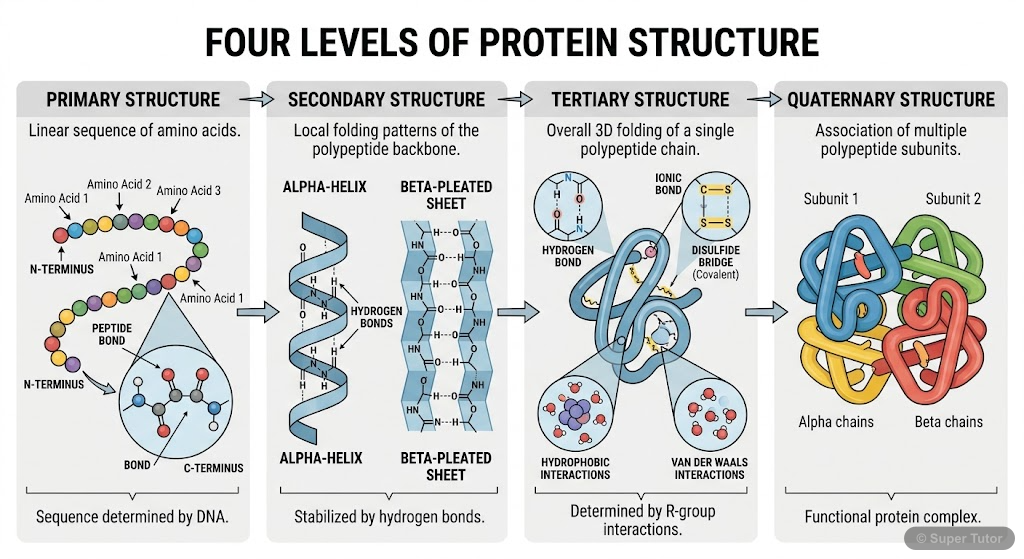
One of 32 illustrations for Biomolecules in Super Tutor — alongside flashcards, concept maps and practice questions.
The first 17 solutions are open to read. The other 16 are free with a Super Tutor account.
Intext Questions
10.1Glucose or sucrose are soluble in water but cyclohexane or benzene (simple six membered ring compounds) are insoluble in water. Explain.Show solution
Given: Glucose/sucrose vs. cyclohexane/benzene — all are six-membered ring compounds, yet solubility in water differs.
Concept: 'Like dissolves like' — polar solutes dissolve in polar solvents (water), non-polar solutes do not.
Explanation:
- Glucose and sucrose contain a large number of –OH (hydroxyl) groups in their structures. These –OH groups form hydrogen bonds with water molecules (H-bonding between O–H of solute and O–H of water). This strong interaction makes them readily soluble in water.
- Cyclohexane and benzene are non-polar hydrocarbons. They have no –OH or any other polar group capable of forming hydrogen bonds with water. Hence they are insoluble in water.
Conclusion: The presence of multiple –OH groups in glucose and sucrose enables extensive hydrogen bonding with water, making them water-soluble, whereas the non-polar nature of cyclohexane and benzene prevents any such interaction.
10.2What are the expected products of hydrolysis of lactose?Show solution
Given: Lactose undergoes hydrolysis.
Concept: Lactose is a disaccharide formed by a glycosidic linkage between one molecule of D-galactose and one molecule of D-glucose (β-1,4-glycosidic bond). On hydrolysis, the glycosidic bond is broken.
Reaction:
Answer: The expected products of hydrolysis of lactose are D-galactose and D-glucose (one molecule each).
10.3How do you explain the absence of aldehyde group in the pentaacetate of D-glucose?Show solution
Given: D-glucose forms a pentaacetate (reacts with 5 molecules of acetic anhydride).
Concept: If D-glucose existed only in the open-chain form, it would have 4 –OH groups and 1 –CHO group. Acetic anhydride acetylates free –OH groups; it does not react with –CHO groups. So the open-chain form should give a pentaacetate with the –CHO group still intact.
Explanation:
- In reality, D-glucose exists predominantly in the cyclic (pyranose) hemiacetal form. In the cyclic form, the –CHO group reacts intramolecularly with the –OH at C-5 to form a hemiacetal, generating a new –OH group at C-1 (anomeric carbon).
- This cyclic form now has 5 free –OH groups (at C-1, C-2, C-3, C-4, and C-6) and no free –CHO group.
- Acetic anhydride acetylates all 5 –OH groups to give glucose pentaacetate.
- Since all 5 acetyl groups have replaced –OH groups and no –CHO is present, the pentaacetate shows no aldehyde group.
Conclusion: The absence of –CHO in the pentaacetate of D-glucose confirms that glucose exists in the cyclic hemiacetal form in which the aldehyde carbon is involved in ring formation, converting –CHO into a –OH (at C-1), which then gets acetylated.
10.4The melting points and solubility in water of amino acids are generally higher than that of the corresponding halo acids. Explain.Show solution
Given: Amino acids have higher melting points and greater water solubility compared to corresponding halo acids (e.g., halo acetic acids).
Concept: Amino acids exist as zwitter ions (internal salts), whereas halo acids exist as covalent molecules.
Explanation:
- In amino acids, the –NH₂ group accepts a proton from the –COOH group to form a zwitter ion (dipolar ion): –CHR–.
- Because amino acids exist as ionic species (zwitter ions), they behave like salts. Ionic compounds have strong electrostatic (ionic) interactions between oppositely charged groups, requiring more energy to break — hence higher melting points.
- Halo acids (e.g., ClCH₂COOH) are covalent molecules with weaker intermolecular forces, so they have lower melting points.
- The ionic nature of zwitter ions also makes amino acids highly soluble in water (a polar solvent), since water solvates the charged groups effectively. Halo acids are less polar and hence less soluble.
Conclusion: The zwitter ionic (salt-like) nature of amino acids is responsible for their higher melting points and greater water solubility compared to halo acids.
10.5Where does the water present in the egg go after boiling the egg?Show solution
Given: An egg is boiled; the egg white (albumin protein) coagulates.
Concept: Denaturation of proteins — on heating, the secondary and tertiary structures of proteins are disrupted.
Explanation:
- Egg white contains the protein albumin dissolved/dispersed in water. In the native state, the protein chains are folded in specific three-dimensional structures stabilised by hydrogen bonds, disulfide bonds, etc.
- On boiling, the thermal energy disrupts these bonds. The protein chains unfold and get denatured.
- The denatured (unfolded) protein chains expose their hydrophobic groups and aggregate together, trapping water molecules within the coagulated protein network.
- The water does not escape; it gets entrapped (bound) within the coagulated/denatured protein mass.
Conclusion: The water present in the egg gets trapped (entrapped) within the coagulated denatured protein network after boiling. It is held inside the solid coagulated egg white.
10.6Why cannot vitamin C be stored in our body?Show solution
Given: Vitamin C (ascorbic acid) cannot be stored in the body.
Concept: Classification of vitamins based on solubility — fat-soluble (A, D, E, K) and water-soluble (B group and C).
Explanation:
- Vitamin C is a water-soluble vitamin. It dissolves readily in water (body fluids).
- Water-soluble vitamins are not stored in the body because any excess amount is readily excreted through urine by the kidneys.
- Unlike fat-soluble vitamins (A, D, E, K) which can be stored in adipose (fatty) tissue and liver, vitamin C has no storage depot in the body.
Conclusion: Since vitamin C is water-soluble, excess amounts are continuously excreted in urine and cannot be stored in the body. Therefore, it must be supplied regularly through diet.
10.7What products would be formed when a nucleotide from DNA containing thymine is hydrolysed?Show solution
Given: A nucleotide from DNA containing the base thymine is hydrolysed.
Concept: A nucleotide consists of three components: (i) a nitrogenous base, (ii) a pentose sugar, and (iii) a phosphate group. In DNA, the sugar is 2-deoxyribose.
Hydrolysis:
On complete hydrolysis, the nucleotide (thymidine monophosphate / deoxythymidine monophosphate) breaks down into:
- Thymine (nitrogenous base — a pyrimidine)
- 2-Deoxyribose (the pentose sugar present in DNA)
- Phosphoric acid ()
Answer: The products of hydrolysis are:
(i) Thymine
(ii) 2-Deoxyribose (deoxyribose sugar)
(iii) Phosphoric acid
10.8When RNA is hydrolysed, there is no relationship among the quantities of different bases obtained. What does this fact suggest about the structure of RNA?Show solution
Given: On hydrolysis of RNA, the four bases (adenine, guanine, cytosine, uracil) are obtained in no fixed ratio — i.e., [A] ≠ [U] and [G] ≠ [C].
Concept: In DNA (double-stranded), Chargaff's rule holds: A = T and G = C because of complementary base pairing between the two strands.
Explanation:
- In DNA, because of the double-helical complementary structure, adenine always pairs with thymine (A = T) and guanine always pairs with cytosine (G = C). This gives a fixed 1:1 ratio between complementary bases.
- In RNA, there is no such fixed ratio between the bases. This means RNA does not have a regular double-stranded complementary structure.
- The absence of a fixed ratio suggests that RNA is a single-stranded molecule. The bases are not required to be complementary to each other, so their quantities are not equal.
Conclusion: The fact that no fixed relationship exists among the quantities of different bases in RNA hydrolysate suggests that RNA is a single-stranded molecule (unlike the double-stranded complementary structure of DNA).
Exercises
10.1What are monosaccharides?Show solution
Definition: Monosaccharides are the simplest carbohydrates that cannot be hydrolysed further into smaller carbohydrate units.
Key features:
- They are the building blocks (monomeric units) of all carbohydrates.
- They are polyhydroxy aldehydes (aldoses) or polyhydroxy ketones (ketoses).
- They are classified on the basis of the number of carbon atoms: trioses (3C), tetroses (4C), pentoses (5C), hexoses (6C), heptoses (7C).
Examples: Glucose (), fructose (), ribose (), 2-deoxyribose ().
10.2What are reducing sugars?Show solution
Definition: Reducing sugars are carbohydrates that can reduce mild oxidising agents such as Fehling's solution or Tollens' reagent.
Structural basis:
- Reducing sugars contain a free aldehyde (–CHO) group or a free ketone (–C=O) group (or a potential free –CHO in the hemiacetal form) that can act as a reducing agent.
- All monosaccharides (both aldoses and ketoses) are reducing sugars.
- Among disaccharides, maltose and lactose are reducing sugars (they have a free anomeric –OH / hemiacetal group), whereas sucrose is a non-reducing sugar (both anomeric carbons are involved in the glycosidic bond).
Examples: Glucose, fructose, maltose, lactose.
10.3Write two main functions of carbohydrates in plants.Show solution
Two main functions of carbohydrates in plants:
- Energy storage: Carbohydrates serve as the primary energy reserve in plants. Starch is the main storage polysaccharide in plants (stored in seeds, tubers, roots). It is hydrolysed to glucose when energy is needed.
- Structural support: Cellulose, a polysaccharide made of D-glucose units linked by β-1,4-glycosidic bonds, forms the cell wall of plant cells. It provides rigidity, mechanical strength, and structural framework to the plant cell and plant body.
10.4Classify the following into monosaccharides and disaccharides. Ribose, 2-deoxyribose, maltose, galactose, fructose and lactose.Show solution
Classification:
Monosaccharides (cannot be hydrolysed further into simpler sugars):
- Ribose () — an aldopentose
- 2-Deoxyribose () — a deoxy aldopentose
- Galactose () — an aldohexose
- Fructose () — a ketohexose
Disaccharides (on hydrolysis give two monosaccharide units):
- Maltose — hydrolysis gives 2 molecules of D-glucose
- Lactose — hydrolysis gives D-glucose + D-galactose
10.5What do you understand by the term glycosidic linkage?Show solution
Definition: A glycosidic linkage (or glycosidic bond) is the bond formed between two monosaccharide units through the loss of a water molecule. It is an acetal (or ketal) type of linkage formed between the anomeric carbon (C-1 of aldose or C-2 of ketose) of one monosaccharide and the –OH group of another monosaccharide.
Formation:
The –C–O–C– linkage formed is called the glycosidic linkage.
Example: In maltose, two glucose units are joined by an α-1,4-glycosidic linkage (C-1 of one glucose to C-4 of another glucose). In sucrose, glucose and fructose are joined by an α,β-1,2-glycosidic linkage.
10.6What is glycogen? How is it different from starch?Show solution
Glycogen:
Glycogen is the storage polysaccharide of animals (and fungi). It is also called 'animal starch'. It is a polymer of D-glucose units linked by α-1,4-glycosidic bonds in the main chain and α-1,6-glycosidic bonds at branch points. It is stored mainly in the liver and muscles.
Differences between Glycogen and Starch:
| Property | Glycogen | Starch |
|---|---|---|
| Occurrence | Found in animals (liver, muscles) | Found in plants (seeds, tubers) |
| Structure | Highly branched; branching occurs every 8–10 glucose units | Amylose (unbranched, α-1,4 links) + Amylopectin (branched, α-1,4 and α-1,6 links); less branched than glycogen |
| Branching frequency | Very high (branch every 8–10 units) | Amylopectin branches every 24–30 units |
| Molecular mass | Very high | High |
| Colour with iodine | Gives red-brown colour | Gives blue-black colour (amylose) |
Both glycogen and starch are made of D-glucose units with α-glycosidic linkages.
10.7What are the hydrolysis products of (i) sucrose and (ii) lactose?Show solution
(i) Hydrolysis of Sucrose:
Sucrose is a disaccharide formed by α-D-glucose and β-D-fructose joined by an α,β-1,2-glycosidic bond.
Products: D-Glucose and D-Fructose (one molecule each).
(ii) Hydrolysis of Lactose:
Lactose is a disaccharide formed by β-D-galactose and D-glucose joined by a β-1,4-glycosidic bond.
Products: D-Galactose and D-Glucose (one molecule each).
10.8What is the basic structural difference between starch and cellulose?Show solution
Starch:
- Starch is a polymer of D-glucose in which the glucose units are joined by α-glycosidic linkages.
- It consists of two components: Amylose (linear, α-1,4-glycosidic bonds) and Amylopectin (branched, α-1,4 in chain and α-1,6 at branch points).
- The α-linkage gives starch a helical (coiled) structure.
- Starch is digestible by humans (enzyme amylase acts on α-linkages).
Cellulose:
- Cellulose is a polymer of D-glucose in which the glucose units are joined by β-glycosidic linkages (specifically β-1,4-glycosidic bonds).
- It is a linear, unbranched polymer.
- The β-linkage gives cellulose a straight, ribbon-like structure that allows chains to align and form strong hydrogen bonds, giving mechanical strength.
- Cellulose is not digestible by humans (we lack the enzyme cellulase to break β-linkages).
Key difference: Starch has α-1,4 (and α-1,6) glycosidic linkages, while cellulose has β-1,4 glycosidic linkages.
10.9What happens when D-glucose is treated with the following reagents? (i) HI (ii) Bromine water (iii) HNO₃Show solution
(i) D-Glucose + HI:
D-Glucose on prolonged treatment with HI (hydroiodic acid) undergoes reduction. All the –OH groups are replaced and the carbonyl group is also reduced. The product is n-hexane.
This confirms that all six carbon atoms of glucose are in a straight chain.
(ii) D-Glucose + Bromine water:
Bromine water is a mild oxidising agent. It oxidises only the aldehyde group (–CHO) to a carboxyl group (–COOH), without affecting the –OH groups.
Product: D-Gluconic acid.
This confirms the presence of an aldehyde group in glucose (distinguishes aldoses from ketoses, as ketoses do not decolourise bromine water).
(iii) D-Glucose + HNO₃:
HNO₃ (dilute nitric acid) is a stronger oxidising agent. It oxidises both the terminal groups — the aldehyde group (–CHO) at C-1 and the primary alcohol group (–CH₂OH) at C-6 — to carboxyl groups (–COOH).
Product: D-Saccharic acid (glucaric acid) — a dicarboxylic acid.
This confirms the presence of a primary alcohol group at C-6 in addition to the aldehyde at C-1.
Free with a Super Tutor account
Free with a Super Tutor account
Free with a Super Tutor account
Free with a Super Tutor account
Free with a Super Tutor account
Free with a Super Tutor account
Free with a Super Tutor account
Free with a Super Tutor account
Free with a Super Tutor account
Free with a Super Tutor account
Free with a Super Tutor account
Free with a Super Tutor account
Free with a Super Tutor account
Free with a Super Tutor account
Free with a Super Tutor account
Free with a Super Tutor account
16 more solved questions in Biomolecules
They are free with a Super Tutor account, along with practice quizzes and flashcards for this chapter. Free to start, no card needed.
Frequently Asked Questions
What are the important topics in Biomolecules for Madhya Pradesh Board Class 12 Chemistry?
Are these NCERT Solutions for Biomolecules free?
How should I revise Biomolecules for the Madhya Pradesh Board Class 12 board exam?
Sources & Official References
Content is aligned to the official syllabus. Refer to the board website for the latest curriculum.
More resources for Biomolecules
Practice Quiz
Test yourself with a quick quiz
Important Questions
Exam-style questions with answers
Revision Notes
Key points for last-minute revision
Formula Sheet
The chapter's formulas in one place
Chapter Summary
Understand the chapter at a glance
Concept Maps
See how topics connect
Study Plan
Step-by-step plan for this chapter
Flashcards
Quick-fire cards for active recall
Syllabus
What topics to cover
For serious students
Get the full Biomolecules chapter — start free.
Quizzes, flashcards, an AI doubt solver and a study plan for Madhya Pradesh Board Class 12 Chemistry. Free to start, no card needed.