Amines — Revision Notes
Madhya Pradesh Board · Class 12 · Chemistry
Amines revision notes for Madhya Pradesh Board Class 12 Chemistry: 4 topics in quick points. Part of the Madhya Pradesh Board Class 12 Chemistry syllabus.
Interactive on Super Tutor
Studying Amines? Get the full interactive chapter.
Quizzes, flashcards, AI doubt-solver and a step-by-step study plan — built for revision notes and more.
Free trial, no card needed.
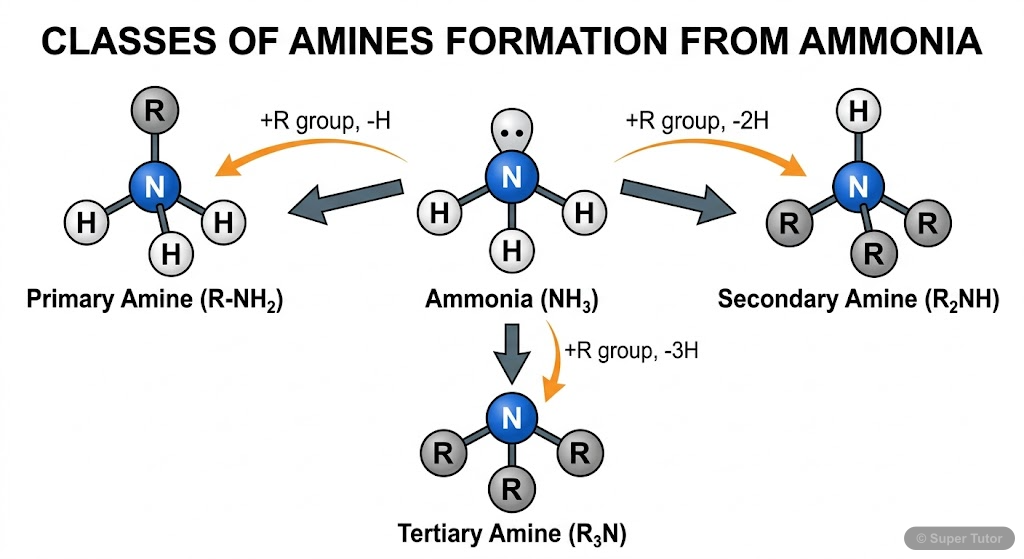
One of 21 illustrations for Amines in Super Tutor — alongside flashcards, concept maps and practice questions.
Key Topics to Revise
1. Structure, Nature, and Classification of Amines
- Amines are derivatives of ammonia obtained by replacing one or more hydrogen atoms of ammonia by alkyl or aryl groups.
- Amines are classified as primary, secondary, and tertiary depending on how many hydrogen atoms of ammonia are replaced.
- Amines are sp3 hybridised and have pyramidal geometry because nitrogen has one unshared pair of electrons.
2. Nomenclature of Amines
- In the common system, aliphatic amines are named as alkylamine, for example methylamine and ethylamine.
- For secondary and tertiary amines, di- or tri- is used when the groups are the same.
- In the IUPAC system, primary amines are named as alkanamines.
3. Preparation of Amines
- Amines are prepared by reduction of nitro compounds, ammonolysis of alkyl halides, reduction of nitriles, reduction of amides, Gabriel phthalimide synthesis, and Hoffmann bromamide degradation.
- Reduction of nitro compounds gives amines; iron scrap and hydrochloric acid are preferred because FeCl2 formed gets hydrolysed to release hydrochloric acid during the reaction.
- Ammonolysis is the reaction of alkyl halides with ethanolic ammonia in a sealed tube at 373 K.
4. Physical Properties and Basicity
- The lower aliphatic amines are gases with fishy odour.
- Primary amines with three or more carbon atoms are liquids, and still higher ones are solids.
- Aniline and other arylamines are usually colourless but become coloured on storage due to atmospheric oxidation.
Get complete notes with diagrams and examples
Full NotesKey Concepts
Frequently Asked Questions
What are the important topics in Amines for Madhya Pradesh Board Class 12 Chemistry?
How should I revise Amines for the Madhya Pradesh Board Class 12 board exam?
Sources & Official References
Content is aligned to the official syllabus. Refer to the board website for the latest curriculum.
More resources for Amines
Practice Quiz
Test yourself with a quick quiz
Important Questions
Exam-style questions with answers
Formula Sheet
The chapter's formulas in one place
Chapter Summary
Understand the chapter at a glance
Concept Maps
See how topics connect
Study Plan
Step-by-step plan for this chapter
Flashcards
Quick-fire cards for active recall
Syllabus
What topics to cover
NCERT Solutions
Every textbook question solved step by step
For serious students
Get the full Amines chapter — start free.
Quizzes, flashcards, an AI doubt solver and a study plan for Madhya Pradesh Board Class 12 Chemistry. Free to start, no card needed.