Solutions — NCERT Solutions
Madhya Pradesh Board · Class 12 · Chemistry
NCERT Solutions for Solutions, Madhya Pradesh Board Class 12 Chemistry: 53 textbook questions solved step by step.
Interactive on Super Tutor
Studying Solutions? Get the full interactive chapter.
Quizzes, flashcards, AI doubt-solver and a step-by-step study plan — built for NCERT solutions and more.
Free trial, no card needed.
Learn better with visuals Super Tutor pairs illustrations like this with notes and quizzes for Solutions.
The first 27 solutions are open to read. The other 26 are free with a Super Tutor account.
Intext Questions (Page – Concentration Terms)
1.1Calculate the mass percentage of benzene (C₆H₆) and carbon tetrachloride (CCl₄) if 22 g of benzene is dissolved in 122 g of carbon tetrachloride.Show solution
Given:
- Mass of benzene = 22 g
- Mass of carbon tetrachloride = 122 g
- Total mass of solution = 22 + 122 = 144 g
Formula:
Mass percentage of benzene:
Mass percentage of CCl₄:
Answer: Mass percentage of benzene = 15.28% and of CCl₄ = 84.72%
1.2Calculate the mole fraction of benzene in solution containing 30% by mass in carbon tetrachloride.Show solution
Given:
- 30% by mass benzene means 30 g of benzene in 100 g of solution.
- Mass of CCl₄ = 100 − 30 = 70 g
Molar masses:
- Benzene (C₆H₆):
- CCl₄:
Moles:
Mole fraction of benzene:
Mole fraction of CCl₄:
Answer: Mole fraction of benzene = 0.459 and of CCl₄ = 0.541
1.3Calculate the molarity of each of the following solutions: (a) 30 g of Co(NO₃)₂·6H₂O in 4.3 L of solution (b) 30 mL of 0.5 M H₂SO₄ diluted to 500 mL.Show solution
Formula:
(a) 30 g of Co(NO₃)₂·6H₂O in 4.3 L:
Molar mass of Co(NO₃)₂·6H₂O:
Moles of Co(NO₃)₂·6H₂O:
Molarity:
(b) 30 mL of 0.5 M H₂SO₄ diluted to 500 mL:
Using dilution formula:
Answer: (a) 0.024 M (b) 0.03 M
1.4Calculate the mass of urea (NH₂CONH₂) required in making 2.5 kg of 0.25 molal aqueous solution.Show solution
Given:
- Molality (m) = 0.25 mol kg⁻¹
- Total mass of solution = 2.5 kg
- Molar mass of urea (NH₂CONH₂) = 14 + 2 + 12 + 16 + 14 + 2 = 60 g mol⁻¹
Let mass of urea = g, then mass of water = g = kg
Using molality formula:
Answer: Mass of urea required = 36.946 g
1.5Calculate (a) molality (b) molarity and (c) mole fraction of KI if the density of 20% (mass/mass) aqueous KI is 1.202 g mL⁻¹.Show solution
Given:
- 20% (w/w) KI solution means 20 g KI in 100 g solution
- Mass of water = 100 − 20 = 80 g = 0.080 kg
- Density = 1.202 g mL⁻¹
- Molar mass of KI = 39 + 127 = 166 g mol⁻¹
- Molar mass of H₂O = 18 g mol⁻¹
Moles of KI:
Moles of water:
(a) Molality:
(b) Molarity:
Volume of 100 g solution:
(c) Mole fraction of KI:
Answer: (a) Molality = 1.5 mol kg⁻¹, (b) Molarity = 1.45 mol L⁻¹, (c) Mole fraction of KI = 0.0263
Intext Questions (Henry's Law)
1.6H₂S, a toxic gas with rotten egg like smell, is used for the qualitative analysis. If the solubility of H₂S in water at STP is 0.195 m, calculate Henry's law constant.Show solution
Given:
- Solubility of H₂S = 0.195 m (molality) = 0.195 mol per kg of water
- At STP, pressure of H₂S = 0.987 atm ≈ 1 atm = 101.325 kPa
Henry's Law:
Finding mole fraction of H₂S:
Moles of H₂S = 0.195 mol (in 1 kg = 1000 g of water)
Moles of H₂O = mol
Henry's law constant:
Converting to bar (1 atm = 1.013 bar):
Answer: Henry's law constant for H₂S = 282 atm (≈ 285.8 bar)
1.7Henry's law constant for CO₂ in water is 1.67×10⁸ Pa at 298 K. Calculate the quantity of CO₂ in 500 mL of soda water when packed under 2.5 atm CO₂ pressure at 298 K.Show solution
Given:
- Pa
- Pressure of CO₂ = 2.5 atm = Pa
- Volume of soda water = 500 mL → mass ≈ 500 g (assuming density ≈ 1 g/mL)
Henry's Law:
Finding moles of CO₂:
Moles of water in 500 g = mol
Since is very small:
Mass of CO₂:
Answer: The quantity of CO₂ in 500 mL of soda water = 1.85 g
Intext Questions (Vapour Pressure and Colligative Properties)
1.8The vapour pressure of pure liquids A and B are 450 and 700 mm Hg respectively, at 350 K. Find out the composition of the liquid mixture if total vapour pressure is 600 mm Hg. Also find the composition of the vapour phase.Show solution
Given:
- mm Hg, mm Hg
- mm Hg
Using Raoult's Law:
Composition of vapour phase:
Partial pressures:
Mole fractions in vapour phase:
Answer: Liquid phase: , ; Vapour phase: ,
1.9Vapour pressure of pure water at 298 K is 23.8 mm Hg. 50 g of urea (NH₂CONH₂) is dissolved in 850 g of water. Calculate the vapour pressure of water for this solution and its relative lowering.Show solution
Given:
- mm Hg
- Mass of urea = 50 g, Molar mass of urea = 60 g mol⁻¹
- Mass of water = 850 g, Molar mass of water = 18 g mol⁻¹
Moles:
Mole fraction of water:
Vapour pressure of solution (Raoult's Law):
Relative lowering of vapour pressure:
Answer: Vapour pressure of solution = 23.4 mm Hg; Relative lowering = 0.0173
1.10Boiling point of water at 750 mm Hg is 99.63°C. How much sucrose is to be added to 500 g of water such that it boils at 100°C?Show solution
Given:
- Normal boiling point of water = 99.63°C
- Desired boiling point = 100°C
- Elevation in boiling point: K
- for water = 0.52 K kg mol⁻¹
- Mass of water = 500 g = 0.5 kg
- Molar mass of sucrose (C₁₂H₂₂O₁₁) = 342 g mol⁻¹
Using:
Moles of sucrose needed:
Mass of sucrose:
Answer: Mass of sucrose to be added = 121.67 g
1.11Calculate the mass of ascorbic acid (Vitamin C, C₆H₈O₆) to be dissolved in 75 g of acetic acid to lower its melting point by 1.5°C. Kf = 3.9 K kg mol⁻¹.Show solution
Given:
- Depression in freezing point: K
- K kg mol⁻¹
- Mass of acetic acid (solvent) = 75 g = 0.075 kg
- Molar mass of ascorbic acid (C₆H₈O₆) = g mol⁻¹
Using:
Moles of ascorbic acid:
Mass of ascorbic acid:
Answer: Mass of ascorbic acid required = 5.077 g
1.12Calculate the osmotic pressure in pascals exerted by a solution prepared by dissolving 1.0 g of polymer of molar mass 185,000 in 450 mL of water at 37°C.Show solution
Given:
- Mass of polymer = 1.0 g
- Molar mass = 185,000 g mol⁻¹
- Volume = 450 mL = 0.450 L
- Temperature = 37°C = 310 K
- Pa m³ mol⁻¹ K⁻¹ = 8.314 J mol⁻¹ K⁻¹
Moles of polymer:
Concentration:
Osmotic pressure:
Answer: Osmotic pressure = 30.96 Pa
Exercises
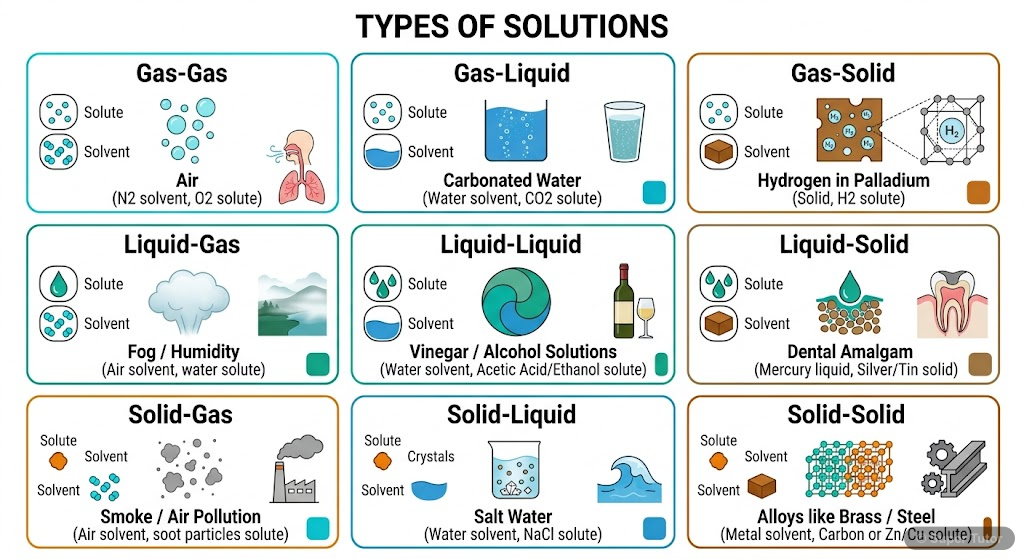
1.1Define the term solution. How many types of solutions are formed? Write briefly about each type with an example.Show solution
Definition of Solution:
A solution is a homogeneous mixture of two or more chemically non-reacting substances. The component present in the largest amount is called the solvent and the other component(s) are called solute(s).
Types of Solutions:
Depending on the physical states of solute and solvent, nine types of solutions are possible:
| S.No. | Type of Solution | Solute | Solvent | Example |
|---|---|---|---|---|
| 1 | Gas in Gas | Gas | Gas | Air (mixture of O₂, N₂, etc.) |
| 2 | Gas in Liquid | Gas | Liquid | CO₂ dissolved in water (soda water) |
| 3 | Gas in Solid | Gas | Solid | H₂ dissolved in palladium |
| 4 | Liquid in Gas | Liquid | Gas | Water vapour in air (humidity) |
| 5 | Liquid in Liquid | Liquid | Liquid | Ethanol in water |
| 6 | Liquid in Solid | Liquid | Solid | Mercury in zinc (amalgam) |
| 7 | Solid in Gas | Solid | Gas | Camphor vapours in N₂ |
| 8 | Solid in Liquid | Solid | Liquid | Salt (NaCl) in water |
| 9 | Solid in Solid | Solid | Solid | Copper dissolved in gold (alloy) |
The most common type of solution is solid in liquid (e.g., salt in water).
1.2Give an example of a solid solution in which the solute is a gas.Show solution
Answer:
An example of a solid solution in which the solute is a gas is hydrogen dissolved in palladium (Pd).
In this solution, hydrogen gas (solute) is dissolved in solid palladium (solvent). Palladium can absorb large volumes of hydrogen gas to form a solid solution.
Another example: dissolved gases in minerals (e.g., O₂ or N₂ dissolved in certain minerals).
1.3Define the following terms: (i) Mole fraction (ii) Molality (iii) Molarity (iv) Mass percentage.Show solution
(i) Mole Fraction:
Mole fraction of a component in a solution is defined as the ratio of the number of moles of that component to the total number of moles of all components present in the solution.
For a binary solution with components A and B:
Note: . Mole fraction is dimensionless and independent of temperature.
(ii) Molality:
Molality (m) is defined as the number of moles of solute dissolved per kilogram of solvent.
Unit: mol kg⁻¹. It is independent of temperature.
(iii) Molarity:
Molarity (M) is defined as the number of moles of solute dissolved per litre (dm³) of solution.
Unit: mol L⁻¹ (M). It depends on temperature since volume changes with temperature.
(iv) Mass Percentage:
Mass percentage of a component in a solution is defined as the mass of that component present per 100 g of the solution.
It is dimensionless and independent of temperature.
1.4Concentrated nitric acid used in laboratory work is 68% nitric acid by mass in aqueous solution. What should be the molarity of such a sample of the acid if the density of the solution is 1.504 g mL⁻¹?Show solution
Given:
- Mass percentage of HNO₃ = 68%
- Density of solution = 1.504 g mL⁻¹
- Molar mass of HNO₃ = 1 + 14 + 48 = 63 g mol⁻¹
Step 1: Consider 1 L (1000 mL) of solution.
Mass of 1 L solution = g
Step 2: Mass of HNO₃ in 1504 g solution:
Step 3: Moles of HNO₃:
Step 4: Molarity:
Answer: Molarity of concentrated HNO₃ = 16.23 M
1.5A solution of glucose in water is labelled as 10% w/w, what would be the molality and mole fraction of each component in the solution? If the density of solution is 1.2 g mL⁻¹, then what shall be the molarity of the solution?Show solution
Given:
- 10% w/w glucose solution → 10 g glucose in 100 g solution
- Mass of water = 100 − 10 = 90 g = 0.090 kg
- Molar mass of glucose (C₆H₁₂O₆) = 180 g mol⁻¹
- Molar mass of water = 18 g mol⁻¹
- Density = 1.2 g mL⁻¹
Moles:
(a) Molality:
(b) Mole fractions:
(c) Molarity:
Volume of 100 g solution:
Answer: Molality = 0.617 mol kg⁻¹; = 0.011, = 0.989; Molarity = 0.667 mol L⁻¹
1.6How many mL of 0.1 M HCl are required to react completely with 1 g mixture of Na₂CO₃ and NaHCO₃ containing equimolar amounts of both?Show solution
Given:
- 1 g mixture of Na₂CO₃ and NaHCO₃ in equimolar amounts
- Concentration of HCl = 0.1 M
Molar masses:
- Na₂CO₃ = 106 g mol⁻¹
- NaHCO₃ = 84 g mol⁻¹
Let moles of each = (equimolar)
Total mass:
Reactions with HCl:
Moles of HCl required:
- For Na₂CO₃: mol
- For NaHCO₃: mol
- Total moles of HCl = mol
Volume of 0.1 M HCl:
Answer: Volume of 0.1 M HCl required = 157.9 mL
1.7A solution is obtained by mixing 300 g of 25% solution and 400 g of 40% solution by mass. Calculate the mass percentage of the resulting solution.Show solution
Given:
- Solution 1: 300 g of 25% (by mass)
- Solution 2: 400 g of 40% (by mass)
Mass of solute in Solution 1:
Mass of solute in Solution 2:
Total mass of solute:
Total mass of solution:
Mass percentage of resulting solution:
Answer: Mass percentage of the resulting solution = 33.57%
1.8An antifreeze solution is prepared from 222.6 g of ethylene glycol (C₂H₆O₂) and 200 g of water. Calculate the molality of the solution. If the density of the solution is 1.072 g mL⁻¹, then what shall be the molarity of the solution?Show solution
Given:
- Mass of ethylene glycol = 222.6 g
- Molar mass of C₂H₆O₂ = 2(12) + 6(1) + 2(16) = 62 g mol⁻¹
- Mass of water = 200 g = 0.200 kg
- Density of solution = 1.072 g mL⁻¹
Moles of ethylene glycol:
(a) Molality:
(b) Molarity:
Total mass of solution = 222.6 + 200 = 422.6 g
Volume of solution:
Answer: Molality = 17.95 mol kg⁻¹; Molarity = 9.11 mol L⁻¹
1.9A sample of drinking water was found to be severely contaminated with chloroform (CHCl₃) supposed to be a carcinogen. The level of contamination was 15 ppm (by mass): (i) express this in percent by mass (ii) determine the molality of chloroform in the water sample.Show solution
Given:
- Contamination level = 15 ppm (by mass)
- 15 ppm means 15 g of CHCl₃ per 10⁶ g of solution
- Molar mass of CHCl₃ = 12 + 1 + 3(35.5) = 119.5 g mol⁻¹
(i) Percent by mass:
(ii) Molality:
In 10⁶ g of solution: 15 g CHCl₃ and (10⁶ − 15) ≈ 10⁶ g water ≈ 1000 kg water
Moles of CHCl₃:
Molality:
Answer: (i) 1.5 × 10⁻³ % (ii) Molality = 1.255 × 10⁻⁴ mol kg⁻¹
1.10What role does the molecular interaction play in a solution of alcohol and water?Show solution
Answer:
Pure water molecules are held together by strong hydrogen bonds (O–H···O). Pure alcohol molecules are also held together by hydrogen bonds, but these are weaker than those in water.
When alcohol and water are mixed:
- New hydrogen bonds form between alcohol (–OH) and water (H₂O) molecules.
- However, the new interactions (alcohol–water) are weaker than the original water–water hydrogen bonds.
- This results in positive deviation from Raoult's law — the vapour pressure of the solution is higher than expected.
- The solution shows an increase in volume (ΔV > 0) and is endothermic (ΔH > 0) on mixing.
In summary, the molecular interactions between alcohol and water are weaker than those in pure components, leading to positive deviation from ideal behaviour.
1.11Why do gases always tend to be less soluble in liquids as the temperature is raised?Show solution
Answer:
The dissolution of a gas in a liquid is an exothermic process:
According to Le Chatelier's Principle, when temperature is increased, the equilibrium shifts in the direction that absorbs heat, i.e., in the reverse direction (towards the gas phase).
This means that at higher temperatures, more gas molecules escape from the solution back into the gas phase, thereby decreasing the solubility of the gas.
Also, at higher temperatures, gas molecules have greater kinetic energy and can overcome the intermolecular forces holding them in solution, making them less soluble.
Conclusion: Gases are always less soluble in liquids as temperature increases because dissolution is exothermic and Le Chatelier's principle favours the reverse reaction at higher temperatures.
1.12State Henry's law and mention some important applications.Show solution
Henry's Law:
At a constant temperature, the solubility of a gas in a liquid is directly proportional to the partial pressure of the gas above the liquid. Mathematically:
where = partial pressure of the gas, = mole fraction of the gas in solution, and = Henry's law constant (characteristic of the gas-liquid system at a given temperature).
Important Applications:
- Carbonated beverages: CO₂ is dissolved in soft drinks under high pressure. When the bottle is opened, pressure decreases and CO₂ escapes, causing fizzing.
- Scuba diving (Bends): At high pressure underwater, N₂ dissolves in the blood. If a diver ascends too quickly, N₂ comes out of solution rapidly forming bubbles in the blood, causing a painful and dangerous condition called 'bends'. To avoid this, scuba tanks are filled with air diluted with helium.
- Anoxia at high altitudes: At high altitudes, partial pressure of O₂ is low, so less O₂ dissolves in blood, causing anoxia (oxygen deficiency), making climbers weak.
- Respiration: Oxygen dissolves in blood in the lungs (high O₂ pressure) and is released in tissues (low O₂ pressure).
1.13The partial pressure of ethane over a solution containing 6.56 × 10⁻³ g of ethane is 1 bar. If the solution contains 5.00 × 10⁻² g of ethane, then what shall be the partial pressure of the gas?Show solution
Given:
- Case 1: mass of ethane = g, partial pressure bar
- Case 2: mass of ethane = g, partial pressure
Using Henry's Law:
At constant temperature, for the same solvent, the mole fraction (and hence mass, for dilute solutions) is proportional to partial pressure.
Since the solvent amount is the same:
Answer: Partial pressure of ethane = 7.62 bar
1.14What is meant by positive and negative deviations from Raoult's law and how is the sign of ΔmixH related to positive and negative deviations from Raoult's law?Show solution
Raoult's Law for ideal solutions:
Positive Deviation from Raoult's Law:
- The observed vapour pressure is greater than predicted by Raoult's law.
- This occurs when solute-solvent interactions are weaker than solute-solute and solvent-solvent interactions.
- The molecules escape more easily into vapour phase.
- (endothermic mixing) — heat is absorbed.
- — volume increases on mixing.
- Example: ethanol + water, acetone + carbon disulphide.
Negative Deviation from Raoult's Law:
- The observed vapour pressure is less than predicted by Raoult's law.
- This occurs when solute-solvent interactions are stronger than solute-solute and solvent-solvent interactions.
- Molecules are held more tightly in solution.
- (exothermic mixing) — heat is released.
- — volume decreases on mixing.
- Example: chloroform + acetone, HCl + water.
Relation of to deviations:
- Positive deviation → (endothermic)
- Negative deviation → (exothermic)
1.15An aqueous solution of 2% non-volatile solute exerts a pressure of 1.004 bar at the normal boiling point of the solvent. What is the molar mass of the solute?Show solution
Given:
- 2% (w/w) non-volatile solute → 2 g solute in 100 g solution → 98 g water
- Vapour pressure of solution, bar
- At normal boiling point of water, bar (1 atm)
- Molar mass of water = 18 g mol⁻¹
Using Raoult's Law:
Moles of water:
Let molar mass of solute = g mol⁻¹
Since is small:
Answer: Molar mass of solute ≈ 41.37 g mol⁻¹
Free with a Super Tutor account
Free with a Super Tutor account
Free with a Super Tutor account
Free with a Super Tutor account
Free with a Super Tutor account
Free with a Super Tutor account
Free with a Super Tutor account
Free with a Super Tutor account
Free with a Super Tutor account
Free with a Super Tutor account
Free with a Super Tutor account
Free with a Super Tutor account
Free with a Super Tutor account
Free with a Super Tutor account
Free with a Super Tutor account
Free with a Super Tutor account
Free with a Super Tutor account
Free with a Super Tutor account
Free with a Super Tutor account
Free with a Super Tutor account
Free with a Super Tutor account
Free with a Super Tutor account
Free with a Super Tutor account
Free with a Super Tutor account
Free with a Super Tutor account
Free with a Super Tutor account
26 more solved questions in Solutions
They are free with a Super Tutor account, along with practice quizzes and flashcards for this chapter. Free to start, no card needed.
Frequently Asked Questions
What are the important topics in Solutions for Madhya Pradesh Board Class 12 Chemistry?
Are these NCERT Solutions for Solutions free?
How should I revise Solutions for the Madhya Pradesh Board Class 12 board exam?
Sources & Official References
Content is aligned to the official syllabus. Refer to the board website for the latest curriculum.
More resources for Solutions
Practice Quiz
Test yourself with a quick quiz
Important Questions
Exam-style questions with answers
Revision Notes
Key points for last-minute revision
Formula Sheet
The chapter's formulas in one place
Chapter Summary
Understand the chapter at a glance
Concept Maps
See how topics connect
Study Plan
Step-by-step plan for this chapter
Flashcards
Quick-fire cards for active recall
Syllabus
What topics to cover
For serious students
Get the full Solutions chapter — start free.
Quizzes, flashcards, an AI doubt solver and a study plan for Madhya Pradesh Board Class 12 Chemistry. Free to start, no card needed.