Coordination Compounds — Revision Notes
Madhya Pradesh Board · Class 12 · Chemistry
Coordination Compounds revision notes for Madhya Pradesh Board Class 12 Chemistry: 4 topics in quick points. Includes Werner's Theory and Basic Terms.
Interactive on Super Tutor
Studying Coordination Compounds? Get the full interactive chapter.
Quizzes, flashcards, AI doubt-solver and a step-by-step study plan — built for revision notes and more.
Free trial, no card needed.
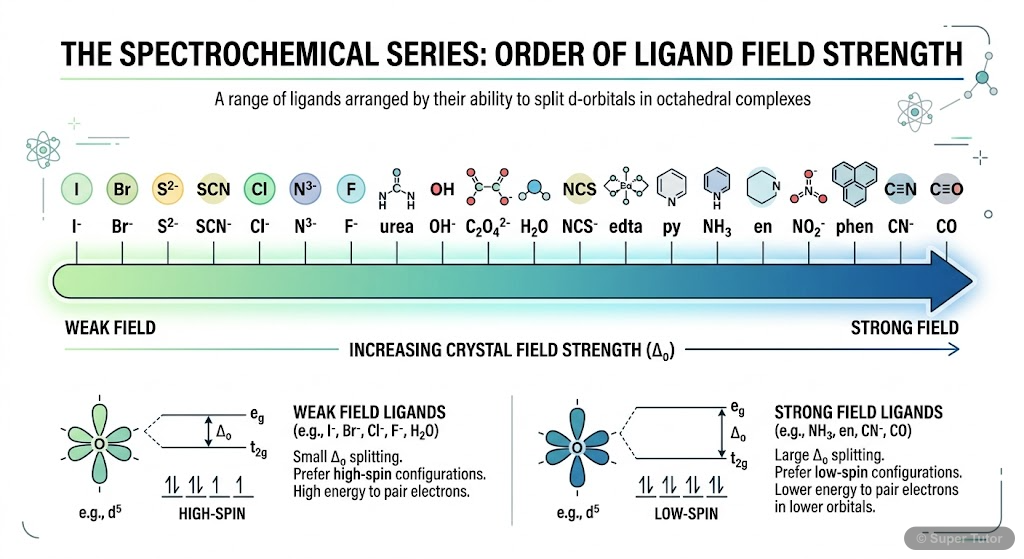
Learn better with visuals Super Tutor pairs illustrations like this with notes and quizzes for Coordination Compounds.
Key Topics to Revise
1. Werner's Theory and Basic Terms
- Alfred Werner first formulated the theory of coordination compounds.
- Werner proposed two types of valence: primary valence and secondary valence.
- Primary valence is ionisable and is satisfied by negative ions.
2. Ligands, Denticity, and Chelation
- Ligands may be simple ions, small molecules, or large molecules.
- Unidentate ligands bind through one donor atom.
- Didentate ligands bind through two donor atoms.
3. Nomenclature of Coordination Compounds
- The formula of a coordination compound is written with the metal first, then ligands in alphabetical order.
- The whole coordination entity is enclosed in square brackets.
- When the coordination entity is charged, the charge is written outside the brackets as a right superscript.
4. Isomerism in Coordination Compounds
- Isomers have the same chemical formula but different arrangement of atoms.
- Coordination compounds show stereoisomerism and structural isomerism.
- Stereoisomerism includes geometrical and optical isomerism.
Get complete notes with diagrams and examples
Full NotesKey Concepts
Frequently Asked Questions
What are the important topics in Coordination Compounds for Madhya Pradesh Board Class 12 Chemistry?
How should I revise Coordination Compounds for the Madhya Pradesh Board Class 12 board exam?
Sources & Official References
Content is aligned to the official syllabus. Refer to the board website for the latest curriculum.
More resources for Coordination Compounds
Practice Quiz
Test yourself with a quick quiz
Important Questions
Exam-style questions with answers
Chapter Summary
Understand the chapter at a glance
Concept Maps
See how topics connect
Study Plan
Step-by-step plan for this chapter
Flashcards
Quick-fire cards for active recall
Syllabus
What topics to cover
NCERT Solutions
Every textbook question solved step by step
For serious students
Get the full Coordination Compounds chapter — start free.
Quizzes, flashcards, an AI doubt solver and a study plan for Madhya Pradesh Board Class 12 Chemistry. Free to start, no card needed.