Semiconductor Electronics: Materials, Devices and Simple Circuits — Flashcards
Madhya Pradesh Board · Class 12 · Physics
60 flashcards for Semiconductor Electronics: Materials, Devices and Simple Circuits (Madhya Pradesh Board Class 12 Physics) to test yourself on key terms.
Interactive on Super Tutor
Studying Semiconductor Electronics: Materials, Devices and Simple Circuits? Get the full interactive chapter.
Quizzes, flashcards, AI doubt-solver and a step-by-step study plan — built for flashcards and more.
Free trial, no card needed.
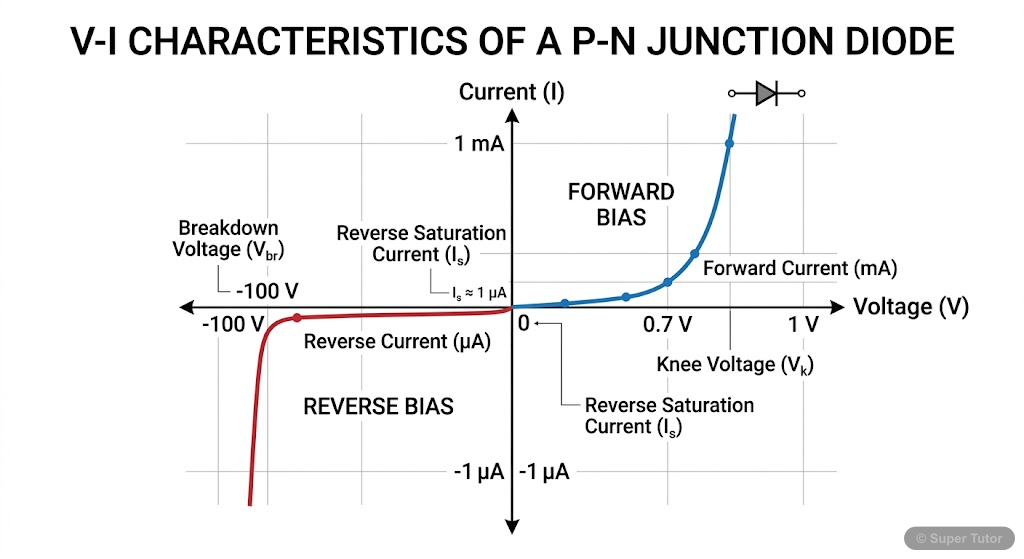
Learn better with visuals Super Tutor pairs illustrations like this with notes and quizzes for Semiconductor Electronics: Materials, Devices and Simple Circuits.
धातुओं, अर्धचालकों, और कुचालकों की प्रतिरोधकता की सीमा बताइए।
Answer
धातु: 10^-2 से 10^-8 ohm m. अर्धचालक: 10^-5 से 10^6 ohm m. कुचालक: 10^11 से 10^19 ohm m. ये सीमाएँ दिखाती हैं कि धातु सबसे अच्छा चालन करते हैं, अर्धचालक बीच के होते हैं, और कुचालक सबसे कम चालन करते है…
State the resistivity range of metals, semiconductors, and insulators.
Answer
Metals: 10^-2 to 10^-8 ohm m. Semiconductors: 10^-5 to 10^6 ohm m. Insulators: 10^11 to 10^19 ohm m. These ranges show that metals conduct best, semiconductors are intermediate, and insulators conduct…
Why is silicon used as a semiconductor while carbon in diamond form is an insulator?
Answer
Silicon has a smaller energy gap of 1.1 eV, so some electrons can jump to the conduction band at room temperature. Diamond has a much larger energy gap of 5.4 eV, so electrons cannot cross easily. Tha…
सिलिकॉन का उपयोग अर्धचालक के रूप में क्यों किया जाता है जबकि हीरे के रूप में कार्बन एक कुचालक है?
Answer
सिलिकॉन का ऊर्जा अंतराल 1.1 eV का छोटा है, इसलिए कमरे के तापमान पर कुछ इलेक्ट्रॉन चालन बैंड में कूद सकते हैं। हीरे का ऊर्जा अंतराल 5.4 eV बहुत बड़ा है, इसलिए इलेक्ट्रॉन आसानी से पार नहीं कर सकते। इसी …
एक अर्धचालक में तापीय साम्यावस्था पर इलेक्ट्रॉन सांद्रता n_e = 2.5 x 10^16 m^-3 है। यदि यह अंतर्जात है, तो होल सांद्रता ज्ञात कीजिए।
Answer
अंतर्जात अर्धचालक के लिए, n_e = n_h = n_i. चरण 1: दिया है n_e = 2.5 x 10^16 m^-3 चरण 2: अतः n_h = n_e उत्तर: n_h = 2.5 x 10^16 m^-3…
A semiconductor has electron concentration n_e = 2.5 x 10^16 m^-3 in thermal equilibrium. Find the hole concentration if it is intrinsic.
Answer
For an intrinsic semiconductor, n_e = n_h = n_i. Step 1: Given n_e = 2.5 x 10^16 m^-3 Step 2: Therefore n_h = n_e Answer: n_h = 2.5 x 10^16 m^-3…
State the relation between electron concentration and hole concentration in an intrinsic semiconductor.
Answer
n_e = n_h = n_i Here n_e is electron concentration, n_h is hole concentration, and n_i is intrinsic carrier concentration. In an intrinsic semiconductor, the number of free electrons equals the number…
अंतर्जात अर्धचालक में इलेक्ट्रॉन सांद्रता और होल सांद्रता के बीच संबंध बताइए।
Answer
n_e = n_h = n_i यहाँ n_e इलेक्ट्रॉन सांद्रता है, n_h होल सांद्रता है, और n_i अंतर्जात वाहक सांद्रता है। अंतर्जात अर्धचालक में मुक्त इलेक्ट्रॉनों की संख्या होलों की संख्या के बराबर होती है।…
+52 more flashcards
Practise AllFrequently Asked Questions
What are the important topics in Semiconductor Electronics: Materials, Devices and Simple Circuits for Madhya Pradesh Board Class 12 Physics?
How many flashcards are available for Semiconductor Electronics: Materials, Devices and Simple Circuits?
How should I revise Semiconductor Electronics: Materials, Devices and Simple Circuits for the Madhya Pradesh Board Class 12 board exam?
Sources & Official References
Content is aligned to the official syllabus. Refer to the board website for the latest curriculum.
More resources for Semiconductor Electronics: Materials, Devices and Simple Circuits
Practice Quiz
Test yourself with a quick quiz
Important Questions
Exam-style questions with answers
Revision Notes
Key points for last-minute revision
Formula Sheet
The chapter's formulas in one place
Chapter Summary
Understand the chapter at a glance
Concept Maps
See how topics connect
Study Plan
Step-by-step plan for this chapter
Syllabus
What topics to cover
NCERT Solutions
Every textbook question solved step by step
For serious students
Get the full Semiconductor Electronics: Materials, Devices and Simple Circuits chapter — start free.
Quizzes, flashcards, an AI doubt solver and a study plan for Madhya Pradesh Board Class 12 Physics. Free to start, no card needed.