Semiconductor Electronics: Materials, Devices and Simple Circuits — Chapter Summary
Madhya Pradesh Board · Class 12 · Physics
Summary of Semiconductor Electronics: Materials, Devices and Simple Circuits for Madhya Pradesh Board Class 12 Physics.
Interactive on Super Tutor
Studying Semiconductor Electronics: Materials, Devices and Simple Circuits? Get the full interactive chapter.
Quizzes, flashcards, AI doubt-solver and a step-by-step study plan — built for chapter summary and more.
Free trial, no card needed.
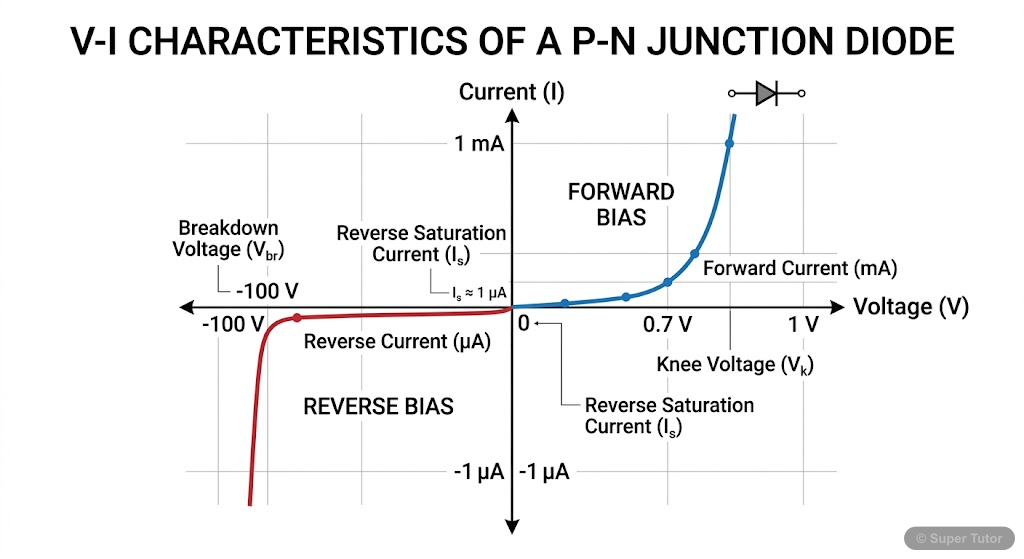
Learn better with visuals Super Tutor pairs illustrations like this with notes and quizzes for Semiconductor Electronics: Materials, Devices and Simple Circuits.
Overview
Semiconductor electronics is the study of materials and devices that control the flow of electric charge. The chapter begins with the shift from vacuum tube devices to semiconductor devices, then explains how solids are classified as metals, semiconductors, and insulators using resistivity and energ
Key Concepts
Metals have very low resistivity
Metals have very low resistivity in the range 10^-2 to 10^-8 Ω m, semiconductors have intermediate resistivity in the range 10^-5 to 10^6 Ω m, and ins
Metals have overlapping or partially filled
Metals have overlapping or partially filled bands with Eg ≈ 0, insulators have a large band gap Eg > 3 eV, and semiconductors have a small band gap Eg
In a pure semiconductor
In a pure semiconductor, the number of free electrons equals the number of holes, so n_e = n_h = n_i. A hole is a vacancy with effective positive char
When a valence electron leaves its
When a valence electron leaves its bond, it creates a vacancy called a hole. Electron motion gives electron current I_e and hole motion gives hole cur
Adding a small amount of impurity
Adding a small amount of impurity changes the conductivity greatly. Doping a tetravalent semiconductor like Si or Ge with pentavalent impurities such
Learning Objectives
- Understand why semiconductors are useful in electronic devices
- Classify solids on the basis of resistivity and energy-band structure
- Explain intrinsic conduction using electrons and holes
- Describe doping and formation of n-type and p-type semiconductors
- Understand p-n junction formation, depletion region, and barrier potential
Frequently Asked Questions
What are the important topics in Semiconductor Electronics: Materials, Devices and Simple Circuits for Madhya Pradesh Board Class 12 Physics?
How should I revise Semiconductor Electronics: Materials, Devices and Simple Circuits for the Madhya Pradesh Board Class 12 board exam?
Sources & Official References
Content is aligned to the official syllabus. Refer to the board website for the latest curriculum.
More resources for Semiconductor Electronics: Materials, Devices and Simple Circuits
Practice Quiz
Test yourself with a quick quiz
Important Questions
Exam-style questions with answers
Revision Notes
Key points for last-minute revision
Formula Sheet
The chapter's formulas in one place
Concept Maps
See how topics connect
Study Plan
Step-by-step plan for this chapter
Flashcards
Quick-fire cards for active recall
Syllabus
What topics to cover
NCERT Solutions
Every textbook question solved step by step
For serious students
Get the full Semiconductor Electronics: Materials, Devices and Simple Circuits chapter — start free.
Quizzes, flashcards, an AI doubt solver and a study plan for Madhya Pradesh Board Class 12 Physics. Free to start, no card needed.