Structural Change — Syllabus
Madhya Pradesh Board · Class 12 · Sociology
What Structural Change covers in Madhya Pradesh Board Class 12 Sociology: 4 topics, for the 2026-27 session. Topics include Understanding Colonialism.
Interactive on Super Tutor
Studying Structural Change? Get the full interactive chapter.
Quizzes, flashcards, AI doubt-solver and a step-by-step study plan — built for syllabus and more.
Free trial, no card needed.
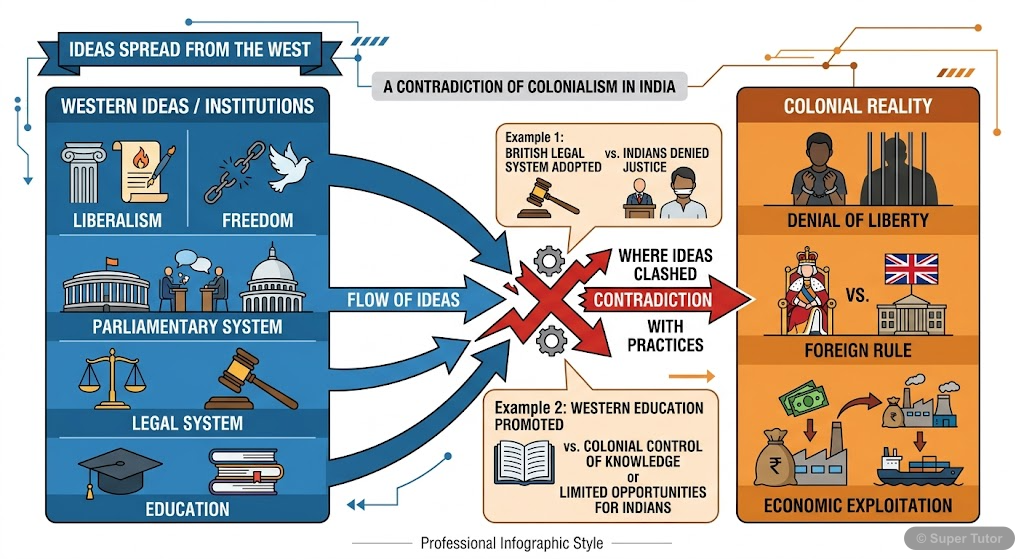
One of 9 illustrations for Structural Change in Super Tutor — alongside flashcards, concept maps and practice questions.
Topics in Structural Change
1. Understanding Colonialism
- Colonialism simply means the establishment of rule by one country over another.
- British colonialism was capitalist-type colonialism and was different from earlier pre-capitalist conquest.
- Pre-capitalist conquerors generally extracted tribute without interfering with the economic base.
2. Industrialisation in Britain and India
- Industrialisation means the emergence of machine production based on inanimate power resources like steam or electricity.
- In Britain, industrialisation and urbanisation moved together.
- In 1800, well under 20% of Britain’s population lived in towns or cities of more than 10,000 people; by 1900 this became 74%.
3. Decline of Old Urban Centres and Rise of Colonial Cities
- Cities had a key role in imperial economic systems.
- Coastal cities such as Kolkata, Mumbai, and Chennai were favoured under colonial rule.
- These cities linked the economic core in Britain with the periphery in India.
4. Colonial Urban Life and the South Asian City
- The South Asian colonial city had a clear separation between the European town and the native town.
- The European town had spacious bungalows, elegant apartment houses, planned streets, trees on both sides of the street, and clubs for afternoon and evening get-togethers.
- Open spaces in the European town were reserved for Western recreational facilities such as race and golf courses, soccer, and cricket.
Key Concepts
Central concept: Colonialism and structural change in India
Work through every topic in Structural Change with notes and quizzes
Start This ChapterFrequently Asked Questions
What are the important topics in Structural Change for Madhya Pradesh Board Class 12 Sociology?
How should I revise Structural Change for the Madhya Pradesh Board Class 12 board exam?
Sources & Official References
Content is aligned to the official syllabus. Refer to the board website for the latest curriculum.
More resources for Structural Change
Practice Quiz
Test yourself with a quick quiz
Important Questions
Exam-style questions with answers
Revision Notes
Key points for last-minute revision
Chapter Summary
Understand the chapter at a glance
Concept Maps
See how topics connect
Study Plan
Step-by-step plan for this chapter
Flashcards
Quick-fire cards for active recall
NCERT Solutions
Every textbook question solved step by step
For serious students
Get the full Structural Change chapter — start free.
Quizzes, flashcards, an AI doubt solver and a study plan for Madhya Pradesh Board Class 12 Sociology. Free to start, no card needed.