The Market as a Social Institution — Syllabus
Madhya Pradesh Board · Class 12 · Sociology
What The Market as a Social Institution covers in Madhya Pradesh Board Class 12 Sociology: 4 topics, for the 2026-27 session.
Interactive on Super Tutor
Studying The Market as a Social Institution? Get the full interactive chapter.
Quizzes, flashcards, AI doubt-solver and a step-by-step study plan — built for syllabus and more.
Free trial, no card needed.
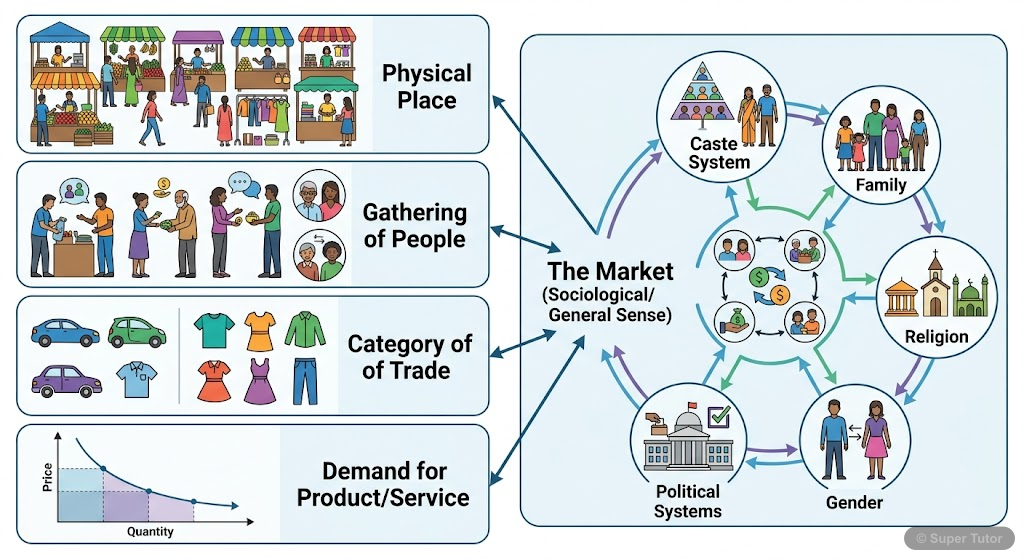
Learn better with visuals Super Tutor pairs illustrations like this with notes and quizzes for The Market as a Social Institution.
Topics in The Market as a Social Institution
1. Meaning of Market and the Sociological View
- 'Market' can mean a physical place, a group of buyers and sellers, a sector of trade, or demand for a product or service.
- In a broad sense, the market is almost equal to the economy.
- Sociology studies markets as social institutions, not only as economic mechanisms.
2. Weekly Markets and Tribal Economies
- Weekly markets are a central feature of many agrarian societies.
- They bring together villagers to sell produce and buy goods not available locally.
- They also attract traders, moneylenders, entertainers, astrologers, and other specialists.
3. Caste-Based Trade and Banking
- Pre-colonial India had organised trading communities, merchant networks, and banking systems.
- India was already extensively monetised in the late pre-colonial period.
- The jajmani system is a non-market exchange system.
4. Colonialism and New Business Communities
- Colonialism disrupted production, trade, and agriculture in India.
- Before colonisation, India was a major supplier of manufactured goods to the world market.
- After colonisation, India became a source of raw materials and agricultural products and a consumer of manufactured goods.
Key Concepts
Central concept: Market as a social institution shaped by economy, caste, class, culture, and power
Work through every topic in The Market as a Social Institution with notes and quizzes
Start This ChapterFrequently Asked Questions
What are the important topics in The Market as a Social Institution for Madhya Pradesh Board Class 12 Sociology?
How should I revise The Market as a Social Institution for the Madhya Pradesh Board Class 12 board exam?
Sources & Official References
Content is aligned to the official syllabus. Refer to the board website for the latest curriculum.
More resources for The Market as a Social Institution
Practice Quiz
Test yourself with a quick quiz
Important Questions
Exam-style questions with answers
Revision Notes
Key points for last-minute revision
Chapter Summary
Understand the chapter at a glance
Concept Maps
See how topics connect
Study Plan
Step-by-step plan for this chapter
Flashcards
Quick-fire cards for active recall
NCERT Solutions
Every textbook question solved step by step
For serious students
Get the full The Market as a Social Institution chapter — start free.
Quizzes, flashcards, an AI doubt solver and a study plan for Madhya Pradesh Board Class 12 Sociology. Free to start, no card needed.