Chapter 9 of 12
NCERT Solutions

Circles

Madhya Pradesh Board · Class 9 · Mathematics

NCERT Solutions for Circles — Madhya Pradesh Board Class 9 Mathematics.

43 questions23 flashcards5 concepts

Interactive on Super Tutor

Studying Circles? Get the full interactive chapter.

Quizzes, flashcards, AI doubt-solver and a step-by-step study plan — built for ncert solutions and more.

1,000+ Class 9 students started this chapter today

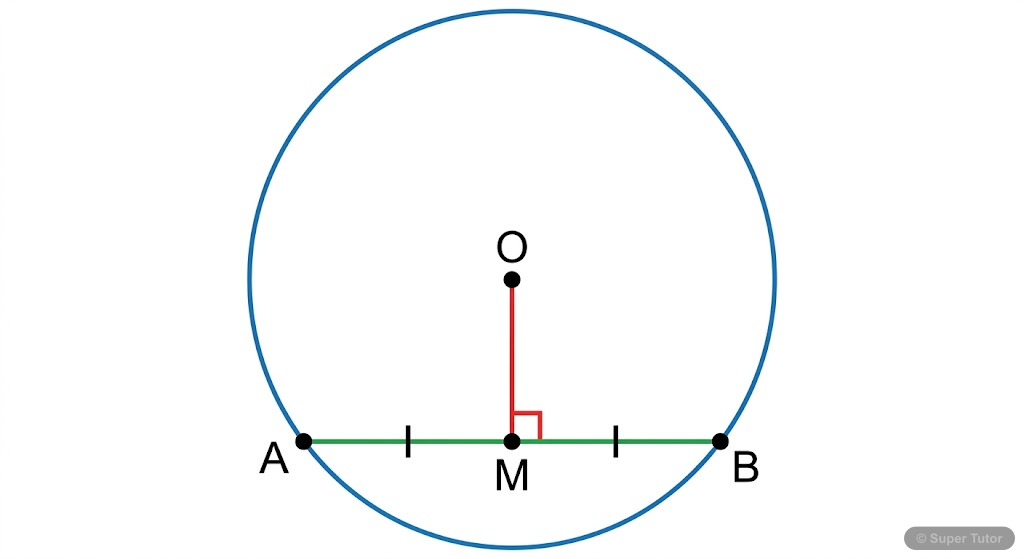
Illustrates a circle with a chord PQ and points R and S on the major and minor arcs respectively. Shows the angle subtended by the chord at the center (POQ), and at points on the major arc (PRQ) and m
Super Tutor

Super Tutor has 16+ illustrations like this for Circles alone — flashcards, concept maps, and step-by-step visuals.

See them all
20 Questions Solved · 3 Sections

Exercise 9.1

1Recall that two circles are congruent if they have the same radii. Prove that equal chords of congruent circles subtend equal angles at their centres.Show solution
Given: Two congruent circles with centres O and O′ and equal radii r. AB and CD are equal chords of the two circles respectively, i.e., AB = CD.

To Prove: ∠AOB = ∠CO′D

Proof:

In △AOB and △CO′D:

OA=OC=r(radii of congruent circles)OA = O'C = r \quad \text{(radii of congruent circles)}

OB=OD=r(radii of congruent circles)OB = O'D = r \quad \text{(radii of congruent circles)}

AB=CD(given)AB = CD \quad \text{(given)}

By SSS congruence criterion:
AOBCOD\triangle AOB \cong \triangle CO'D

Therefore, by CPCT:
AOB=COD\angle AOB = \angle CO'D

Hence proved. Equal chords of congruent circles subtend equal angles at their centres.
2Prove that if chords of congruent circles subtend equal angles at their centres, then the chords are equal.Show solution
Given: Two congruent circles with centres O and O′ and equal radii r. Chords AB and CD subtend equal angles at their respective centres, i.e., ∠AOB = ∠CO′D.

To Prove: AB = CD

Proof:

In △AOB and △CO′D:

OA=OC=r(radii of congruent circles)OA = O'C = r \quad \text{(radii of congruent circles)}

OB=OD=r(radii of congruent circles)OB = O'D = r \quad \text{(radii of congruent circles)}

AOB=COD(given)\angle AOB = \angle CO'D \quad \text{(given)}

By SAS congruence criterion:
AOBCOD\triangle AOB \cong \triangle CO'D

Therefore, by CPCT:
AB=CDAB = CD

Hence proved. If chords of congruent circles subtend equal angles at their centres, then the chords are equal.

Exercise 9.2

1Two circles of radii 5 cm and 3 cm intersect at two points and the distance between their centres is 4 cm. Find the length of the common chord.Show solution
Given: Two circles with centres O and O′, radii 5 cm and 3 cm respectively. They intersect at points A and B. Distance OO′ = 4 cm.

To Find: Length of common chord AB.

Solution:

Let the common chord AB intersect OO′ at point M.

Let OM = x, so O′M = 4 − x.

In △OMA (right-angled at M, since the line joining centres is perpendicular to the common chord):
OA2=OM2+AM2OA^2 = OM^2 + AM^2
25=x2+AM2(1)25 = x^2 + AM^2 \quad \cdots (1)

In △O′MA (right-angled at M):
OA2=OM2+AM2O'A^2 = O'M^2 + AM^2
9=(4x)2+AM2(2)9 = (4-x)^2 + AM^2 \quad \cdots (2)

Subtracting (2) from (1):
259=x2(4x)225 - 9 = x^2 - (4-x)^2
16=x216+8xx216 = x^2 - 16 + 8x - x^2
16=8x1616 = 8x - 16
8x=328x = 32
x=4 cmx = 4 \text{ cm}

Substituting in (1):
AM2=2516=9AM^2 = 25 - 16 = 9
AM=3 cmAM = 3 \text{ cm}

Since M is the midpoint of AB (perpendicular from centre bisects the chord):
AB=2×AM=2×3=6 cmAB = 2 \times AM = 2 \times 3 = 6 \text{ cm}

Note: Since x = 4 cm = OO′, point M coincides with O′. This means O′ lies on AB, confirming AB passes through O′.

AB=6 cm\boxed{AB = 6 \text{ cm}}
2If two equal chords of a circle intersect within the circle, prove that the segments of one chord are equal to corresponding segments of the other chord.Show solution
Given: A circle with centre O. Two equal chords AB and CD intersect at point E inside the circle, i.e., AB = CD.

To Prove: AE = CE and BE = DE (corresponding segments are equal).

Construction: Draw OM ⊥ AB and ON ⊥ CD.

Proof:

Since AB = CD and equal chords are equidistant from the centre:
OM=ON(1)OM = ON \quad \cdots (1)

Also, since perpendicular from centre bisects the chord:
MB=AB2andND=CD2MB = \frac{AB}{2} \quad \text{and} \quad ND = \frac{CD}{2}

Since AB = CD:
MB=ND(2)MB = ND \quad \cdots (2)

In △OME and △ONE:
OM=ON(from (1))OM = ON \quad \text{(from (1))}
OME=ONE=90°\angle OME = \angle ONE = 90°
OE=OE(common)OE = OE \quad \text{(common)}

By RHS congruence:
OMEONE\triangle OME \cong \triangle ONE

By CPCT:
ME=NE(3)ME = NE \quad \cdots (3)

Now:
BE=MBME=NDNE=DEBE = MB - ME = ND - NE = DE

Also:
AE=ABBE=CDDE=CEAE = AB - BE = CD - DE = CE

Hence proved. AE = CE and BE = DE.
3If two equal chords of a circle intersect within the circle, prove that the line joining the point of intersection to the centre makes equal angles with the chords.Show solution
Given: A circle with centre O. Two equal chords AB and CD intersect at point E inside the circle. OE is joined.

To Prove: ∠OEM = ∠OEN, i.e., OE makes equal angles with the two chords (where M and N are feet of perpendiculars from O to AB and CD respectively).

Construction: Draw OM ⊥ AB and ON ⊥ CD.

Proof:

Since AB = CD (equal chords of the same circle), they are equidistant from the centre:
OM=ON(1)OM = ON \quad \cdots (1)

In △OME and △ONE:
OM=ON(from (1))OM = ON \quad \text{(from (1))}
OME=ONE=90°\angle OME = \angle ONE = 90°
OE=OE(common)OE = OE \quad \text{(common)}

By RHS congruence:
OMEONE\triangle OME \cong \triangle ONE

By CPCT:
OEM=OEN\angle OEM = \angle OEN

Hence proved. The line joining the point of intersection to the centre makes equal angles with the chords.
4If a line intersects two concentric circles (circles with the same centre) with centre O at A, B, C and D, prove that AB = CD (see Fig. 9.12).Show solution
Given: Two concentric circles with common centre O. A line intersects the inner circle at B and C, and the outer circle at A and D.

To Prove: AB = CD

Construction: Draw OM perpendicular to the line AD from centre O.

Proof:

For the outer circle, OM ⊥ AD:
Since perpendicular from centre bisects the chord:
AM=MD(1)AM = MD \quad \cdots (1)

For the inner circle, OM ⊥ BC:
Since perpendicular from centre bisects the chord:
BM=MC(2)BM = MC \quad \cdots (2)

Subtracting (2) from (1):
AMBM=MDMCAM - BM = MD - MC
AB=CDAB = CD

Hence proved.
5Three girls Reshma, Salma and Mandip are playing a game by standing on a circle of radius 5m drawn in a park. Reshma throws a ball to Salma, Salma to Mandip, Mandip to Reshma. If the distance between Reshma and Salma and between Salma and Mandip is 6m each, what is the distance between Reshma and Mandip?Show solution
Given: A circle of radius 5 m. Let Reshma, Salma and Mandip be at points R, S and M on the circle. RS = SM = 6 m.

To Find: RM

Solution:

Let O be the centre of the circle. Draw OA ⊥ RS and OB ⊥ SM.

Since OA ⊥ RS and perpendicular from centre bisects the chord:
AS=RS2=3 mAS = \frac{RS}{2} = 3 \text{ m}

In △OAS:
OA2=OS2AS2=259=16OA^2 = OS^2 - AS^2 = 25 - 9 = 16
OA=4 mOA = 4 \text{ m}

Similarly, OB = 4 m (since SM = 6 m and radius = 5 m).

Let O be the origin. Place S at the top. Since RS = SM = 6 m and both chords are equal, by symmetry, R and M are symmetric about the line OS.

Let the perpendicular from O to RS meet RS at A, and from O to SM meet SM at B.

Using coordinate geometry: Let O = (0, 0).

Since OA ⊥ RS and OA = 4 m, place A along the y-axis direction.

Let S = (0, 5) (topmost point).

For chord RS: midpoint A is at distance 4 from O along OS direction.
A=(0,4)A = (0, 4)

R and S are symmetric about A:
R=(3,4),S=(3,4)R = (-3, 4), \quad S = (3, 4)

Wait — let me redo with S as a general point.

Let S = (0, 5). Chord RS has length 6, midpoint A satisfies OA ⊥ RS.

Since RS is horizontal (by symmetry, if S is at top and R, M are symmetric):
A=(0,4),R=(3,4),M=(3,4)A = (0, 4), \quad R = (-3, 4), \quad M = (3, 4)

Verify: OR=9+16=5OR = \sqrt{9+16} = 5 ✓, OM=9+16=5OM = \sqrt{9+16} = 5

Check SM: SM=(30)2+(45)2=9+1=106SM = \sqrt{(3-0)^2+(4-5)^2} = \sqrt{9+1} = \sqrt{10} \neq 6

Let me use a proper coordinate approach.

Let O = (0,0). Let S = (s_x, s_y) on the circle, so sx2+sy2=25s_x^2 + s_y^2 = 25.

Let the perpendicular from O to RS have foot A. Since OA = 4 and AS = 3:

Place the coordinate system so that S = (0, 5).

For chord RS (length 6): The perpendicular from O to RS has length 259=4\sqrt{25-9} = 4.

Let RS be along a line. The foot of perpendicular from O to RS is at distance 4 from O.

Let A = foot on RS. Then OARS\vec{OA} \perp RS and OA=4|OA| = 4, AS=3|AS| = 3.

So A=S3u^A = S - 3\hat{u} where u^\hat{u} is unit vector along RS.

Also OAu^=0\vec{OA} \cdot \hat{u} = 0, meaning OSu^=3\vec{OS} \cdot \hat{u} = 3.

Let u^=(cosθ,sinθ)\hat{u} = (\cos\theta, \sin\theta). Then sxcosθ+sysinθ=3s_x\cos\theta + s_y\sin\theta = 3.

Similarly for chord SM: sxcosϕ+sysinϕ=3s_x\cos\phi + s_y\sin\phi = 3 where v^=(cosϕ,sinϕ)\hat{v} = (\cos\phi, \sin\phi) is direction of SM.

This is getting complex. Let me use a direct approach.

Let O = (0,0), S = (0, 5).

For chord RS of length 6: perpendicular from O to RS = 4.
Let R = (x1,y1)(x_1, y_1) on circle, x12+y12=25x_1^2+y_1^2=25, RS=6RS=6.

Midpoint of RS = (x12,y1+52)\left(\frac{x_1}{2}, \frac{y_1+5}{2}\right), and this is perpendicular to RS from O.

Distance from O to midpoint = 4:
x124+(y1+5)24=16\frac{x_1^2}{4} + \frac{(y_1+5)^2}{4} = 16
x12+y12+10y1+25=64x_1^2 + y_1^2 + 10y_1 + 25 = 64
25+10y1+25=6425 + 10y_1 + 25 = 64
10y1=14y1=1.410y_1 = 14 \Rightarrow y_1 = 1.4

Then x12=251.96=23.04x_1^2 = 25 - 1.96 = 23.04, so x1=±4.8x_1 = \pm 4.8.

By symmetry, R=(4.8,1.4)R = (-4.8, 1.4) and M=(4.8,1.4)M = (4.8, 1.4).

Verify SM: SM=(4.8)2+(1.45)2=23.04+12.96=36=6SM = \sqrt{(4.8)^2+(1.4-5)^2} = \sqrt{23.04+12.96} = \sqrt{36} = 6

Now:
RM=(4.8(4.8))2+02=(9.6)2=9.6 mRM = \sqrt{(4.8-(-4.8))^2 + 0^2} = \sqrt{(9.6)^2} = 9.6 \text{ m}

RM=9.6 m\boxed{RM = 9.6 \text{ m}}
6A circular park of radius 20m is situated in a colony. Three boys Ankur, Syed and David are sitting at equal distance on its boundary each having a toy telephone in his hands to talk each other. Find the length of the string of each phone.Show solution
Given: A circular park of radius 20 m. Three boys Ankur (A), Syed (S) and David (D) sit at equal distances on the boundary, forming an equilateral triangle inscribed in the circle of radius 20 m.

To Find: Side length of the equilateral triangle (length of string).

Solution:

Since the three boys are at equal distances, they form an equilateral triangle inscribed in the circle.

For an equilateral triangle inscribed in a circle of radius R, the relationship between side aa and circumradius R is:
R=a3R = \frac{a}{\sqrt{3}}

Derivation using perpendicular from centre:

Let O be the centre. Draw OM ⊥ AS where M is the midpoint of AS.

Let side of equilateral triangle = aa, so AM=a2AM = \frac{a}{2}.

In △OAS, O is the circumcentre. The centroid divides the median in ratio 2:1.

Median of equilateral triangle =32a= \frac{\sqrt{3}}{2}a

Circumradius =23×32a=a3= \frac{2}{3} \times \frac{\sqrt{3}}{2}a = \frac{a}{{\sqrt{3}}}

So:
20=a320 = \frac{a}{\sqrt{3}}
a=203 ma = 20\sqrt{3} \text{ m}

Length of each string=20334.64 m\boxed{\text{Length of each string} = 20\sqrt{3} \approx 34.64 \text{ m}}

Exercise 9.3

1In Fig. 9.23, A, B and C are three points on a circle with centre O such that ∠BOC = 30° and ∠AOB = 60°. If D is a point on the circle other than the arc ABC, find ∠ADC.Show solution
Given: ∠BOC = 30°, ∠AOB = 60°. D is a point on the circle on the arc other than arc ABC.

To Find: ∠ADC

Solution:

AOC=AOB+BOC=60°+30°=90°\angle AOC = \angle AOB + \angle BOC = 60° + 30° = 90°

By the theorem — the angle subtended by an arc at the centre is double the angle subtended at any point on the remaining part of the circle:

AOC=2×ADC\angle AOC = 2 \times \angle ADC

ADC=AOC2=90°2=45°\angle ADC = \frac{\angle AOC}{2} = \frac{90°}{2} = 45°

ADC=45°\boxed{\angle ADC = 45°}
2A chord of a circle is equal to the radius of the circle. Find the angle subtended by the chord at a point on the minor arc and also at a point on the major arc.Show solution
Given: Chord AB = radius of the circle (= r).

To Find: Angle subtended at a point on the minor arc and at a point on the major arc.

Solution:

Let O be the centre. Since OA = OB = AB = r, triangle OAB is equilateral.

AOB=60°\angle AOB = 60°

Angle at a point on the major arc:

Let P be a point on the major arc. By the inscribed angle theorem:
APB=12AOB=12×60°=30°\angle APB = \frac{1}{2} \angle AOB = \frac{1}{2} \times 60° = 30°

Angle at a point on the minor arc:

Let Q be a point on the minor arc. AQBP is a cyclic quadrilateral (all on the circle). The sum of opposite angles:
AQB+APB=180°\angle AQB + \angle APB = 180°
AQB=180°30°=150°\angle AQB = 180° - 30° = 150°

Angle on major arc=30°,Angle on minor arc=150°\boxed{\text{Angle on major arc} = 30°, \quad \text{Angle on minor arc} = 150°}
3In Fig. 9.24, ∠PQR = 100°, where P, Q and R are points on a circle with centre O. Find ∠OPR.Show solution
Given: P, Q, R are on a circle with centre O. ∠PQR = 100°.

To Find: ∠OPR

Solution:

Since PQRS is not given, we use the reflex angle concept.

The angle subtended by arc PR at the centre = 2 × angle subtended at any point on the major arc.

Here ∠PQR = 100° is the angle in the major segment (Q is on the major arc).

Reflex ∠POR = 2 × ∠PQR = 2 × 100° = 200°

Therefore:
POR=360°200°=160°\angle POR = 360° - 200° = 160°

In △OPR:
OP=OR(radii)OP = OR \quad \text{(radii)}

So △OPR is isosceles:
OPR=ORP=180°POR2=180°160°2=20°2=10°\angle OPR = \angle ORP = \frac{180° - \angle POR}{2} = \frac{180° - 160°}{2} = \frac{20°}{2} = 10°

OPR=10°\boxed{\angle OPR = 10°}
4In Fig. 9.25, ∠ABC = 69°, ∠ACB = 31°, find ∠BDC.Show solution
Given: ∠ABC = 69°, ∠ACB = 31°. Points A, B, C, D lie on a circle.

To Find: ∠BDC

Solution:

In △ABC:
BAC=180°ABCACB=180°69°31°=80°\angle BAC = 180° - \angle ABC - \angle ACB = 180° - 69° - 31° = 80°

Angles ∠BAC and ∠BDC are angles in the same segment (both subtended by arc BC on the same side).

By the theorem — angles in the same segment are equal:
BDC=BAC=80°\angle BDC = \angle BAC = 80°

BDC=80°\boxed{\angle BDC = 80°}
5In Fig. 9.26, A, B, C and D are four points on a circle. AC and BD intersect at a point E such that ∠BEC = 130° and ∠ECD = 20°. Find ∠BAC.Show solution
Given: ∠BEC = 130°, ∠ECD = 20°. A, B, C, D are concyclic.

To Find: ∠BAC

Solution:

In △ECD (where E is intersection of diagonals AC and BD):

∠DEC = 180° − ∠BEC = 180° − 130° = 50° (linear pair)

In △ECD:
EDC=180°DECECD=180°50°20°=110°\angle EDC = 180° - \angle DEC - \angle ECD = 180° - 50° - 20° = 110°

Wait — ∠EDC = ∠BDC (same angle).

BDC=110°\angle BDC = 110°

Hmm, that seems large. Let me reconsider.

Actually in △EBC:
∠EBC + ∠BCE + ∠BEC = 180°

Let me use exterior angle approach.

In △BCE:
∠BEC = 130°, so ∠CBE + ∠BCE = 50°.

Using the exterior angle: In △ECD:
∠BEC is exterior angle to △ECD at E:
BEC=EDC+ECD\angle BEC = \angle EDC + \angle ECD
130°=EDC+20°130° = \angle EDC + 20°
EDC=110°\angle EDC = 110°

But ∠EDC = ∠BDC = 110°. This is the angle subtended by arc BC at D.

Angles ∠BAC and ∠BDC are in the same segment:
BAC=BDC\angle BAC = \angle BDC

Wait — ∠BAC and ∠BDC subtend the same chord BC but they need to be on the same arc.

Actually, ∠BAC subtends arc BC (not containing A) and ∠BDC subtends arc BC (not containing D). If A and D are on the same arc, they are equal.

From the figure, A, B, C, D are on the circle with AC and BD intersecting inside. So A and D are on opposite sides relative to chord BC... Let me reconsider.

Using the correct approach:

∠ECD = ∠ACD = 20° (angle subtended by arc AD at C)
∠BAC = ∠DAC subtends arc DC...

Actually: ∠ABD and ∠ACD are in the same segment (subtend arc AD), so ∠ABD = ∠ACD = 20°.

In △ABE:
∠AEB = ∠BEC = 130° (vertically opposite... no, ∠AEB = 180° − 130° = 50°)

Wait: ∠AEB + ∠BEC = 180° (linear pair), so ∠AEB = 50°.

In △ABE:
BAC+ABE=180°AEB\angle BAC + \angle ABE = 180° - \angle AEB
BAC+ABD=180°50°=130°\angle BAC + \angle ABD = 180° - 50° = 130°

Hmm, but I need another relation.

Correct method:
∠ECD = 20° means ∠DCA = 20°, which is the angle subtended by chord AD at C.
So ∠DAB = ∠DCA = 20° ... no, ∠DAB subtends arc DB.

Let me use: In △BEC, ∠BEC = 130°.
Exterior angle of △BEC at E = ∠AEB = 50°.

In △AEB: ∠BAE + ∠ABE = 130° (exterior angle at E for the other triangle... )

Actually the cleanest approach:

∠ABD = ∠ACD = 20° (angles in same segment, subtending arc AD)

In △BEC:
∠CBE + ∠BCE = 180° − 130° = 50°
∠BCE = ∠BCA (part of it)

Using exterior angle theorem in △ECD:
∠BEC = ∠DCE + ∠CDE (exterior angle)
130° = 20° + ∠CDE
∠CDE = 110°

But ∠CDE = ∠CDB = 110°. Since ABCD is cyclic:
∠CAB + ∠CDB = 180° (opposite angles... no, they're not opposite angles of the quadrilateral necessarily).

Angles ∠BAC and ∠BDC subtend the same chord BC. If both A and D are on the major arc, they are equal. From the figure description, E is inside the circle, so A and D are on opposite arcs relative to BC. Therefore:
BAC+BDC=180°\angle BAC + \angle BDC = 180°
BAC=180°110°=70°\angle BAC = 180° - 110° = 70°

BAC=70°\boxed{\angle BAC = 70°}
6ABCD is a cyclic quadrilateral whose diagonals intersect at a point E. If ∠DBC = 70°, ∠BAC is 30°, find ∠BCD. Further, if AB = BC, find ∠ECD.Show solution
Given: ABCD is a cyclic quadrilateral. Diagonals AC and BD intersect at E. ∠DBC = 70°, ∠BAC = 30°.

Part 1: Find ∠BCD

∠DAC and ∠DBC are angles in the same segment (both subtend arc DC):
DAC=DBC=70°\angle DAC = ∠DBC = 70°

DAB=DAC+CAB=70°+30°=100°\angle DAB = \angle DAC + \angle CAB = 70° + 30° = 100°

Since ABCD is a cyclic quadrilateral, opposite angles are supplementary:
DAB+BCD=180°\angle DAB + \angle BCD = 180°
BCD=180°100°=80°\angle BCD = 180° - 100° = 80°

BCD=80°\boxed{\angle BCD = 80°}

Part 2: Find ∠ECD, given AB = BC

Since AB = BC, triangle ABC is isosceles:
BAC=BCA=30°\angle BAC = \angle BCA = 30°

BCD=80°\angle BCD = 80°

ECD=BCDBCE=80°30°=50°\angle ECD = \angle BCD - \angle BCE = 80° - 30° = 50°

ECD=50°\boxed{\angle ECD = 50°}
7If diagonals of a cyclic quadrilateral are diameters of the circle through the vertices of the quadrilateral, prove that it is a rectangle.Show solution
Given: ABCD is a cyclic quadrilateral. Diagonals AC and BD are diameters of the circle.

To Prove: ABCD is a rectangle.

Proof:

Since AC is a diameter:
ABC=90°(angle in a semicircle)\angle ABC = 90° \quad \text{(angle in a semicircle)}
ADC=90°(angle in a semicircle)\angle ADC = 90° \quad \text{(angle in a semicircle)}

Since BD is a diameter:
BAD=90°(angle in a semicircle)\angle BAD = 90° \quad \text{(angle in a semicircle)}
BCD=90°(angle in a semicircle)\angle BCD = 90° \quad \text{(angle in a semicircle)}

Since all four angles of quadrilateral ABCD are 90°:
A=B=C=D=90°\angle A = \angle B = \angle C = \angle D = 90°

Also, since both diameters bisect each other (they pass through the centre), the diagonals bisect each other. A parallelogram with all right angles is a rectangle.

Hence, ABCD is a rectangle. Proved.
8If the non-parallel sides of a trapezium are equal, prove that it is cyclic.Show solution
Given: ABCD is a trapezium with AB ∥ CD and AD = BC (non-parallel sides equal).

To Prove: ABCD is a cyclic quadrilateral.

Construction: Draw DE ⊥ AB and CF ⊥ AB.

Proof:

In △DAE and △CBF:
- DE = CF (perpendicular distance between parallel lines AB and CD is equal)
- AD = BC (given)
- ∠DEA = ∠CFB = 90°

By RHS congruence:
DAECBF\triangle DAE \cong \triangle CBF

By CPCT:
DAB=CBA(1)\angle DAB = \angle CBA \quad \cdots (1)

Since AB ∥ CD:
DAB+CDA=180°(co-interior angles)(2)\angle DAB + \angle CDA = 180° \quad \text{(co-interior angles)} \quad \cdots (2)

From (1): ∠CBA = ∠DAB

Substituting in (2):
CBA+CDA=180°\angle CBA + \angle CDA = 180°

Since the sum of one pair of opposite angles is 180°, ABCD is a cyclic quadrilateral.

Hence proved.
9Two circles intersect at two points B and C. Through B, two line segments ABD and PBQ are drawn to intersect the circles at A, D and P, Q respectively (see Fig. 9.27). Prove that ∠ACP = ∠QCD.Show solution
Given: Two circles intersect at B and C. Line ABD intersects the circles at A (first circle) and D (second circle). Line PBQ intersects the circles at P (first circle) and Q (second circle).

To Prove: ∠ACP = ∠QCD

Proof:

For the first circle (passing through A, B, P, C):
∠ACP and ∠ABP are in the same circle.

Since ABPC is a cyclic quadrilateral (A, B, P, C lie on the first circle):
ACP=ABP(1)\angle ACP = \angle ABP \quad \cdots (1)
(Angles subtended by arc AP at C and B — angles in the same segment)

For the second circle (passing through D, B, Q, C):
Since DBQC is a cyclic quadrilateral (D, B, Q, C lie on the second circle):
QCD=QBD(2)\angle QCD = \angle QBD \quad \cdots (2)
(Angles in the same segment, subtended by arc QD)

Now, ∠ABP and ∠QBD are vertically opposite angles:
ABP=QBD(3)\angle ABP = \angle QBD \quad \cdots (3)

From (1), (2) and (3):
ACP=QCD\angle ACP = \angle QCD

Hence proved.
10If circles are drawn taking two sides of a triangle as diameters, prove that the point of intersection of these circles lie on the third side.Show solution
Given: △ABC. A circle is drawn with AB as diameter and another circle with AC as diameter. Let D be a point of intersection of these two circles (other than A).

To Prove: D lies on BC.

Proof:

Since AB is a diameter of the first circle and D lies on it:
ADB=90°(angle in a semicircle)(1)\angle ADB = 90° \quad \text{(angle in a semicircle)} \quad \cdots (1)

Since AC is a diameter of the second circle and D lies on it:
ADC=90°(angle in a semicircle)(2)\angle ADC = 90° \quad \text{(angle in a semicircle)} \quad \cdots (2)

Adding (1) and (2):
ADB+ADC=90°+90°=180°\angle ADB + \angle ADC = 90° + 90° = 180°

Since ∠ADB + ∠ADC = 180°, the rays DB and DC form a straight line.

Therefore, B, D and C are collinear, i.e., D lies on BC.

Hence proved.
11ABC and ADC are two right triangles with common hypotenuse AC. Prove that ∠CAD = ∠CBD.Show solution
Given: △ABC and △ADC are right triangles with common hypotenuse AC. ∠ABC = 90° and ∠ADC = 90°.

To Prove: ∠CAD = ∠CBD

Proof:

Since ∠ABC = 90°, point B lies on a circle with AC as diameter.

Since ∠ADC = 90°, point D also lies on a circle with AC as diameter.

Therefore, A, B, C and D are concyclic (all lie on the circle with AC as diameter).

Now, ∠CAD and ∠CBD both subtend the same chord CD in the same circle.

Since angles in the same segment are equal:
CAD=CBD\angle CAD = \angle CBD

Hence proved.
12Prove that a cyclic parallelogram is a rectangle.Show solution
Given: ABCD is a cyclic parallelogram.

To Prove: ABCD is a rectangle.

Proof:

Since ABCD is a cyclic quadrilateral, the sum of opposite angles is 180°:
A+C=180°(1)\angle A + \angle C = 180° \quad \cdots (1)

Since ABCD is a parallelogram, opposite angles are equal:
A=C(2)\angle A = \angle C \quad \cdots (2)

From (1) and (2):
A+A=180°\angle A + \angle A = 180°
2A=180°2\angle A = 180°
A=90°\angle A = 90°

Since ∠A = 90° and opposite angles of a parallelogram are equal:
A=C=90°\angle A = \angle C = 90°

Also, ∠B + ∠A = 180° (co-interior angles, since AB ∥ CD):
B=90°,D=90°\angle B = 90°, \quad \angle D = 90°

Since all angles of the parallelogram are 90°, ABCD is a rectangle.

Hence proved.

Stuck on a step?

Ask Super Tutor AI to explain any solution on this page in a simpler way — free, 24x7.

Ask a Doubt Free

Frequently Asked Questions

What are the important topics in Circles for Madhya Pradesh Board Class 9 Mathematics?
Circles covers several key topics that are frequently asked in Madhya Pradesh Board Class 9 board exams. Focus on the core concepts listed on this page and practise related questions to build confidence.
How to score full marks in Circles — Madhya Pradesh Board Class 9 Mathematics?
Understand the core concepts first, then work through the 43 practice questions available for this chapter. Revise formulas and definitions regularly, and use flashcards for quick recall before the exam.
Where can I get free NCERT Solutions for Circles Class 9 Mathematics?
This page has free step-by-step NCERT Solutions for every exercise question in Circles (Madhya Pradesh Board Class 9 Mathematics) — written the way examiners award marks: given, formula, working, answer.

Sources & Official References

Content is aligned to the official syllabus. Refer to the board website for the latest curriculum.

For serious students

Get the full Circles chapter — for free.

Quizzes, flashcards, AI doubt-solver and a step-by-step study plan for Madhya Pradesh Board Class 9 Mathematics.