Chapter 8 of 12
NCERT Solutions

Quadrilaterals

Madhya Pradesh Board · Class 9 · Mathematics

NCERT Solutions for Quadrilaterals — Madhya Pradesh Board Class 9 Mathematics.

45 questions22 flashcards5 concepts

Interactive on Super Tutor

Studying Quadrilaterals? Get the full interactive chapter.

Quizzes, flashcards, AI doubt-solver and a step-by-step study plan — built for ncert solutions and more.

1,000+ Class 9 students started this chapter today

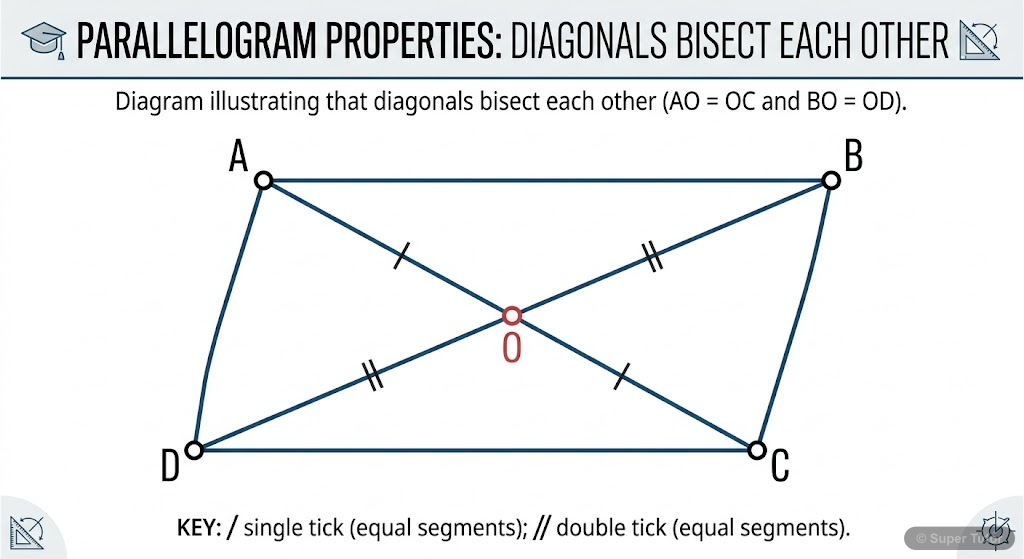
A labeled diagram of a parallelogram ABCD with diagonals AC and BD intersecting at point O, showing that AO=OC and BO=OD with tick marks.
Super Tutor

Learn better with visuals Super Tutor has hundreds of illustrations like this across every chapter — all free to try.

Get started
13 Questions Solved · 2 Sections

7 worked solutions below. Unlock all 13 free in Super Tutor

Exercise 8.1

1If the diagonals of a parallelogram are equal, then show that it is a rectangle.Show solution
Given: ABCD is a parallelogram in which diagonal AC = diagonal BD.

To prove: ABCD is a rectangle.

Proof:

In ABC\triangle ABC and DCB\triangle DCB:
- AB=DCAB = DC (opposite sides of a parallelogram)
- BC=BCBC = BC (common)
- AC=DBAC = DB (given, diagonals are equal)

By SSS congruence rule:
ABCDCB\triangle ABC \cong \triangle DCB

Therefore, ABC=DCB\angle ABC = \angle DCB (CPCT)

Since ABDCAB \parallel DC and BCBC is a transversal:
ABC+DCB=180(co-interior angles)\angle ABC + \angle DCB = 180^\circ \quad \text{(co-interior angles)}

2ABC=180\Rightarrow 2\angle ABC = 180^\circ

ABC=90\Rightarrow \angle ABC = 90^\circ

Since ABCD is a parallelogram with one angle =90= 90^\circ, ABCD is a rectangle. \blacksquare

Not sure why a step works? check your working in Super Tutor

2Show that the diagonals of a square are equal and bisect each other at right angles.Show solution
Given: ABCD is a square, i.e., AB=BC=CD=DAAB = BC = CD = DA and all angles are 9090^\circ.

To prove: (a) AC=BDAC = BD, (b) diagonals bisect each other, (c) they bisect at right angles.

---

(a) AC = BD:

In ABC\triangle ABC and BAD\triangle BAD:
- AB=BAAB = BA (common)
- BC=ADBC = AD (sides of a square)
- ABC=BAD=90\angle ABC = \angle BAD = 90^\circ

By SAS: ABCBAD\triangle ABC \cong \triangle BAD

AC=BD\therefore AC = BD (CPCT) \checkmark

---

(b) Diagonals bisect each other:

Let diagonals AC and BD intersect at O.

In AOB\triangle AOB and COD\triangle COD:
- AB=CDAB = CD (sides of a square)
- OAB=OCD\angle OAB = \angle OCD (alternate interior angles, ABCDAB \parallel CD)
- OBA=ODC\angle OBA = \angle ODC (alternate interior angles)

By AAS: AOBCOD\triangle AOB \cong \triangle COD

OA=OC\therefore OA = OC and OB=ODOB = OD (CPCT)

Hence diagonals bisect each other. \checkmark

---

(c) Diagonals bisect at right angles:

In AOB\triangle AOB and AOD\triangle AOD:
- OB=ODOB = OD (proved above)
- AB=ADAB = AD (sides of a square)
- AO=AOAO = AO (common)

By SSS: AOBAOD\triangle AOB \cong \triangle AOD

AOB=AOD\therefore \angle AOB = \angle AOD (CPCT)

But AOB+AOD=180\angle AOB + \angle AOD = 180^\circ (linear pair)

2AOB=180AOB=90\Rightarrow 2\angle AOB = 180^\circ \Rightarrow \angle AOB = 90^\circ

Hence diagonals bisect each other at right angles. \blacksquare

Not sure why a step works? check your working in Super Tutor

3Diagonal AC of a parallelogram ABCD bisects A\angle A (see Fig. 8.11). Show that (i) it bisects C\angle C also, (ii) ABCD is a rhombus.Show solution
Given: ABCD is a parallelogram in which diagonal AC bisects A\angle A, i.e., DAC=BAC\angle DAC = \angle BAC.

---

**(i) AC bisects C\angle C:**

Since ABDCAB \parallel DC and ACAC is a transversal:
BAC=DCA(alternate interior angles)(1)\angle BAC = \angle DCA \quad \text{(alternate interior angles)} \quad \ldots(1)

Since ADBCAD \parallel BC and ACAC is a transversal:
DAC=BCA(alternate interior angles)(2)\angle DAC = \angle BCA \quad \text{(alternate interior angles)} \quad \ldots(2)

But DAC=BAC\angle DAC = \angle BAC (given) (3)\ldots(3)

From (1), (2) and (3):
DCA=BCA\angle DCA = \angle BCA

Therefore, AC bisects C\angle C also. \checkmark

---

(ii) ABCD is a rhombus:

In ABC\triangle ABC:
BAC=BCA(from (1) and (3))\angle BAC = \angle BCA \quad \text{(from (1) and (3))}

BC=AB\Rightarrow BC = AB (sides opposite equal angles are equal)

Since ABCD is a parallelogram, AB=CDAB = CD and BC=ADBC = AD.

Therefore AB=BC=CD=DAAB = BC = CD = DA.

Hence ABCD is a rhombus. \blacksquare

Not sure why a step works? check your working in Super Tutor

4ABCD is a rectangle in which diagonal AC bisects A\angle A as well as C\angle C. Show that: (i) ABCD is a square (ii) diagonal BD bisects B\angle B as well as D\angle D.Show solution
Given: ABCD is a rectangle; AC bisects A\angle A and C\angle C.

So DAC=BAC=45\angle DAC = \angle BAC = 45^\circ and DCA=BCA=45\angle DCA = \angle BCA = 45^\circ (since each angle of a rectangle is 9090^\circ).

---

(i) ABCD is a square:

In ABC\triangle ABC:
BAC=45 and BCA=45\angle BAC = 45^\circ \text{ and } \angle BCA = 45^\circ
BAC=BCA\Rightarrow \angle BAC = \angle BCA
BC=AB(sides opposite equal angles)\Rightarrow BC = AB \quad \text{(sides opposite equal angles)}

Since ABCD is a rectangle, AB=CDAB = CD and BC=ADBC = AD.

Therefore AB=BC=CD=DAAB = BC = CD = DA.

A rectangle with all sides equal is a square. \checkmark

---

**(ii) BD bisects B\angle B and D\angle D:**

Since ABCD is a square, AB=BC=CD=DAAB = BC = CD = DA.

In ABD\triangle ABD:
AB=ADABD=ADBAB = AD \Rightarrow \angle ABD = \angle ADB

Also ABD+ADB=90\angle ABD + \angle ADB = 90^\circ (since A=90\angle A = 90^\circ)
ABD=ADB=45=12×90\Rightarrow \angle ABD = \angle ADB = 45^\circ = \frac{1}{2} \times 90^\circ

So BD bisects B\angle B.

Similarly in BCD\triangle BCD: BC=CDCBD=CDB=45BC = CD \Rightarrow \angle CBD = \angle CDB = 45^\circ

So BD bisects D\angle D also. \blacksquare

Not sure why a step works? check your working in Super Tutor

5In parallelogram ABCD, two points P and Q are taken on diagonal BD such that DP = BQ (see Fig. 8.12). Show that: (i) ΔAPDΔCQB\Delta APD \cong \Delta CQB (ii) AP=CQAP = CQ (iii) ΔAQBΔCPD\Delta AQB \cong \Delta CPD (iv) AQ=CPAQ = CP (v) APCQ is a parallelogram.Show solution
Given: ABCD is a parallelogram; P and Q are on diagonal BD such that DP=BQDP = BQ.

---

**(i) APDCQB\triangle APD \cong \triangle CQB:**

In APD\triangle APD and CQB\triangle CQB:
- AD=CBAD = CB (opposite sides of parallelogram)
- DP=BQDP = BQ (given)
- ADP=CBQ\angle ADP = \angle CBQ (alternate interior angles, since ADBCAD \parallel BC and BDBD is transversal)

By SAS: APDCQB\triangle APD \cong \triangle CQB \checkmark

---

**(ii) AP=CQAP = CQ:**

From (i), AP=CQAP = CQ (CPCT) \checkmark

---

**(iii) AQBCPD\triangle AQB \cong \triangle CPD:**

In AQB\triangle AQB and CPD\triangle CPD:
- AB=CDAB = CD (opposite sides of parallelogram)
- BQ=DPBQ = DP (given)
- ABQ=CDP\angle ABQ = \angle CDP (alternate interior angles, since ABCDAB \parallel CD and BDBD is transversal)

By SAS: AQBCPD\triangle AQB \cong \triangle CPD \checkmark

---

**(iv) AQ=CPAQ = CP:**

From (iii), AQ=CPAQ = CP (CPCT) \checkmark

---

(v) APCQ is a parallelogram:

From (ii): AP=CQAP = CQ
From (iv): AQ=CPAQ = CP

Since both pairs of opposite sides are equal, APCQ is a parallelogram. \blacksquare

Not sure why a step works? check your working in Super Tutor

6ABCD is a parallelogram and AP and CQ are perpendiculars from vertices A and C on diagonal BD (see Fig. 8.13). Show that (i) ΔAPBΔCQD\Delta APB \cong \Delta CQD (ii) AP=CQAP = CQ.Show solution
Given: ABCD is a parallelogram; APBDAP \perp BD and CQBDCQ \perp BD.

---

**(i) APBCQD\triangle APB \cong \triangle CQD:**

In APB\triangle APB and CQD\triangle CQD:
- APB=CQD=90\angle APB = \angle CQD = 90^\circ (given, AP and CQ are perpendiculars)
- AB=CDAB = CD (opposite sides of parallelogram)
- ABP=CDQ\angle ABP = \angle CDQ (alternate interior angles, since ABCDAB \parallel CD and BDBD is transversal)

By AAS: APBCQD\triangle APB \cong \triangle CQD \checkmark

---

**(ii) AP=CQAP = CQ:**

From (i), AP=CQAP = CQ (CPCT) \blacksquare

Not sure why a step works? check your working in Super Tutor

7ABCD is a trapezium in which AB || CD and AD = BC (see Fig. 8.14). Show that (i) A=B\angle A = \angle B (ii) C=D\angle C = \angle D (iii) ΔABCΔBAD\Delta ABC \cong \Delta BAD (iv) diagonal AC = diagonal BD.
[Hint: Extend AB and draw a line through C parallel to DA intersecting AB produced at E.]
Show solution
Given: ABCD is a trapezium with ABCDAB \parallel CD and AD=BCAD = BC.

Construction: Extend AB to E and draw CEDACE \parallel DA, meeting AB produced at E.

---

**(i) A=B\angle A = \angle B:**

Since ADCEAD \parallel CE and AEDCAE \parallel DC (by construction and given), ADCE is a parallelogram.

AD=CE\therefore AD = CE (opposite sides of parallelogram)

But AD=BCAD = BC (given), so BC=CEBC = CE.

In BCE\triangle BCE: BC=CECBE=CEBBC = CE \Rightarrow \angle CBE = \angle CEB (base angles of isosceles triangle)

CBE=ABC\angle CBE = \angle ABC (same angle)

Now, DAB+CBE=180\angle DAB + \angle CBE = 180^\circ ... wait, let us use co-interior angles.

Since ADCEAD \parallel CE:
DAE+CEA=180(co-interior angles on same side of AE)\angle DAE + \angle CEA = 180^\circ \quad \text{(co-interior angles on same side of AE)}

In BCE\triangle BCE, BC=CEBC = CE, so CBE=CEB\angle CBE = \angle CEB.

ABC=180CBE=180CEB\angle ABC = 180^\circ - \angle CBE = 180^\circ - \angle CEB

Also DAB+CEB=180\angle DAB + \angle CEB = 180^\circ (since DAE=DAB\angle DAE = \angle DAB and CEA=CEB\angle CEA = \angle CEB, co-interior angles with ADCEAD \parallel CE)

DAB=180CEB=ABC\Rightarrow \angle DAB = 180^\circ - \angle CEB = \angle ABC

A=B\therefore \angle A = \angle B \checkmark

---

**(ii) C=D\angle C = \angle D:**

Since ABCDAB \parallel CD:
A+D=180andB+C=180\angle A + \angle D = 180^\circ \quad \text{and} \quad \angle B + \angle C = 180^\circ

Since A=B\angle A = \angle B:
D=180A=180B=C\angle D = 180^\circ - \angle A = 180^\circ - \angle B = \angle C

C=D\therefore \angle C = \angle D \checkmark

---

**(iii) ABCBAD\triangle ABC \cong \triangle BAD:**

In ABC\triangle ABC and BAD\triangle BAD:
- AB=BAAB = BA (common)
- BC=ADBC = AD (given)
- ABC=BAD\angle ABC = \angle BAD (proved in (i))

By SAS: ABCBAD\triangle ABC \cong \triangle BAD \checkmark

---

(iv) diagonal AC = diagonal BD:

From (iii): AC=BDAC = BD (CPCT) \blacksquare

Not sure why a step works? check your working in Super Tutor

Exercise 8.2

1ABCD is a quadrilateral in which P, Q, R and S are mid-points of the sides AB, BC, CD and DA (see Fig 8.20). AC is a diagonal. Show that: (i) SRACSR \parallel AC and SR=12ACSR = \frac{1}{2}AC (ii) PQ=SRPQ = SR (iii) PQRS is a parallelogram.
2ABCD is a rhombus and P, Q, R and S are the mid-points of the sides AB, BC, CD and DA respectively. Show that the quadrilateral PQRS is a rectangle.
3ABCD is a rectangle and P, Q, R and S are mid-points of the sides AB, BC, CD and DA respectively. Show that the quadrilateral PQRS is a rhombus.
4ABCD is a trapezium in which AB \parallel DC, BD is a diagonal and E is the mid-point of AD. A line is drawn through E parallel to AB intersecting BC at F (see Fig. 8.21). Show that F is the mid-point of BC.
5In a parallelogram ABCD, E and F are the mid-points of sides AB and CD respectively (see Fig. 8.22). Show that the line segments AF and EC trisect the diagonal BD.
6ABC is a triangle right angled at C. A line through the mid-point M of hypotenuse AB and parallel to BC intersects AC at D. Show that (i) D is the mid-point of AC (ii) MDACMD \perp AC (iii) CM=MA=12ABCM = MA = \frac{1}{2}AB.

6 more solved questions in Quadrilaterals

Every remaining exercise is solved step by step in Super Tutor, plus practice quizzes and flashcards for this chapter. Free to start.

Stuck on a step?

Ask Super Tutor AI to explain any solution on this page in a simpler way — free, 24x7.

Ask a Doubt Free

Frequently Asked Questions

What are the important topics in Quadrilaterals for Madhya Pradesh Board Class 9 Mathematics?
Quadrilaterals covers several key topics that are frequently asked in Madhya Pradesh Board Class 9 board exams. Focus on the core concepts listed on this page and practise related questions to build confidence.
How to score full marks in Quadrilaterals — Madhya Pradesh Board Class 9 Mathematics?
Understand the core concepts first, then work through the 45 practice questions available for this chapter. Revise formulas and definitions regularly, and use flashcards for quick recall before the exam.
Where can I get free NCERT Solutions for Quadrilaterals Class 9 Mathematics?
This page has free step-by-step NCERT Solutions for every exercise question in Quadrilaterals (Madhya Pradesh Board Class 9 Mathematics) — written the way examiners award marks: given, formula, working, answer.

Sources & Official References

Content is aligned to the official syllabus. Refer to the board website for the latest curriculum.

For serious students

Get the full Quadrilaterals chapter — for free.

Quizzes, flashcards, AI doubt-solver and a step-by-step study plan for Madhya Pradesh Board Class 9 Mathematics.