Polynomials — NCERT Solutions
Madhya Pradesh Board · Class 9 · Mathematics
NCERT Solutions for Polynomials, Madhya Pradesh Board Class 9 Mathematics: 30 textbook questions solved step by step.
Interactive on Super Tutor
Studying Polynomials? Get the full interactive chapter.
Quizzes, flashcards, AI doubt-solver and a step-by-step study plan — built for NCERT solutions and more.
Free trial, no card needed.
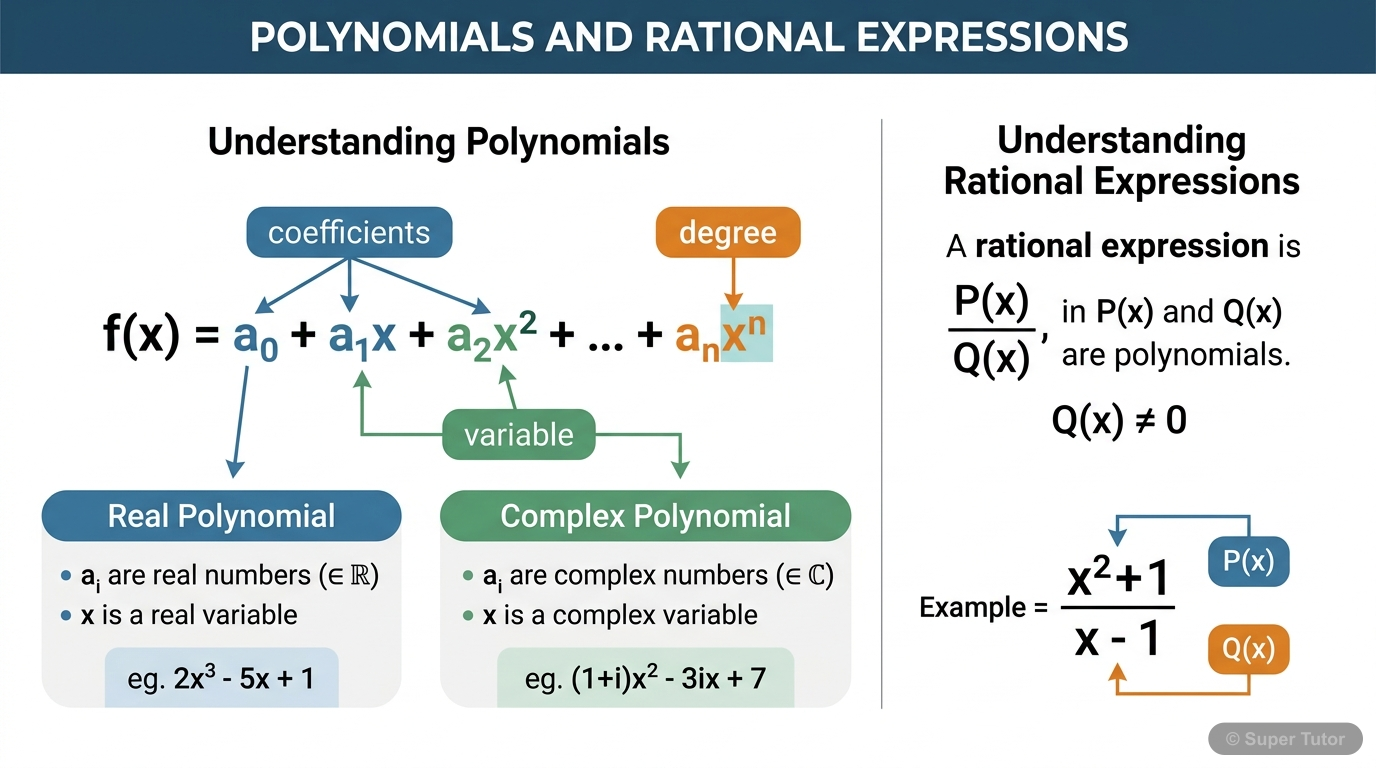
One of 3 illustrations for Polynomials in Super Tutor — alongside flashcards, concept maps and practice questions.
The first 15 solutions are open to read. The other 15 are free with a Super Tutor account.
Exercise 2.1
1Which of the following expressions are polynomials in one variable and which are not? State reasons for your answer.
(i)
(ii)
(iii)
(iv)
(v) Show solution
Concept: A polynomial in one variable is an expression of the form where all exponents of the variable are whole numbers (non-negative integers).
(i)
All exponents of are whole numbers (2, 1, 0). It is a polynomial in one variable .
(ii)
All exponents of are whole numbers (2, 0). It is a polynomial in one variable .
(iii)
. The exponent is not a whole number. Hence it is not a polynomial.
(iv)
. The exponent is not a whole number. Hence it is not a polynomial.
(v)
This expression contains three variables , , and . Hence it is not a polynomial in one variable (it is a polynomial in three variables).
2Write the coefficients of in each of the following:
(i)
(ii)
(iii)
(iv) Show solution
Concept: The coefficient of is the number multiplied with in the expression.
(i)
The term containing is .
Coefficient of =
(ii)
The term containing is .
Coefficient of =
(iii)
The term containing is .
Coefficient of =
(iv)
There is no term in this expression.
Coefficient of =
3Give one example each of a binomial of degree 35, and of a monomial of degree 100.Show solution
Concept:
- A binomial has exactly two terms.
- A monomial has exactly one term.
- The degree is the highest power of the variable.
Binomial of degree 35:
This has two terms and the highest power is 35.
Monomial of degree 100:
This has one term and the highest power is 100.
4Write the degree of each of the following polynomials:
(i)
(ii)
(iii)
(iv) 3Show solution
Concept: The degree of a polynomial is the highest power of the variable in the polynomial.
(i)
Highest power of is 3.
Degree =
(ii)
Highest power of is 2.
Degree =
(iii)
Highest power of is 1.
Degree =
(iv)
. This is a non-zero constant polynomial.
Degree =
5Classify the following as linear, quadratic and cubic polynomials:
(i)
(ii)
(iii)
(iv)
(v)
(vi)
(vii) Show solution
Concept:
- Linear polynomial: degree 1
- Quadratic polynomial: degree 2
- Cubic polynomial: degree 3
(i) — Highest degree = 2 → Quadratic polynomial
(ii) — Highest degree = 3 → Cubic polynomial
(iii) — Highest degree = 2 → Quadratic polynomial
(iv) — Highest degree = 1 → Linear polynomial
(v) — Highest degree = 1 → Linear polynomial
(vi) — Highest degree = 2 → Quadratic polynomial
(vii) — Highest degree = 3 → Cubic polynomial
Exercise 2.2
1Find the value of the polynomial at
(i)
(ii)
(iii) Show solution
Let
(i) At :
(ii) At :
(iii) At :
2Find and for each of the following polynomials:
(i)
(ii)
(iii)
(iv) Show solution
(i)
(ii)
(iii)
(iv)
3Verify whether the following are zeroes of the polynomial, indicated against them.
(i)
(ii)
(iii)
(iv)
(v)
(vi)
(vii)
(viii) Show solution
Concept: is a zero of if and only if .
(i) at :
Yes, is a zero of .
(ii) at :
No, is not a zero of .
(iii) at and :
Yes, both and are zeroes of .
(iv) at and :
Yes, both and are zeroes of .
(v) at :
Yes, is a zero of .
(vi) at :
Yes, is a zero of .
(vii) at and :
So is a zero.
So is not a zero of .
(viii) at :
No, is not a zero of .
4Find the zero of the polynomial in each of the following cases:
(i)
(ii)
(iii)
(iv)
(v)
(vi)
(vii) Show solution
Concept: To find the zero, set and solve for .
(i) :
Zero is .
(ii) :
Zero is .
(iii) :
Zero is .
(iv) :
Zero is .
(v) :
Zero is .
(vi) :
Zero is .
(vii) :
Zero is .
Exercise 2.3
1Determine which of the following polynomials has a factor:
(i)
(ii)
(iii)
(iv) Show solution
Concept (Factor Theorem): is a factor of if and only if .
(i) :
Since , is a factor.
(ii) :
Since , is not a factor.
(iii) :
Since , is not a factor.
(iv) :
Since , is not a factor.
2Use the Factor Theorem to determine whether is a factor of in each of the following cases:
(i)
(ii)
(iii) Show solution
Concept: is a factor of iff .
(i) , zero is :
Since , is a factor of .
(ii) , zero is :
Since , is not a factor of .
(iii) , zero is :
Since , is a factor of .
3Find the value of , if is a factor of in each of the following cases:
(i)
(ii)
(iii)
(iv) Show solution
Concept: If is a factor of , then by Factor Theorem, .
(i) :
(ii) :
(iii) :
(iv) :
4Factorise:
(i)
(ii)
(iii)
(iv) Show solution
Method: Splitting the middle term.
(i) :
We need two numbers whose product = and sum = .
Numbers: and .
(ii) :
Product = , sum = . Numbers: and .
(iii) :
Product = , sum = . Numbers: and .
(iv) :
Product = , sum = . Numbers: and .
5Factorise:
(i)
(ii)
(iii)
(iv) Show solution
Method: Factor Theorem — find a zero by trial, then divide/group.
(i) :
, so is a factor.
Let us group:
Better: divide by :
Now factorise .
(ii) :
, so is a factor.
Divide:
(iii) :
, so is a factor.
Divide:
Factorise .
(iv) :
, so is a factor.
Group:
Exercise 2.4
1Use suitable identities to find the following products:
(i)
(ii)
(iii)
(iv)
(v) Show solution
Identity used: and , .
(i) : Using Identity IV with :
(ii) : Using Identity IV with :
(iii) : Using Identity IV with , , :
(iv) : Using Identity II with , :
(v) : Using Identity III with , :
(i)
(ii)
(iii)
Free with a Super Tutor account
(i)
(ii)
(iii)
Free with a Super Tutor account
(i)
(ii)
(iii)
(iv)
(v)
(vi)
Free with a Super Tutor account
(i)
(ii)
Free with a Super Tutor account
(i)
(ii)
(iii)
(iv)
Free with a Super Tutor account
(i)
(ii)
(iii)
Free with a Super Tutor account
(i)
(ii)
(iii)
(iv)
(v)
Free with a Super Tutor account
(i)
(ii)
Free with a Super Tutor account
(i)
(ii)
Free with a Super Tutor account
Free with a Super Tutor account
Free with a Super Tutor account
Free with a Super Tutor account
(i)
(ii)
Free with a Super Tutor account
(i) Area:
(ii) Area:
Free with a Super Tutor account
(i) Volume:
(ii) Volume:
Free with a Super Tutor account
15 more solved questions in Polynomials
They are free with a Super Tutor account, along with practice quizzes and flashcards for this chapter. Free to start, no card needed.
Frequently Asked Questions
What are the important topics in Polynomials for Madhya Pradesh Board Class 9 Mathematics?
Are these NCERT Solutions for Polynomials free?
How should I revise Polynomials for Class 9 exams?
Sources & Official References
Content is aligned to the official syllabus. Refer to the board website for the latest curriculum.
More resources for Polynomials
Practice Quiz
Test yourself with a quick quiz
Important Questions
Exam-style questions with answers
Revision Notes
Key points for last-minute revision
Formula Sheet
The chapter's formulas in one place
Chapter Summary
Understand the chapter at a glance
Concept Maps
See how topics connect
Study Plan
Step-by-step plan for this chapter
Flashcards
Quick-fire cards for active recall
Syllabus
What topics to cover
For serious students
Get the full Polynomials chapter — start free.
Quizzes, flashcards, an AI doubt solver and a study plan for Madhya Pradesh Board Class 9 Mathematics. Free to start, no card needed.