Chapter 1 of 12
NCERT Solutions

Number System

Madhya Pradesh Board · Class 9 · Mathematics

NCERT Solutions for Number System — Madhya Pradesh Board Class 9 Mathematics.

29 questions25 flashcards5 concepts

Interactive on Super Tutor

Studying Number System? Get the full interactive chapter.

Quizzes, flashcards, AI doubt-solver and a step-by-step study plan — built for ncert solutions and more.

1,000+ Class 9 students started this chapter today

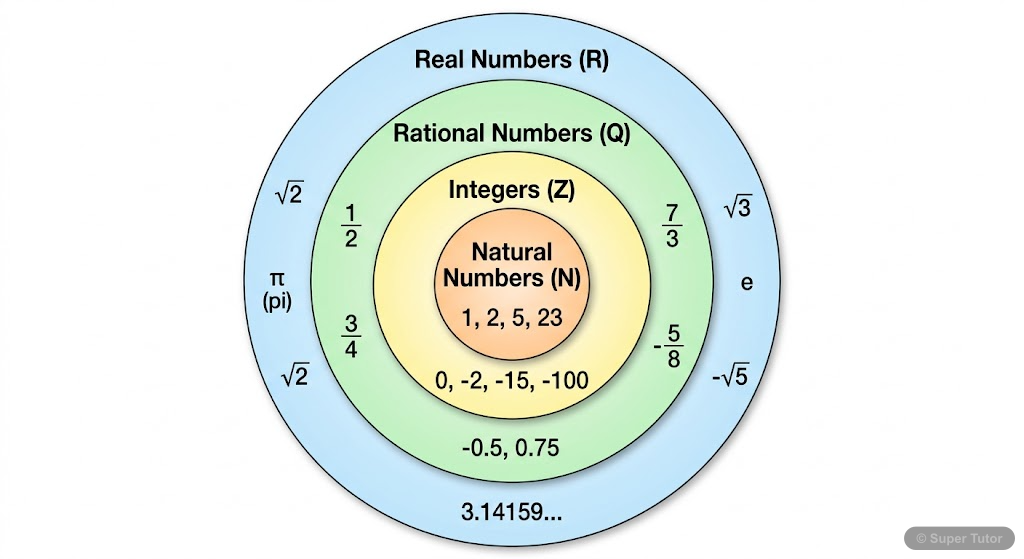
A nested Venn diagram illustrating the relationships between natural numbers (N), integers (Z), rational numbers (Q), and real numbers (R) as subsets of each other.
Super Tutor

Learn better with visuals Super Tutor has hundreds of illustrations like this across every chapter — all free to try.

Get started
25 Questions Solved · 5 Sections

Exercise 1.1

1Is zero a rational number? Can you write it in the form pq\frac{p}{q}, where pp and qq are integers and q0q \neq 0?Show solution
Given: The number zero (0).

Concept: A number is rational if it can be expressed as pq\frac{p}{q}, where pp and qq are integers and q0q \neq 0.

Working:
Yes, zero is a rational number. We can write:
0=01=02=03=01 etc.0 = \frac{0}{1} = \frac{0}{2} = \frac{0}{3} = \frac{0}{-1} \text{ etc.}
In each case, p=0p = 0 (an integer) and q0q \neq 0 (an integer).

Conclusion: Zero is indeed a rational number and can be written in the form pq\frac{p}{q} in infinitely many ways.
2Find six rational numbers between 3 and 4.Show solution
Given: Two rational numbers 3 and 4.

Concept: To find nn rational numbers between two numbers aa and bb, multiply numerator and denominator to create a gap. Here we need 6 rational numbers, so we write:
3=3×77=217and4=4×77=2873 = \frac{3 \times 7}{7} = \frac{21}{7} \quad \text{and} \quad 4 = \frac{4 \times 7}{7} = \frac{28}{7}

Working:
The rational numbers between 217\frac{21}{7} and 287\frac{28}{7} are:
227, 237, 247, 257, 267, 277\frac{22}{7},\ \frac{23}{7},\ \frac{24}{7},\ \frac{25}{7},\ \frac{26}{7},\ \frac{27}{7}

Answer: Six rational numbers between 3 and 4 are:
227, 237, 247, 257, 267, 277\frac{22}{7},\ \frac{23}{7},\ \frac{24}{7},\ \frac{25}{7},\ \frac{26}{7},\ \frac{27}{7}
(Note: There are infinitely many such rational numbers; this is one possible set.)
3Find five rational numbers between 35\frac{3}{5} and 45\frac{4}{5}.Show solution
Given: 35\frac{3}{5} and 45\frac{4}{5}.

Concept: To find 5 rational numbers between them, convert both fractions to equivalent fractions with a larger denominator (multiply by 6):
35=3×65×6=1830and45=4×65×6=2430\frac{3}{5} = \frac{3 \times 6}{5 \times 6} = \frac{18}{30} \quad \text{and} \quad \frac{4}{5} = \frac{4 \times 6}{5 \times 6} = \frac{24}{30}

Working:
The rational numbers between 1830\frac{18}{30} and 2430\frac{24}{30} are:
1930, 2030, 2130, 2230, 2330\frac{19}{30},\ \frac{20}{30},\ \frac{21}{30},\ \frac{22}{30},\ \frac{23}{30}

Answer: Five rational numbers between 35\frac{3}{5} and 45\frac{4}{5} are:
1930, 2030, 2130, 2230, 2330\frac{19}{30},\ \frac{20}{30},\ \frac{21}{30},\ \frac{22}{30},\ \frac{23}{30}
4State whether the following statements are true or false. Give reasons for your answers.
(i) Every natural number is a whole number.
(ii) Every integer is a whole number.
(iii) Every rational number is a whole number.
Show solution
(i) Every natural number is a whole number.

Answer: TRUE

Reason: The set of natural numbers is N={1,2,3,4,}\mathbb{N} = \{1, 2, 3, 4, \ldots\} and the set of whole numbers is W={0,1,2,3,}\mathbb{W} = \{0, 1, 2, 3, \ldots\}. Every natural number is present in the set of whole numbers. Hence, every natural number is a whole number.

---

(ii) Every integer is a whole number.

Answer: FALSE

Reason: The set of integers is Z={,3,2,1,0,1,2,3,}\mathbb{Z} = \{\ldots, -3, -2, -1, 0, 1, 2, 3, \ldots\}. Negative integers such as 1,2,3,-1, -2, -3, \ldots are integers but they are NOT whole numbers. Hence, every integer is not a whole number.

---

(iii) Every rational number is a whole number.

Answer: FALSE

Reason: Rational numbers include fractions such as 12,34,23\frac{1}{2}, \frac{3}{4}, \frac{-2}{3}, etc. These are not whole numbers. For example, 12\frac{1}{2} is a rational number but not a whole number. Hence, every rational number is not a whole number.

Exercise 1.2

1State whether the following statements are true or false. Justify your answers.
(i) Every irrational number is a real number.
(ii) Every point on the number line is of the form m\sqrt{m}, where mm is a natural number.
(iii) Every real number is an irrational number.
Show solution
(i) Every irrational number is a real number.

Answer: TRUE

Reason: The set of real numbers consists of all rational numbers and all irrational numbers together. Therefore, every irrational number is a part of the collection of real numbers, making this statement true.

---

(ii) Every point on the number line is of the form m\sqrt{m}, where mm is a natural number.

Answer: FALSE

Reason: Points on the number line include negative numbers (e.g., 1,2-1, -2), zero, and positive numbers. Negative numbers cannot be expressed as m\sqrt{m} where mm is a natural number (since square roots of natural numbers are non-negative). Also, numbers like 2,32, 3 are on the number line but m\sqrt{m} for natural number mm gives 1=1,2,3,4=2,\sqrt{1}=1, \sqrt{2}, \sqrt{3}, \sqrt{4}=2, \ldots — not every point is covered. Hence the statement is false.

---

(iii) Every real number is an irrational number.

Answer: FALSE

Reason: Real numbers include both rational and irrational numbers. For example, 2,34,02, \frac{3}{4}, 0 are real numbers but they are rational, not irrational. Hence, not every real number is irrational.
2Are the square roots of all positive integers irrational? If not, give an example of the square root of a number that is a rational number.Show solution
Answer: No, the square roots of all positive integers are not irrational.

Example:
4=2,9=3,16=4\sqrt{4} = 2, \quad \sqrt{9} = 3, \quad \sqrt{16} = 4
Here, 4=2\sqrt{4} = 2 is a rational number (it can be written as 21\frac{2}{1}).

Conclusion: The square roots of perfect squares like 1,4,9,16,25,1, 4, 9, 16, 25, \ldots are rational numbers. Only the square roots of non-perfect-square positive integers are irrational.
3Show how 5\sqrt{5} can be represented on the number line.Show solution
Concept: We use the Pythagorean theorem to construct 5\sqrt{5}.

Steps:

Step 1: Draw a number line and mark the origin OO (representing 0) and point AA representing 2, so OA=2OA = 2 units.

Step 2: At point AA, draw ABAB perpendicular to the number line such that AB=1AB = 1 unit.

Step 3: Join OBOB. By the Pythagorean theorem:
OB=OA2+AB2=22+12=4+1=5OB = \sqrt{OA^2 + AB^2} = \sqrt{2^2 + 1^2} = \sqrt{4 + 1} = \sqrt{5}

Step 4: With OO as centre and OBOB as radius, draw an arc that cuts the number line at point PP.

Conclusion: The point PP on the number line represents 5\sqrt{5}, since OP=OB=5OP = OB = \sqrt{5}.
4Classroom activity (Constructing the 'square root spiral'): Take a large sheet of paper and construct the 'square root spiral' in the following fashion. Start with a point O and draw a line segment OP1\mathrm{OP}_1 of unit length. Draw a line segment P1P2\mathrm{P}_1\mathrm{P}_2 perpendicular to OP1\mathrm{OP}_1 of unit length. Now draw a line segment P2P3\mathrm{P}_2\mathrm{P}_3 perpendicular to OP2\mathrm{OP}_2. Then draw a line segment P3P4\mathrm{P}_3\mathrm{P}_4 perpendicular to OP3\mathrm{OP}_3. Continuing in this manner, you can get the line segment Pn1Pn\mathrm{P}_{n-1}\mathrm{P}_n by drawing a line segment of unit length perpendicular to OPn1\mathrm{OP}_{n-1}.Show solution
This is a classroom activity. Below is the mathematical justification:

Step 1: Start at point OO. Draw OP1=1OP_1 = 1 unit along the number line.
OP1=1=1OP_1 = \sqrt{1} = 1

Step 2: Draw P1P2OP1P_1P_2 \perp OP_1, with P1P2=1P_1P_2 = 1 unit.
OP2=OP12+P1P22=12+12=2OP_2 = \sqrt{OP_1^2 + P_1P_2^2} = \sqrt{1^2 + 1^2} = \sqrt{2}

Step 3: Draw P2P3OP2P_2P_3 \perp OP_2, with P2P3=1P_2P_3 = 1 unit.
OP3=OP22+P2P32=(2)2+12=2+1=3OP_3 = \sqrt{OP_2^2 + P_2P_3^2} = \sqrt{(\sqrt{2})^2 + 1^2} = \sqrt{2+1} = \sqrt{3}

Step 4: Draw P3P4OP3P_3P_4 \perp OP_3, with P3P4=1P_3P_4 = 1 unit.
OP4=(3)2+12=3+1=4=2OP_4 = \sqrt{(\sqrt{3})^2 + 1^2} = \sqrt{3+1} = \sqrt{4} = 2

General Pattern: At each step nn:
OPn=nOP_n = \sqrt{n}

Conclusion: By continuing this process, we obtain a spiral (called the square root spiral or Theodorus spiral) where the distance from OO to PnP_n equals n\sqrt{n}, representing 2,3,4,\sqrt{2}, \sqrt{3}, \sqrt{4}, \ldots on the plane.

Exercise 1.3

1Write the following in decimal form and say what kind of decimal expansion each has:
(i) 36100\frac{36}{100} (ii) 111\frac{1}{11} (iii) 4184\frac{1}{8} (iv) 313\frac{3}{13} (v) 211\frac{2}{11} (vi) 329400\frac{329}{400}
Show solution
(i) 36100\frac{36}{100}
36100=0.36\frac{36}{100} = 0.36
Type: Terminating decimal

---

(ii) 111\frac{1}{11}
Performing long division: 1÷111 \div 11:
111=0.090909=0.09\frac{1}{11} = 0.090909\ldots = 0.\overline{09}
Type: Non-terminating recurring (repeating block: 09)

---

(iii) 4184\frac{1}{8}
418=3384\frac{1}{8} = \frac{33}{8}
Performing long division: 33÷833 \div 8:
338=4.125\frac{33}{8} = 4.125
Type: Terminating decimal

---

(iv) 313\frac{3}{13}
Performing long division: 3÷133 \div 13:
313=0.230769230769=0.230769\frac{3}{13} = 0.230769230769\ldots = 0.\overline{230769}
Type: Non-terminating recurring (repeating block: 230769)

---

(v) 211\frac{2}{11}
Performing long division: 2÷112 \div 11:
211=0.181818=0.18\frac{2}{11} = 0.181818\ldots = 0.\overline{18}
Type: Non-terminating recurring (repeating block: 18)

---

(vi) 329400\frac{329}{400}
Performing long division: 329÷400329 \div 400:
329400=0.8225\frac{329}{400} = 0.8225
Type: Terminating decimal
2You know that 17=0.142857\frac{1}{7} = 0.\overline{142857}. Can you predict what the decimal expansions of 27\frac{2}{7}, 37\frac{3}{7}, 47\frac{4}{7}, 57\frac{5}{7}, 67\frac{6}{7} are, without actually doing the long division? If so, how?Show solution
Given: 17=0.142857\frac{1}{7} = 0.\overline{142857}

Concept: Since 27=2×17\frac{2}{7} = 2 \times \frac{1}{7}, 37=3×17\frac{3}{7} = 3 \times \frac{1}{7}, etc., we can multiply the repeating block. Also, the remainders while dividing 11 by 77 cycle through 1,3,2,6,4,51, 3, 2, 6, 4, 5 — each remainder corresponds to a cyclic permutation of the block 142857142857.

Predictions:
27=2×0.142857=0.285714\frac{2}{7} = 2 \times 0.\overline{142857} = 0.\overline{285714}
37=3×0.142857=0.428571\frac{3}{7} = 3 \times 0.\overline{142857} = 0.\overline{428571}
47=4×0.142857=0.571428\frac{4}{7} = 4 \times 0.\overline{142857} = 0.\overline{571428}
57=5×0.142857=0.714285\frac{5}{7} = 5 \times 0.\overline{142857} = 0.\overline{714285}
67=6×0.142857=0.857142\frac{6}{7} = 6 \times 0.\overline{142857} = 0.\overline{857142}

Observation: Each decimal is a cyclic permutation of the digits 142857142857. This happens because the remainders when dividing by 7 cycle through all non-zero residues.
3Express the following in the form pq\frac{p}{q}, where pp and qq are integers and q0q \neq 0.
(i) 0.60.\overline{6} (ii) 0.470.4\overline{7} (iii) 0.0010.\overline{001}
Show solution
(i) 0.60.\overline{6}

Let x=0.6666x = 0.6666\ldots (1)\quad \cdots (1)

Multiply both sides by 10:
10x=6.6666(2)10x = 6.6666\ldots \quad \cdots (2)

Subtract (1) from (2):
10xx=6.66660.666610x - x = 6.6666\ldots - 0.6666\ldots
9x=69x = 6
x=69=23x = \frac{6}{9} = \frac{2}{3}

0.6=23\boxed{0.\overline{6} = \frac{2}{3}}

---

(ii) 0.470.4\overline{7}

Let x=0.4777x = 0.4777\ldots (1)\quad \cdots (1)

Multiply both sides by 10:
10x=4.777(2)10x = 4.777\ldots \quad \cdots (2)

Multiply both sides by 100:
100x=47.777(3)100x = 47.777\ldots \quad \cdots (3)

Subtract (2) from (3):
100x10x=47.7774.777100x - 10x = 47.777\ldots - 4.777\ldots
90x=4390x = 43
x=4390x = \frac{43}{90}

0.47=4390\boxed{0.4\overline{7} = \frac{43}{90}}

---

(iii) 0.0010.\overline{001}

Let x=0.001001001x = 0.001001001\ldots (1)\quad \cdots (1)

Multiply both sides by 1000:
1000x=1.001001001(2)1000x = 1.001001001\ldots \quad \cdots (2)

Subtract (1) from (2):
1000xx=1.0010010.0010011000x - x = 1.001001\ldots - 0.001001\ldots
999x=1999x = 1
x=1999x = \frac{1}{999}

0.001=1999\boxed{0.\overline{001} = \frac{1}{999}}
4Express 0.999990.99999\ldots in the form pq\frac{p}{q}. Are you surprised by your answer? With your teacher and classmates discuss why the answer makes sense.Show solution
Let x=0.9999x = 0.9999\ldots (1)\quad \cdots (1)

Multiply both sides by 10:
10x=9.9999(2)10x = 9.9999\ldots \quad \cdots (2)

Subtract (1) from (2):
10xx=9.99990.999910x - x = 9.9999\ldots - 0.9999\ldots
9x=99x = 9
x=1x = 1

0.99999=11=1\boxed{0.99999\ldots = \frac{1}{1} = 1}

Discussion: This result may seem surprising, but it makes sense because 0.99990.9999\ldots is a non-terminating recurring decimal and the difference between 1 and 0.99990.9999\ldots is 0.0000=00.0000\ldots = 0. There is no gap between 0.99990.9999\ldots and 11; they represent the same number. This shows that every non-terminating recurring decimal is a rational number.
5What can the maximum number of digits be in the repeating block of digits in the decimal expansion of 117\frac{1}{17}? Perform the division to check your answer.Show solution
Concept: When we divide 11 by 1717, the remainders at each step can only be 1,2,3,,161, 2, 3, \ldots, 16 (i.e., at most 1616 different non-zero remainders). Once a remainder repeats, the decimal block repeats. Therefore, the maximum length of the repeating block is 16\mathbf{16}.

Verification by long division:

Performing 1÷171 \div 17:

1.000000000000000÷171.000000000000000 \div 17

Step-by-step remainders: 10,10015,15014,1404,406,609,905,5016,1607,702,203,3013,13011,1108,8012,120110, 100\to 15, 150\to 14, 140\to 4, 40\to 6, 60\to 9, 90\to 5, 50\to 16, 160\to 7, 70\to 2, 20\to 3, 30\to 13, 130\to 11, 110\to 8, 80\to 12, 120\to 1 (remainder 1 repeats)

117=0.0588235294117647\frac{1}{17} = 0.\overline{0588235294117647}

The repeating block is 05882352941176470588235294117647, which has 16 digits.

Conclusion: The maximum number of digits in the repeating block of 117\frac{1}{17} is 1616, which is confirmed by the division.
6Look at several examples of rational numbers in the form pq\frac{p}{q} (q0q \neq 0), where pp and qq are integers with no common factors other than 1 and having terminating decimal representations (expansions). Can you guess what property qq must satisfy?Show solution
Examples of terminating decimals:
12=0.5(q=2=21)\frac{1}{2} = 0.5 \quad (q = 2 = 2^1)
14=0.25(q=4=22)\frac{1}{4} = 0.25 \quad (q = 4 = 2^2)
15=0.2(q=5=51)\frac{1}{5} = 0.2 \quad (q = 5 = 5^1)
18=0.125(q=8=23)\frac{1}{8} = 0.125 \quad (q = 8 = 2^3)
110=0.1(q=10=21×51)\frac{1}{10} = 0.1 \quad (q = 10 = 2^1 \times 5^1)
125=0.04(q=25=52)\frac{1}{25} = 0.04 \quad (q = 25 = 5^2)
720=0.35(q=20=22×51)\frac{7}{20} = 0.35 \quad (q = 20 = 2^2 \times 5^1)

Observation and Conclusion:

In all the above examples, the denominator qq (in lowest terms) has only 22 and 55 as its prime factors.

Property: A rational number pq\frac{p}{q} (in lowest terms) has a terminating decimal expansion if and only if qq is of the form 2m×5n2^m \times 5^n, where mm and nn are non-negative integers.
7Write three numbers whose decimal expansions are non-terminating non-recurring.Show solution
Concept: Non-terminating non-recurring decimals represent irrational numbers.

Three such numbers are:

1. 2=1.41421356\sqrt{2} = 1.41421356\ldots (non-terminating, non-recurring)

2. 3=1.73205080\sqrt{3} = 1.73205080\ldots (non-terminating, non-recurring)

3. π=3.14159265\pi = 3.14159265\ldots (non-terminating, non-recurring)

Alternatively, one can write numbers like:
0.1010010001000010.101001000100001\ldots
0.2020020002000020.202002000200002\ldots
0.3030030003000030.303003000300003\ldots
where the pattern never repeats.
8Find three different irrational numbers between the rational numbers 57\frac{5}{7} and 911\frac{9}{11}.Show solution
Given: 57\frac{5}{7} and 911\frac{9}{11}.

Step 1: Convert to decimals.
57=0.7142850.7142\frac{5}{7} = 0.\overline{714285} \approx 0.7142\ldots
911=0.81=0.8181\frac{9}{11} = 0.\overline{81} = 0.8181\ldots

Step 2: We need irrational numbers between 0.71420.7142\ldots and 0.81810.8181\ldots

Three irrational numbers between them:

1. 0.730730073000730000730.73073007300073000073\ldots (non-terminating, non-recurring)

2. 0.750750075000750000750.75075007500075000075\ldots (non-terminating, non-recurring)

3. 0.790790079000790000790.79079007900079000079\ldots (non-terminating, non-recurring)

Conclusion: These three numbers lie between 57\frac{5}{7} and 911\frac{9}{11} and are irrational (non-terminating non-recurring decimals).
9Classify the following numbers as rational or irrational:
(i) 23\sqrt{23} (ii) 225\sqrt{225} (iii) 0.37960.3796 (iv) 7.4784787.478478\ldots (v) 1.1010010001000011.101001000100001\ldots
Show solution
(i) 23\sqrt{23}

23 is not a perfect square. Its square root cannot be expressed as pq\frac{p}{q}.
23=4.79583 (non-terminating, non-recurring)\sqrt{23} = 4.79583\ldots \text{ (non-terminating, non-recurring)}
Classification: Irrational number

---

(ii) 225\sqrt{225}
225=152=15\sqrt{225} = \sqrt{15^2} = 15
15 is an integer and can be written as 151\frac{15}{1}.
Classification: Rational number

---

(iii) 0.37960.3796

This is a terminating decimal.
0.3796=379610000=94925000.3796 = \frac{3796}{10000} = \frac{949}{2500}
Classification: Rational number

---

(iv) 7.478478=7.4787.478478\ldots = 7.\overline{478}

This is a non-terminating but recurring (repeating) decimal.
Classification: Rational number

---

(v) 1.1010010001000011.101001000100001\ldots

The pattern shows one more zero is inserted between consecutive 1s each time. This decimal is non-terminating and non-recurring (the block never repeats).
Classification: Irrational number

Exercise 1.4

1Classify the following numbers as rational or irrational:
(i) 252 - \sqrt{5} (ii) (3+23)23(3 + \sqrt{23}) - \sqrt{23} (iii) 2777\frac{2\sqrt{7}}{7\sqrt{7}} (iv) 12\frac{1}{\sqrt{2}} (v) 2π2\pi
Show solution
(i) 252 - \sqrt{5}

Here, 22 is rational and 5\sqrt{5} is irrational.
By the property: rational - irrational == irrational.
Classification: Irrational number

---

(ii) (3+23)23(3 + \sqrt{23}) - \sqrt{23}

(3+23)23=3+2323=3(3 + \sqrt{23}) - \sqrt{23} = 3 + \sqrt{23} - \sqrt{23} = 3
3 can be written as 31\frac{3}{1}.
Classification: Rational number

---

(iii) 2777\frac{2\sqrt{7}}{7\sqrt{7}}

2777=27\frac{2\sqrt{7}}{7\sqrt{7}} = \frac{2}{7}
27\frac{2}{7} is of the form pq\frac{p}{q} where p=2p = 2, q=70q = 7 \neq 0.
Classification: Rational number

---

(iv) 12\frac{1}{\sqrt{2}}

2\sqrt{2} is irrational. The reciprocal of an irrational number is irrational.
12=220.7071 (non-terminating, non-recurring)\frac{1}{\sqrt{2}} = \frac{\sqrt{2}}{2} \approx 0.7071\ldots \text{ (non-terminating, non-recurring)}
Classification: Irrational number

---

(v) 2π2\pi

π\pi is irrational. A non-zero rational number (22) multiplied by an irrational number is irrational.
2π=6.28318 (non-terminating, non-recurring)2\pi = 6.28318\ldots \text{ (non-terminating, non-recurring)}
Classification: Irrational number
2Simplify each of the following expressions:
(i) (3+3)(2+2)(3 + \sqrt{3})(2 + \sqrt{2})
(ii) (3+3)(33)(3 + \sqrt{3})(3 - \sqrt{3})
(iii) (5+2)2(\sqrt{5} + \sqrt{2})^2
(iv) (52)(5+2)(\sqrt{5} - \sqrt{2})(\sqrt{5} + \sqrt{2})
Show solution
(i) (3+3)(2+2)(3 + \sqrt{3})(2 + \sqrt{2})

Using distributive property:
(3+3)(2+2)=32+32+23+32(3 + \sqrt{3})(2 + \sqrt{2}) = 3 \cdot 2 + 3\sqrt{2} + 2\sqrt{3} + \sqrt{3} \cdot \sqrt{2}
=6+32+23+6= 6 + 3\sqrt{2} + 2\sqrt{3} + \sqrt{6}

---

(ii) (3+3)(33)(3 + \sqrt{3})(3 - \sqrt{3})

Using identity (a+b)(ab)=a2b2(a+b)(a-b) = a^2 - b^2, with a=3a = 3, b=3b = \sqrt{3}:
(3+3)(33)=32(3)2=93=6(3 + \sqrt{3})(3 - \sqrt{3}) = 3^2 - (\sqrt{3})^2 = 9 - 3 = 6

---

(iii) (5+2)2(\sqrt{5} + \sqrt{2})^2

Using identity (a+b)2=a2+2ab+b2(a + b)^2 = a^2 + 2ab + b^2, with a=5a = \sqrt{5}, b=2b = \sqrt{2}:
(5+2)2=(5)2+252+(2)2(\sqrt{5} + \sqrt{2})^2 = (\sqrt{5})^2 + 2 \cdot \sqrt{5} \cdot \sqrt{2} + (\sqrt{2})^2
=5+210+2=7+210= 5 + 2\sqrt{10} + 2 = 7 + 2\sqrt{10}

---

(iv) (52)(5+2)(\sqrt{5} - \sqrt{2})(\sqrt{5} + \sqrt{2})

Using identity (ab)(a+b)=a2b2(a - b)(a + b) = a^2 - b^2, with a=5a = \sqrt{5}, b=2b = \sqrt{2}:
(52)(5+2)=(5)2(2)2=52=3(\sqrt{5} - \sqrt{2})(\sqrt{5} + \sqrt{2}) = (\sqrt{5})^2 - (\sqrt{2})^2 = 5 - 2 = 3
3Recall, π\pi is defined as the ratio of the circumference (say cc) of a circle to its diameter (say dd). That is, π=cd\pi = \frac{c}{d}. This seems to contradict the fact that π\pi is irrational. How will you resolve this contradiction?Show solution
Understanding the apparent contradiction:

The definition π=cd\pi = \frac{c}{d} (circumference divided by diameter) looks like a ratio of two quantities, which might suggest π\pi is rational.

Resolution:

For π\pi to be rational, both cc and dd must be integers (or at least rational numbers with d0d \neq 0). However, when we measure the circumference cc and diameter dd of any circle, at least one of them will be irrational.

For example:
- If d=1d = 1 (rational), then c=π×1=πc = \pi \times 1 = \pi (irrational).
- If d=2d = 2 (rational), then c=2πc = 2\pi (irrational).

So π=cd\pi = \frac{c}{d} is a ratio of two real numbers (not necessarily integers), and a ratio of two real numbers need not be rational.

Conclusion: There is no contradiction. The definition π=cd\pi = \frac{c}{d} means π\pi is the ratio of two lengths (real numbers), not necessarily integers. Since cc and dd cannot both be rational simultaneously for any circle, π\pi remains irrational.
4Represent 9.3\sqrt{9.3} on the number line.Show solution
Steps to represent 9.3\sqrt{9.3} on the number line:

Step 1: Draw a line segment AB=9.3AB = 9.3 units on the number line (from point AA at 0 to point BB at 9.3).

Step 2: Extend ABAB by 1 unit to point CC, so BC=1BC = 1 unit. Thus AC=10.3AC = 10.3 units.

Step 3: Find the midpoint MM of ACAC. So AM=MC=10.32=5.15AM = MC = \frac{10.3}{2} = 5.15 units.

Step 4: With MM as centre and MCMC (= 5.15 units) as radius, draw a semicircle above the line ACAC.

Step 5: At point BB, draw a perpendicular to ACAC. Let it meet the semicircle at point DD.

Step 6: By the geometric mean relation:
BD=AB×BC=9.3×1=9.3BD = \sqrt{AB \times BC} = \sqrt{9.3 \times 1} = \sqrt{9.3}

Step 7: With BB as centre and BDBD as radius, draw an arc to cut the number line at point PP.

Conclusion: The point PP on the number line represents 9.3\sqrt{9.3}.
5Rationalise the denominators of the following:
(i) 17\frac{1}{\sqrt{7}} (ii) 176\frac{1}{\sqrt{7} - \sqrt{6}} (iii) 15+2\frac{1}{\sqrt{5} + \sqrt{2}} (iv) 172\frac{1}{\sqrt{7} - 2}
Show solution
(i) 17\frac{1}{\sqrt{7}}

Multiply numerator and denominator by 7\sqrt{7}:
17×77=77\frac{1}{\sqrt{7}} \times \frac{\sqrt{7}}{\sqrt{7}} = \frac{\sqrt{7}}{7}

17=77\boxed{\frac{1}{\sqrt{7}} = \frac{\sqrt{7}}{7}}

---

(ii) 176\frac{1}{\sqrt{7} - \sqrt{6}}

Multiply numerator and denominator by the conjugate (7+6)(\sqrt{7} + \sqrt{6}):
176×7+67+6=7+6(7)2(6)2=7+676=7+61\frac{1}{\sqrt{7} - \sqrt{6}} \times \frac{\sqrt{7} + \sqrt{6}}{\sqrt{7} + \sqrt{6}} = \frac{\sqrt{7} + \sqrt{6}}{(\sqrt{7})^2 - (\sqrt{6})^2} = \frac{\sqrt{7} + \sqrt{6}}{7 - 6} = \frac{\sqrt{7} + \sqrt{6}}{1}

176=7+6\boxed{\frac{1}{\sqrt{7} - \sqrt{6}} = \sqrt{7} + \sqrt{6}}

---

(iii) 15+2\frac{1}{\sqrt{5} + \sqrt{2}}

Multiply numerator and denominator by the conjugate (52)(\sqrt{5} - \sqrt{2}):
15+2×5252=52(5)2(2)2=5252=523\frac{1}{\sqrt{5} + \sqrt{2}} \times \frac{\sqrt{5} - \sqrt{2}}{\sqrt{5} - \sqrt{2}} = \frac{\sqrt{5} - \sqrt{2}}{(\sqrt{5})^2 - (\sqrt{2})^2} = \frac{\sqrt{5} - \sqrt{2}}{5 - 2} = \frac{\sqrt{5} - \sqrt{2}}{3}

15+2=523\boxed{\frac{1}{\sqrt{5} + \sqrt{2}} = \frac{\sqrt{5} - \sqrt{2}}{3}}

---

(iv) 172\frac{1}{\sqrt{7} - 2}

Multiply numerator and denominator by the conjugate (7+2)(\sqrt{7} + 2):
172×7+27+2=7+2(7)2(2)2=7+274=7+23\frac{1}{\sqrt{7} - 2} \times \frac{\sqrt{7} + 2}{\sqrt{7} + 2} = \frac{\sqrt{7} + 2}{(\sqrt{7})^2 - (2)^2} = \frac{\sqrt{7} + 2}{7 - 4} = \frac{\sqrt{7} + 2}{3}

172=7+23\boxed{\frac{1}{\sqrt{7} - 2} = \frac{\sqrt{7} + 2}{3}}

Exercise 1.5

1Find:
(i) 641264^{\frac{1}{2}} (ii) 321532^{\frac{1}{5}} (iii) 12513125^{\frac{1}{3}}
Show solution
(i) 641264^{\frac{1}{2}}

6412=64=82=864^{\frac{1}{2}} = \sqrt{64} = \sqrt{8^2} = 8

6412=8\boxed{64^{\frac{1}{2}} = 8}

---

(ii) 321532^{\frac{1}{5}}

32=2532 = 2^5
3215=(25)15=25×15=21=232^{\frac{1}{5}} = (2^5)^{\frac{1}{5}} = 2^{5 \times \frac{1}{5}} = 2^1 = 2

3215=2\boxed{32^{\frac{1}{5}} = 2}

---

(iii) 12513125^{\frac{1}{3}}

125=53125 = 5^3
12513=(53)13=53×13=51=5125^{\frac{1}{3}} = (5^3)^{\frac{1}{3}} = 5^{3 \times \frac{1}{3}} = 5^1 = 5

12513=5\boxed{125^{\frac{1}{3}} = 5}
2Find:
(i) 9329^{\frac{3}{2}} (ii) 322532^{\frac{2}{5}} (iii) 163416^{\frac{3}{4}} (iv) 12513125^{-\frac{1}{3}}
Show solution
(i) 9329^{\frac{3}{2}}

932=(912)3=(9)3=33=279^{\frac{3}{2}} = (9^{\frac{1}{2}})^3 = (\sqrt{9})^3 = 3^3 = 27

932=27\boxed{9^{\frac{3}{2}} = 27}

---

(ii) 322532^{\frac{2}{5}}

32=2532 = 2^5
3225=(25)25=25×25=22=432^{\frac{2}{5}} = (2^5)^{\frac{2}{5}} = 2^{5 \times \frac{2}{5}} = 2^2 = 4

3225=4\boxed{32^{\frac{2}{5}} = 4}

---

(iii) 163416^{\frac{3}{4}}

16=2416 = 2^4
1634=(24)34=24×34=23=816^{\frac{3}{4}} = (2^4)^{\frac{3}{4}} = 2^{4 \times \frac{3}{4}} = 2^3 = 8

1634=8\boxed{16^{\frac{3}{4}} = 8}

---

(iv) 12513125^{-\frac{1}{3}}

125=53125 = 5^3
12513=(53)13=53×(13)=51=15125^{-\frac{1}{3}} = (5^3)^{-\frac{1}{3}} = 5^{3 \times (-\frac{1}{3})} = 5^{-1} = \frac{1}{5}

12513=15\boxed{125^{-\frac{1}{3}} = \frac{1}{5}}
3Simplify:
(i) 2232152^{\frac{2}{3}} \cdot 2^{\frac{1}{5}} (ii) (133)7\left(\frac{1}{3^3}\right)^7 (iii) 11121114\frac{11^{\frac{1}{2}}}{11^{\frac{1}{4}}} (iv) 7128127^{\frac{1}{2}} \cdot 8^{\frac{1}{2}}
Show solution
(i) 2232152^{\frac{2}{3}} \cdot 2^{\frac{1}{5}}

Using law aman=am+na^m \cdot a^n = a^{m+n}:
223215=223+15=21015+315=213152^{\frac{2}{3}} \cdot 2^{\frac{1}{5}} = 2^{\frac{2}{3} + \frac{1}{5}} = 2^{\frac{10}{15} + \frac{3}{15}} = 2^{\frac{13}{15}}

223215=21315\boxed{2^{\frac{2}{3}} \cdot 2^{\frac{1}{5}} = 2^{\frac{13}{15}}}

---

(ii) (133)7\left(\frac{1}{3^3}\right)^7

(133)7=(33)7=33×7=321=1321\left(\frac{1}{3^3}\right)^7 = \left(3^{-3}\right)^7 = 3^{-3 \times 7} = 3^{-21} = \frac{1}{3^{21}}

(133)7=1321\boxed{\left(\frac{1}{3^3}\right)^7 = \frac{1}{3^{21}}}

---

(iii) 11121114\frac{11^{\frac{1}{2}}}{11^{\frac{1}{4}}}

Using law aman=amn\frac{a^m}{a^n} = a^{m-n}:
11121114=111214=112414=1114\frac{11^{\frac{1}{2}}}{11^{\frac{1}{4}}} = 11^{\frac{1}{2} - \frac{1}{4}} = 11^{\frac{2}{4} - \frac{1}{4}} = 11^{\frac{1}{4}}

11121114=1114\boxed{\frac{11^{\frac{1}{2}}}{11^{\frac{1}{4}}} = 11^{\frac{1}{4}}}

---

(iv) 7128127^{\frac{1}{2}} \cdot 8^{\frac{1}{2}}

Using law ambm=(ab)ma^m \cdot b^m = (ab)^m:
712812=(7×8)12=5612=567^{\frac{1}{2}} \cdot 8^{\frac{1}{2}} = (7 \times 8)^{\frac{1}{2}} = 56^{\frac{1}{2}} = \sqrt{56}

712812=56\boxed{7^{\frac{1}{2}} \cdot 8^{\frac{1}{2}} = \sqrt{56}}

Stuck on a step?

Ask Super Tutor AI to explain any solution on this page in a simpler way — free, 24x7.

Ask a Doubt Free

Frequently Asked Questions

What are the important topics in Number System for Madhya Pradesh Board Class 9 Mathematics?
Number System covers several key topics that are frequently asked in Madhya Pradesh Board Class 9 board exams. Focus on the core concepts listed on this page and practise related questions to build confidence.
How to score full marks in Number System — Madhya Pradesh Board Class 9 Mathematics?
Understand the core concepts first, then work through the 29 practice questions available for this chapter. Revise formulas and definitions regularly, and use flashcards for quick recall before the exam.
Where can I get free NCERT Solutions for Number System Class 9 Mathematics?
This page has free step-by-step NCERT Solutions for every exercise question in Number System (Madhya Pradesh Board Class 9 Mathematics) — written the way examiners award marks: given, formula, working, answer.

Sources & Official References

Content is aligned to the official syllabus. Refer to the board website for the latest curriculum.

For serious students

Get the full Number System chapter — for free.

Quizzes, flashcards, AI doubt-solver and a step-by-step study plan for Madhya Pradesh Board Class 9 Mathematics.