Impact Of British Rule On India Economic, Social And Cultural (1757-1857) — Study Plan
NIOS · Class 10 · Social Studies
A step-by-step study plan for Impact Of British Rule On India Economic, Social And Cultural (1757-1857), NIOS Class 10 Social Studies: what to learn.
Interactive on Super Tutor
Studying Impact Of British Rule On India Economic, Social And Cultural (1757-1857)? Get the full interactive chapter.
Quizzes, flashcards, AI doubt-solver and a step-by-step study plan — built for study plan and more.
Free trial, no card needed.
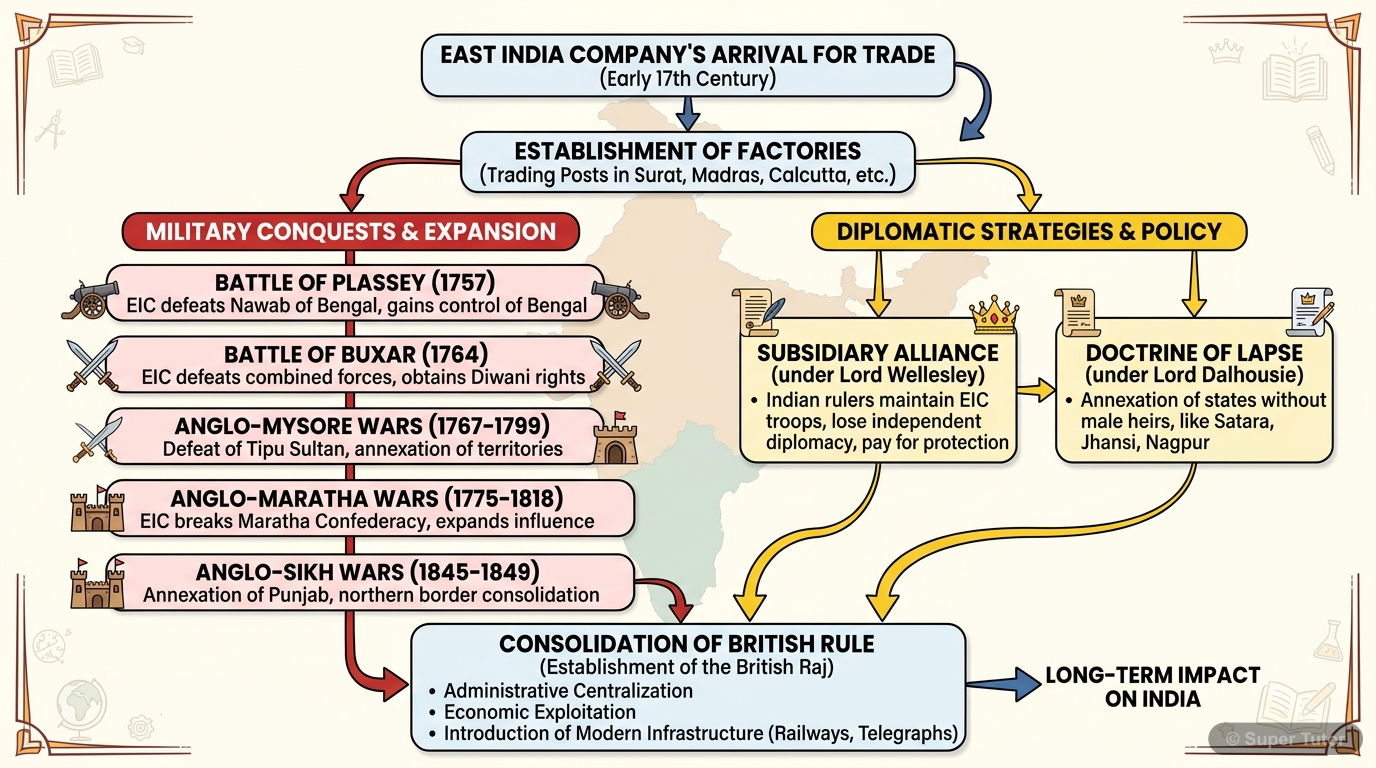
One of 5 illustrations for Impact Of British Rule On India Economic, Social And Cultural (1757-1857) in Super Tutor — alongside flashcards, concept maps and practice questions.
Study Plan
Learn the Theory
Read the textbook chapter carefully. Note down definitions, formulas and key ideas. Focus on: 1. Arrival of the British and Growth of Power, 2. Methods Used to Colonize India, 3. Economic Impact of British Rule.
Practise
Solve the textbook exercises and extra practice questions. There are 87 questions available for this chapter.
Revise & Test
Revise key points without looking at your notes. Take a practice quiz and mark weak areas for another pass.
Spaced Revision
Come back to Impact Of British Rule On India Economic, Social And Cultural (1757-1857) after a week. Use flashcards for quick recall and try past exam questions on this chapter.
What to Focus On
- The British came first as traders.
- The Industrial Revolution increased the need for raw materials and markets.
- Vasco da Gama discovered a sea route to India in 1498.
- Plassey was in 1757 and Buxar in 1764.
- Buxar took place on 22 October 1764.
- Mir Jafar was installed after Plassey and later reinstated.
- British policy turned India into a supplier of raw materials and a market for British goods.
- Indian handicrafts lost domestic and foreign markets by 1813.
- Duty, tax and tariff are important trade terms.
Common Mistakes to Avoid
The British came to India only as traders and never wanted political control.
Mir Jafar and Mir Qasim were the same person or played the same role at Buxar.
The Battle of Buxar happened in 1757 and the Battle of Plassey happened in 1764.
Memory Tips
Vasco da Gama discovering the sea route to India in 1498
East India Company established in 1600
First factory at Surat in 1613 and Sir Thomas Roe getting permission in 1615
Fort St. George as the first proprietary holding on Indian soil
Want a personalised study plan?
Super Tutor builds a day-by-day plan for NIOS Class 10 Social Studies that fits your exam date and pace.
Create My Study PlanFrequently Asked Questions
What are the important topics in Impact Of British Rule On India Economic, Social And Cultural (1757-1857) for NIOS Class 10 Social Studies?
How should I revise Impact Of British Rule On India Economic, Social And Cultural (1757-1857) for the NIOS Class 10 board exam?
Sources & Official References
Content is aligned to the official syllabus. Refer to the board website for the latest curriculum.
More resources for Impact Of British Rule On India Economic, Social And Cultural (1757-1857)
Practice Quiz
Test yourself with a quick quiz
Important Questions
Exam-style questions with answers
Revision Notes
Key points for last-minute revision
Chapter Summary
Understand the chapter at a glance
Concept Maps
See how topics connect
Flashcards
Quick-fire cards for active recall
Syllabus
What topics to cover
For serious students
Get the full Impact Of British Rule On India Economic, Social And Cultural (1757-1857) chapter — start free.
Quizzes, flashcards, an AI doubt solver and a study plan for NIOS Class 10 Social Studies. Free to start, no card needed.