Modern World-II — Study Plan
NIOS · Class 10 · Social Studies
A step-by-step study plan for Modern World-II, NIOS Class 10 Social Studies: what to learn first, what to practise and when to revise.
Interactive on Super Tutor
Studying Modern World-II? Get the full interactive chapter.
Quizzes, flashcards, AI doubt-solver and a step-by-step study plan — built for study plan and more.
Free trial, no card needed.
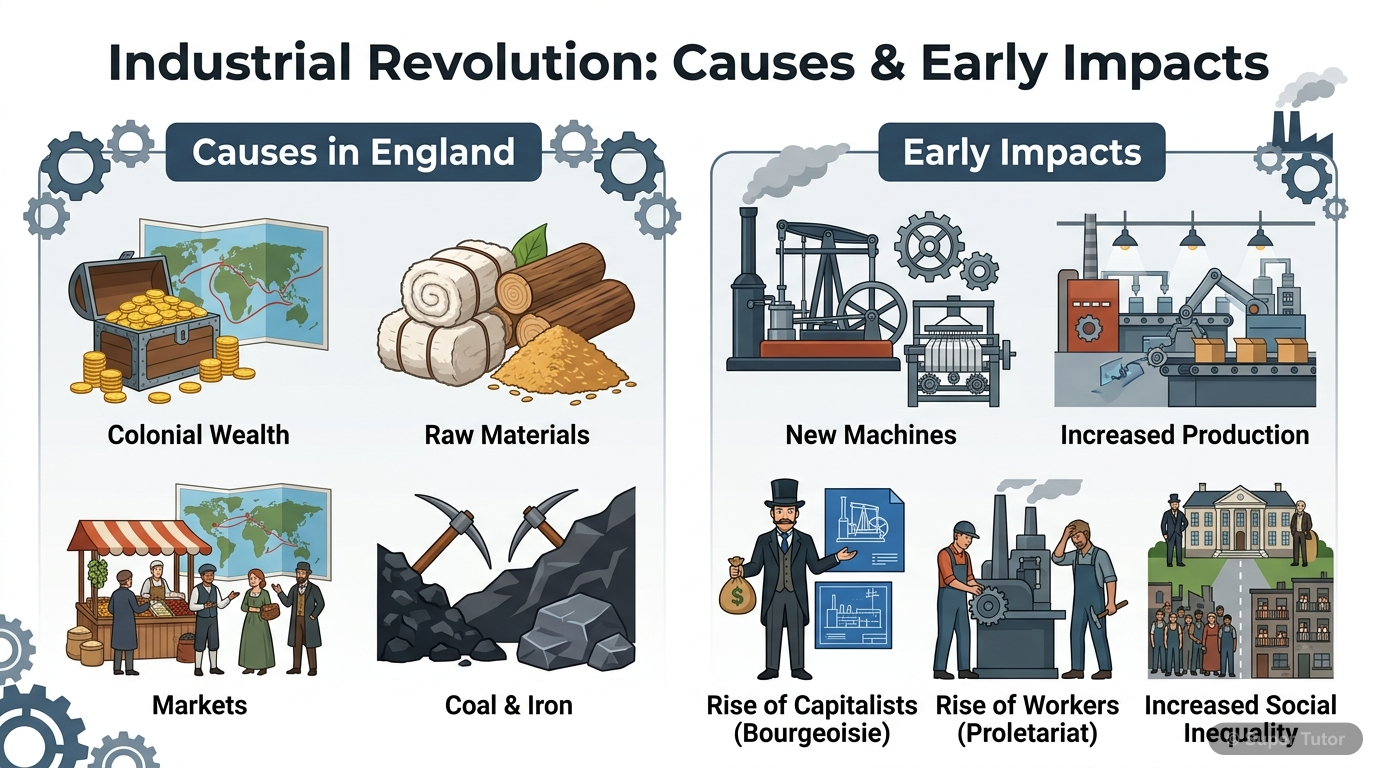
Learn better with visuals Super Tutor pairs illustrations like this with notes and quizzes for Modern World-II.
Study Plan
Learn the Theory
Read the textbook chapter carefully. Note down definitions, formulas and key ideas. Focus on: 1. Industrial Revolution, 2. Imperialism and Colonialism, 3. World War I and the League of Nations.
Practise
Solve the textbook exercises and extra practice questions. There are 84 questions available for this chapter.
Revise & Test
Revise key points without looking at your notes. Take a practice quiz and mark weak areas for another pass.
Spaced Revision
Come back to Modern World-II after a week. Use flashcards for quick recall and try past exam questions on this chapter.
What to Focus On
- The Industrial Revolution changed society from agricultural to industrial.
- Britain led the Industrial Revolution because of coal, iron, transport, political stability, and trade advantages.
- Enclosure Acts increased farm output but pushed many workers into cities.
- Flying Shuttle was invented by John Kay in 1733.
- Spinning Jenny was invented by James Hargreaves.
- Spinning Mule was invented by Samuel Crompton in 1779.
- Thomas Newcomen built an engine for pumping water from coal mines in 1705.
- James Watt improved the efficiency of Newcomen’s engine fourfold in 1764.
- John Wilkinson’s drilling machine helped bore the cylinder for Watt’s engine.
Common Mistakes to Avoid
The Industrial Revolution was mainly about the discovery of steam engines and nothing else.
James Watt built the first steam engine, so Thomas Newcomen is not important.
The Spinning Jenny and the Spinning Mule are the same machine, or both were invented by Samuel Crompton.
Memory Tips
Industrial Revolution as a big shift from handwork to machine work
James Watt and the steam engine
Thomas Newcomen came before James Watt
John Kay and the Flying Shuttle
Want a personalised study plan?
Super Tutor builds a day-by-day plan for NIOS Class 10 Social Studies that fits your exam date and pace.
Create My Study PlanFrequently Asked Questions
What are the important topics in Modern World-II for NIOS Class 10 Social Studies?
How should I revise Modern World-II for the NIOS Class 10 board exam?
Sources & Official References
Content is aligned to the official syllabus. Refer to the board website for the latest curriculum.
More resources for Modern World-II
Practice Quiz
Test yourself with a quick quiz
Important Questions
Exam-style questions with answers
Revision Notes
Key points for last-minute revision
Chapter Summary
Understand the chapter at a glance
Concept Maps
See how topics connect
Flashcards
Quick-fire cards for active recall
Syllabus
What topics to cover
For serious students
Get the full Modern World-II chapter — start free.
Quizzes, flashcards, an AI doubt solver and a study plan for NIOS Class 10 Social Studies. Free to start, no card needed.