Indian National Movement — Study Plan
NIOS · Class 10 · Social Studies
A step-by-step study plan for Indian National Movement, NIOS Class 10 Social Studies: what to learn first, what to practise and when to revise.
Interactive on Super Tutor
Studying Indian National Movement? Get the full interactive chapter.
Quizzes, flashcards, AI doubt-solver and a step-by-step study plan — built for study plan and more.
Free trial, no card needed.
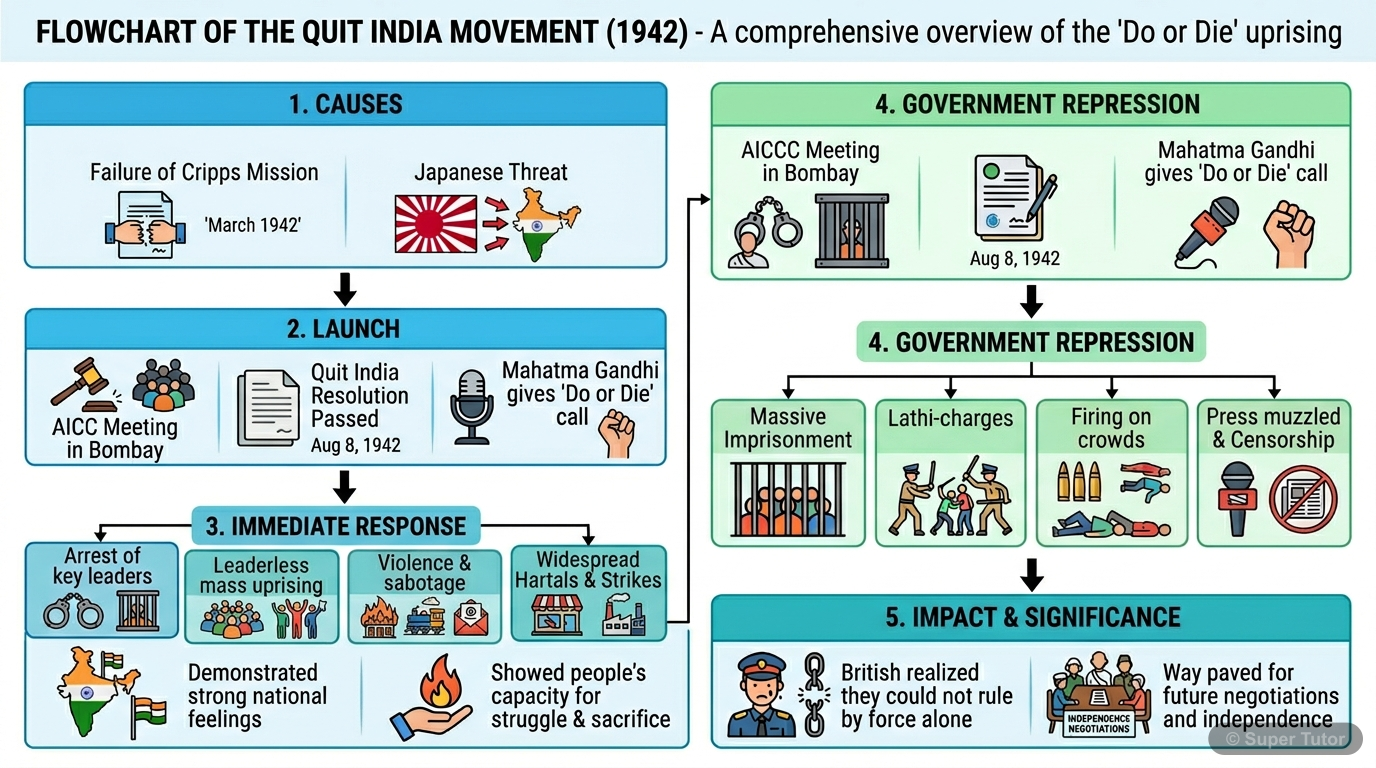
One of 14 illustrations for Indian National Movement in Super Tutor — alongside flashcards, concept maps and practice questions.
Study Plan
Learn the Theory
Read the textbook chapter carefully. Note down definitions, formulas and key ideas. Focus on: 1. Rise of Nationalism in India, 2. Emergence of the Indian National Congress, 3. British Repression and the Partition of Bengal.
Practise
Solve the textbook exercises and extra practice questions. There are 79 questions available for this chapter.
Revise & Test
Revise key points without looking at your notes. Take a practice quiz and mark weak areas for another pass.
Spaced Revision
Come back to Indian National Movement after a week. Use flashcards for quick recall and try past exam questions on this chapter.
What to Focus On
- Nationalism in India grew strongly in the 19th century after 1857.
- British rule created political and administrative unity.
- Economic exploitation strengthened anti-colonial feeling.
- INC was founded in 1885 by Allan Octavian Hume.
- Lord Dufferin supported Hume's scheme.
- Womesh Chandra Banerjee was the first President.
- Curzon passed a restrictive Act in 1898 and the Indian Universities Act in 1904.
- Partition of Bengal was announced in 1905.
- The partition was opposed through Swadeshi and boycott.
Common Mistakes to Avoid
The Indian National Congress was founded to demand complete independence from the very beginning.
The early Congress leaders were radicals who wanted boycotts, protests, and Swadeshi from the start.
The Congress split into Moderates and Radicals in 1905.
Memory Tips
Foundation of the Indian National Congress in 1885
First President of the Indian National Congress
Early Congress leaders
Moderates and their style
Want a personalised study plan?
Super Tutor builds a day-by-day plan for NIOS Class 10 Social Studies that fits your exam date and pace.
Create My Study PlanFrequently Asked Questions
What are the important topics in Indian National Movement for NIOS Class 10 Social Studies?
How should I revise Indian National Movement for the NIOS Class 10 board exam?
Sources & Official References
Content is aligned to the official syllabus. Refer to the board website for the latest curriculum.
More resources for Indian National Movement
Practice Quiz
Test yourself with a quick quiz
Important Questions
Exam-style questions with answers
Revision Notes
Key points for last-minute revision
Chapter Summary
Understand the chapter at a glance
Concept Maps
See how topics connect
Flashcards
Quick-fire cards for active recall
Syllabus
What topics to cover
For serious students
Get the full Indian National Movement chapter — start free.
Quizzes, flashcards, an AI doubt solver and a study plan for NIOS Class 10 Social Studies. Free to start, no card needed.