Impact Of British Rule On India Economic, Social And Cultural (1757-1857) — Practice Quiz
NIOS · Class 10 · Social Studies
Try a 4-question quiz on Impact Of British Rule On India Economic, Social And Cultural (1757-1857) for NIOS Class 10 Social Studies: tap an answer.
Interactive on Super Tutor
Studying Impact Of British Rule On India Economic, Social And Cultural (1757-1857)? Get the full interactive chapter.
Quizzes, flashcards, AI doubt-solver and a step-by-step study plan — built for practice quiz and more.
Free trial, no card needed.
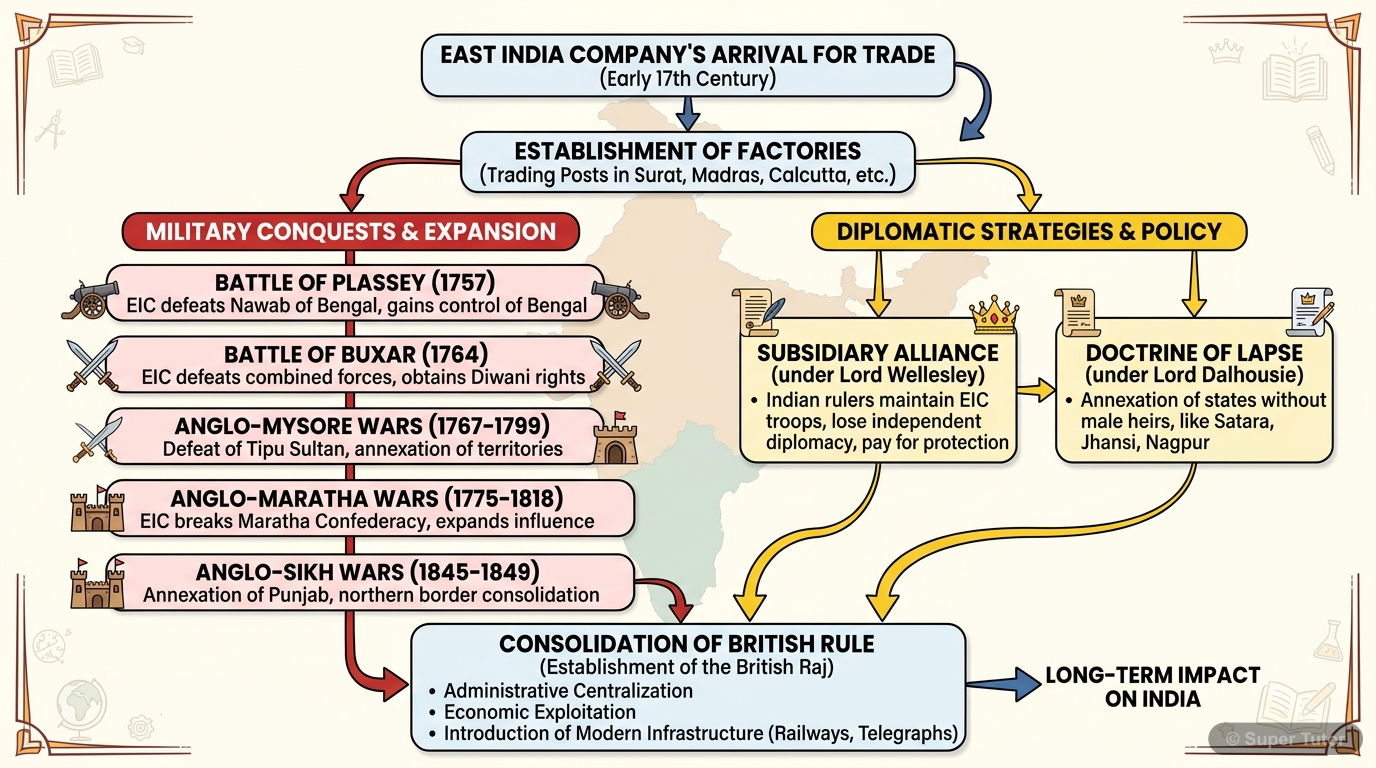
One of 5 illustrations for Impact Of British Rule On India Economic, Social And Cultural (1757-1857) in Super Tutor — alongside flashcards, concept maps and practice questions.
Quick Quiz: Impact Of British Rule On India Economic, Social And Cultural (1757-1857)
0/4Tap an answer to check it instantly. No sign-up needed for these 4.
The Battle of Plassey, which marked the beginning of British political control in India, was fought in which year?
Which policy allowed the British to annex Indian states whose rulers died without natural heirs?
The Industrial Revolution in Britain created a demand for which two things from India?
Under the Permanent Settlement introduced by Lord Cornwallis, who became the owner of land?
Sample Questions
Which commercial crop introduced by the British was used as a dyeing agent and made the land infertile?
Show answer
Indigo
Indigo was a problematic commercial crop forced upon Indian farmers by the British. Step 1: Indigo was used as a blue dyeing agent for cloth produced in British factories. Step 2: Farmers were compelled to grow indigo on 3/20th of their land under the tinkathia system. Step 3: The major problem was that indigo cultivation made the land infertile for several years. Step 4: This led to farmer resistance, including the famous Indigo Revolt in Bengal. Cotton, opium, and tea were other commercial crops but didn't have the same soil-damaging effects as indigo.
The practice of Sati was banned in which year during British rule?
Show answer
1829
Lord Bentinck banned the practice of Sati in 1829, marking an important social reform. Step 1: Sati was the practice where widows were forced to burn themselves on their husband's funeral pyre. Step 2: Social reformers like Raja Ram Mohan Roy campaigned against this inhuman practice. Step 3: Lord William Bentinck, the Governor-General, passed the law banning Sati in 1829. Step 4: This was one of the first major social reforms under British rule. 1856 was when Widow Remarriage Act was passed, and 1872 was when inter-caste marriage was legalized.
Which language did the British promote in India to create a class of educated Indians loyal to them?
Show answer
English
The British actively promoted English education as part of their administrative strategy. Step 1: They wanted to create English-educated Indians who would work as clerks and administrators at lower wages than British personnel. Step 2: This class was expected to be loyal to British culture and help in ruling India. Step 3: English education also created a market for British goods among educated Indians. Step 4: The Charter Act of 1813 allocated funds for promoting English education and Western sciences. Sanskrit and Persian were traditional languages, while Hindi was not promoted by the Britis
Who was the famous queen who fought against the British under the Doctrine of Lapse?
Show answer
Rani Lakshmibai
Rani Lakshmibai of Jhansi became a symbol of resistance against British annexation policies. Step 1: When her husband Raja Gangadhar Rao died, the British refused to recognize her adopted son as heir under the Doctrine of Lapse. Step 2: The British annexed Jhansi in 1854, which led to Rani Lakshmibai's fierce resistance. Step 3: She played a crucial role in the 1857 revolt, fighting bravely against British forces. Step 4: She died heroically in battle in 1858, becoming an icon of Indian resistance. The other queens mentioned fought against different rulers or in different time periods.
+83 more questions on Impact Of British Rule On India Economic, Social And Cultural (1757-1857) (NIOS Class 10 Social Studies)
Practise AllFrequently Asked Questions
What are the important topics in Impact Of British Rule On India Economic, Social And Cultural (1757-1857) for NIOS Class 10 Social Studies?
How many practice questions are there for Impact Of British Rule On India Economic, Social And Cultural (1757-1857)?
Sources & Official References
Content is aligned to the official syllabus. Refer to the board website for the latest curriculum.
More resources for Impact Of British Rule On India Economic, Social And Cultural (1757-1857)
Important Questions
Exam-style questions with answers
Revision Notes
Key points for last-minute revision
Chapter Summary
Understand the chapter at a glance
Concept Maps
See how topics connect
Study Plan
Step-by-step plan for this chapter
Flashcards
Quick-fire cards for active recall
Syllabus
What topics to cover
For serious students
Get the full Impact Of British Rule On India Economic, Social And Cultural (1757-1857) chapter — start free.
Quizzes, flashcards, an AI doubt solver and a study plan for NIOS Class 10 Social Studies. Free to start, no card needed.