Chapter 2 of 8
Concept Maps
Periodic Table and Periodicity in Properties — Concept Maps
NIOS · Class 12 · Chemistry
3 concept maps of Periodic Table and Periodicity in Properties for NIOS Class 12 Chemistry, each also written out as a text outline.
45 questions30 flashcards5 concepts
Interactive on Super Tutor
Studying Periodic Table and Periodicity in Properties? Get the full interactive chapter.
Quizzes, flashcards, AI doubt-solver and a step-by-step study plan — built for concept maps and more.
Free trial, no card needed.
Super Tutor
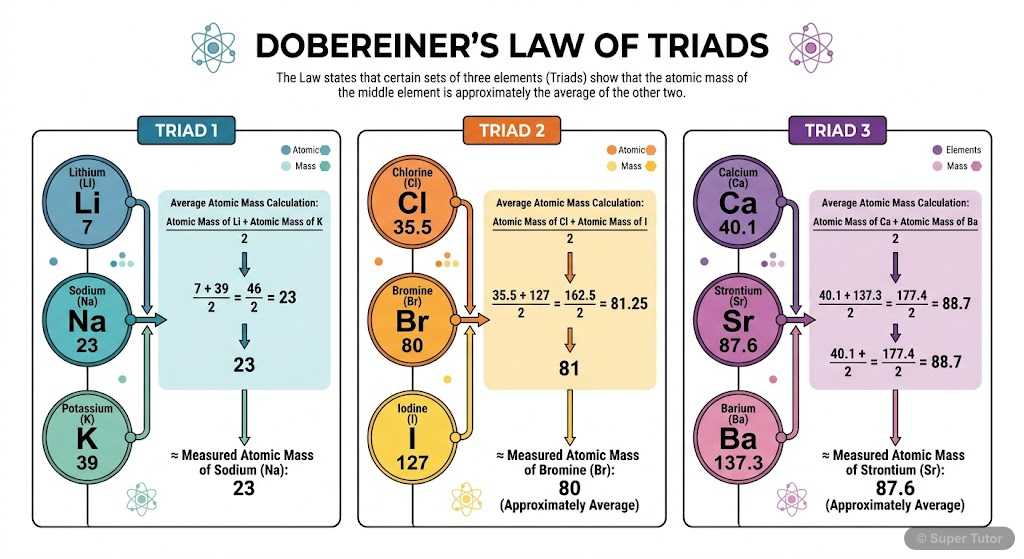
One of 16 illustrations for Periodic Table and Periodicity in Properties in Super Tutor — alongside flashcards, concept maps and practice questions.
3 Concept Maps
Periodic Table and Periodicity in Properties - Complete Chapter Overview
The map in words
- Periodic Table and Periodicity
- Early Attempts
- Dobereiner Triads 1817
- Groups of Three Elements
- Middle = Arithmetic Mean
- Newlands Law of Octaves 1863
- Every 8th Element Similar
- First Periodicity Concept
- Lother Meyer
- Physical Properties Trend
- Dobereiner Triads 1817
- Mendeleev 1869
- Arranged by Atomic Weight
- Left Gaps for Unknowns
- Predicted Eka Elements
- Defects
- No Place for Isotopes
- No Place for Noble Gases
- Wrong Order Co and Ni
- Modern Periodic Law
- Moseley 1913
- Based on Atomic Number
- Solved All Mendeleev Defects
- Structure of Periodic Table
- 18 Groups Vertical
- 7 Periods Horizontal
- Blocks
- s block Groups 1 and 2
- p block Groups 13 to 18
- d block Groups 3 to 12
- f block Lanthanoids Actinoids
- Special Names
- Alkali Metals Group 1
- Alkaline Earth Group 2
- Halogens Group 17
- Noble Gases Group 18
- Transition Metals Groups 3 to 12
- IUPAC Naming Above 100
- Roots 0 to 9
- Add ium at End
- Examples Seaborgium Bohrium
- Periodic Properties
- Atomic Size
- Decreases Across Period
- Increases Down Group
- Ionic Size
- Cation Smaller than Atom
- Anion Bigger than Atom
- Ionization Enthalpy
- Increases Across Period
- Decreases Down Group
- Anomaly N greater than O
- Electron Gain Enthalpy
- More Negative Across Period
- Less Negative Down Group
- Anomaly Cl greater than F
- Electronegativity
- Increases Across Period
- Decreases Down Group
- F Most Electronegative
- Valency
- Based on Valence Electrons
- Octet Rule
- Exceptions in Period 3
- Atomic Size
- Early Attempts
Periodic Table and Periodicity Concepts Overview
The map in words
- Periodic Table and Periodicity
- Historical Development
- Dobereiner Triads
- Atomic weight relationships
- Early classification
- Newlands Law of Octaves
- Music-like periodicity
- Recurrence of properties
- Mendeleev Periodic Table
- Atomic weight basis
- Predicted elements
- Left gaps
- Modern Periodic Table
- Moseley discovery
- Atomic number basis
- Current standard
- Dobereiner Triads
- Periodic Table Structure
- Periods
- 7 horizontal rows
- Shell numbers
- Groups
- 18 vertical columns
- Similar properties
- Blocks
- s-block Group 1-2
- p-block Group 13-18
- d-block Group 3-12
- f-block Lanthanoids
- Periods
- Periodic Trends
- Atomic Properties
- Atomic size
- Ionic size
- Ionization enthalpy
- Electron gain enthalpy
- Chemical Properties
- Electronegativity
- Valence
- Reducing power
- Oxidizing power
- Trend Patterns
- Increase across period
- Decrease down group
- Half-filled stability
- Exceptions
- Atomic Properties
- Classification
- Metals
- Alkali metals
- Alkaline earth metals
- Transition metals
- Non-metals
- Halogens
- Chalcogens
- Other non-metals
- Metalloids
- Semiconductors
- Mixed properties
- Metals
- Historical Development
Shows the structure of Dobereiner's triads and how the mathematical relationship works with the lithium-sodium-potassium example
The map in words
- Dobereiner's Triads 1817
- Group 3 elements by atomic weight
- Observe pattern: Middle = Average
- Lithium 6.94
- Sodium 22.99
- Check: 6.94 + 39.10 ÷ 2 = 22.99 ✓
- Pattern Found! But limited scope
- Check: 6.94 + 39.10 ÷ 2 = 22.99 ✓
- Potassium 39.10
- Observe pattern: Middle = Average
- Group 3 elements by atomic weight
Explore these maps interactively
Explore DiagramsFrequently Asked Questions
What are the important topics in Periodic Table and Periodicity in Properties for NIOS Class 12 Chemistry?
Key topics in Periodic Table and Periodicity in Properties include Early Attempts at Classification of Elements, Mendeleev's Periodic Table, Modern Periodic Law and Long Form of the Periodic Table, IUPAC Nomenclature for Elements with Atomic Number > 100. Study these first, then practise questions on each for the NIOS Class 12 board exam.
What do the concept maps for Periodic Table and Periodicity in Properties show?
The 3 maps show how the ideas in Periodic Table and Periodicity in Properties connect: Periodic Table and Periodicity in Properties - Complete Chapter Overview; Periodic Table and Periodicity Concepts Overview. Each map is also written out as an outline on this page.
How should I revise Periodic Table and Periodicity in Properties for the NIOS Class 12 board exam?
Learn the core ideas first, then work through the 45 practice questions on Periodic Table and Periodicity in Properties. Revise definitions regularly and use flashcards for quick recall before the exam.
Sources & Official References
Content is aligned to the official syllabus. Refer to the board website for the latest curriculum.
More resources for Periodic Table and Periodicity in Properties
For serious students
Get the full Periodic Table and Periodicity in Properties chapter — start free.
Quizzes, flashcards, an AI doubt solver and a study plan for NIOS Class 12 Chemistry. Free to start, no card needed.